The network for creativity
Join 1.25M professional creatives like you
Connect with clients, get discovered, and run your business 100% commission-free
Creatives on Contra have earned over $150M and we are just getting started
Back to feedPost

Most businesses do not have an AI problem.
They have a workflow problem.
They buy ChatGPT.
They add Zapier.
They try an AI agent.
They connect three tools.
Then they wonder why nothing really changes.
Because automation does not fix a messy process.
It makes a messy process happen faster.
Before adding AI to a workflow, ask:
What triggers the work?
Who owns each step?
Where does information get copied manually?
Which task repeats every week?
Where do delays, errors, or dropped handoffs happen?
What needs human judgment—and what does not?
What should AI recommend, draft, organise, or route… rather than decide on its own?
The best first AI workflow is rarely the flashiest one.
It is usually the boring one:
• Lead details copied between tools
• Meeting notes turned into follow-ups
• Repetitive client onboarding
• Proposals built from the same inputs
• Weekly reports assembled manually
• Content repurposed across channels
• Customer enquiries sorted before a human responds
The real opportunity is not “replace people with AI.”
It is to remove the low-value friction that stops good people from doing their best work.
That is why I created the AI Workflow Audit & Automation Blueprint.
It is a focused, personalized audit of one business workflow—designed to identify the highest-value automation opportunity, map the process, recommend the right tool stack, and give you a practical implementation plan.
You do not need more AI tools.
You need one workflow that works better.
Explore the blueprint:
https://contra.com/products/KvaP2zWi-ai-workflow-audit-and-automation-blueprint #AI #AIWorkflows #AIAutomation #WorkflowAutomation #BusinessAutomation #NoCode #Productivity #Operations #DigitalTransformation #Founders


Highlighting the lead details copy between tools hits a common bottleneck that eats time.
The network for creativity
Join 1.25M professional creatives like you
Connect with clients, get discovered, and run your business 100% commission-free
Creatives on Contra have earned over $150M and we are just getting started






Related posts

Created these interactive animation variants for a section in my recent web design project.
Which one do you think grabs users’ attention and keeps them engaged?
Linear ✲ or Dotted⚪?

24 voted
52%
22 voted
48%
46 votes
Closed

dotted one

LumaClean was losing hours to manual quoting, scheduling, confirmations, rescheduling, and follow-up. LumaFlow turns that entire process into one automated booking workflow.
I built LumaFlow for a fictional Chicago cleaning business, LumaClean.
The problem was simple: too much back-and-forth just to turn a customer inquiry into a confirmed booking.
So I built a workflow that handles the journey:
→ Instant quote
→ Smart availability
→ $40 deposit
→ Booking confirmation
→ Reminders
→ Rescheduling
→ Booking recovery
The goal wasn't to build another pretty booking page.
It was to give the owner less work to do.

Vert nice

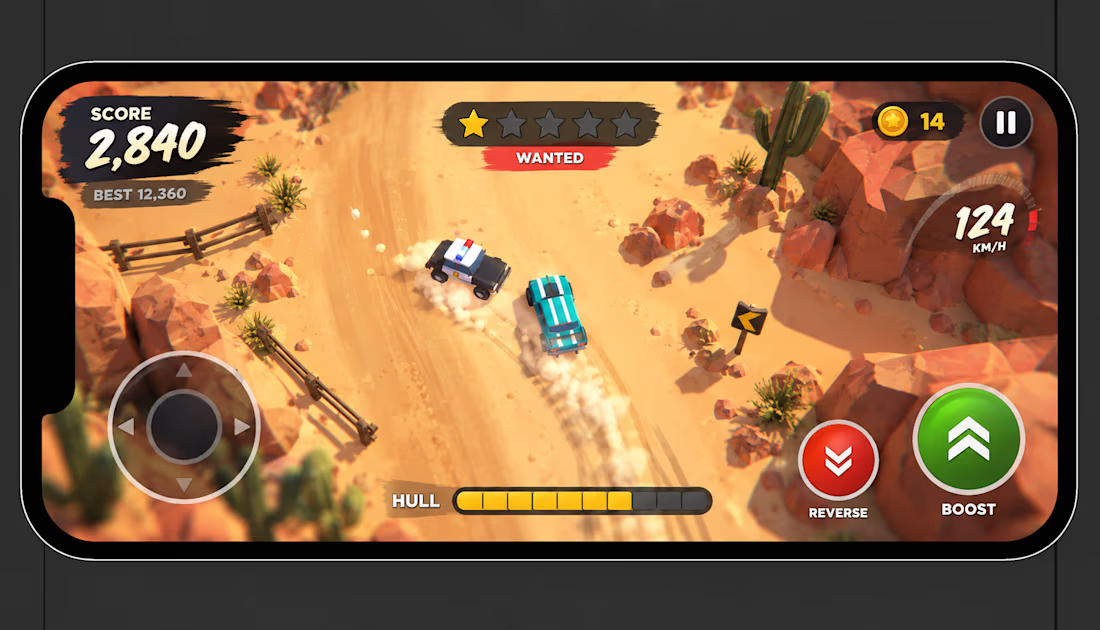
I tested Opus 5.5 and had it build an arcade game in Unity using the CLI and Claude Code.
The game is called Heatwave and is a quick and fun little police chase game.
Of all the games I've made, this is actually the one I enjoy to test the most.
I'm terrible at it, but it's fun.



Wanting another run even when you are bad at it is a pretty good sign. What took more iteration in Heatwave, the driving feel or the police chase behavior?