The network for creativity
Join 1.25M professional creatives like you
Connect with clients, get discovered, and run your business 100% commission-free
Creatives on Contra have earned over $150M and we are just getting started
Back to feedPost
This project explores how far RIVE can be pushed using scripting alone.
The project combines rasterization, real-time stylized ray tracing, ray marching, implicit surfaces, volumetric effects, and more, with consistent visibility and occlusion across techniques.
The main idea is simple: the world is rasterized by default, but if you shine the flashlight on an object, you can see what's hidden inside (ray traced).
I also added a small Easter egg to the background planet: when you look away, the red spot changes position; when you look back, it stays still. But if you stare for long enough, it eventually gives up pretending to be static and starts moving again.


Here's my post on X.com. For now, the content is the same, but I might include more videos later.
Although the challenge is already over, I figured it’s still worth sharing a few follow-ups.
Someone asked whether the ray tracer supports multiple bounces — yes, it does, and I included some extra footage to show that.
Supporting reflections and refraction made the ray tracing...
Instead of aesthetics, the stylization was originally motivated by performance. Certain styles were significantly faster — for example, drawing long colored curves was much cheaper than rendering each pixel as a quad. Gradient-aware pixel orientation also improved visuals at no...

Thank you!
Yes, I do plan to open-source it once I get a bit more time. At the moment, the codebase is still in a transitional state and could use some cleanup and documentation before I feel comfortable releasing it.
As you might notice, there are occasional flickers—these happen...
The network for creativity
Join 1.25M professional creatives like you
Connect with clients, get discovered, and run your business 100% commission-free
Creatives on Contra have earned over $150M and we are just getting started






Related posts

Built a custom @Rive component for the About section of my agency site.
The lanyard and badge are fully interactive. You can grab them, throw them around, and spin the badge 360° to see both sides.
It doesn’t necessarily need to do all of that, but that’s kind of the point.
Small interactive moments like this can turn a pretty standard section of a website into something people actually want to play with, remember, and come back to.


Wow Work bro.

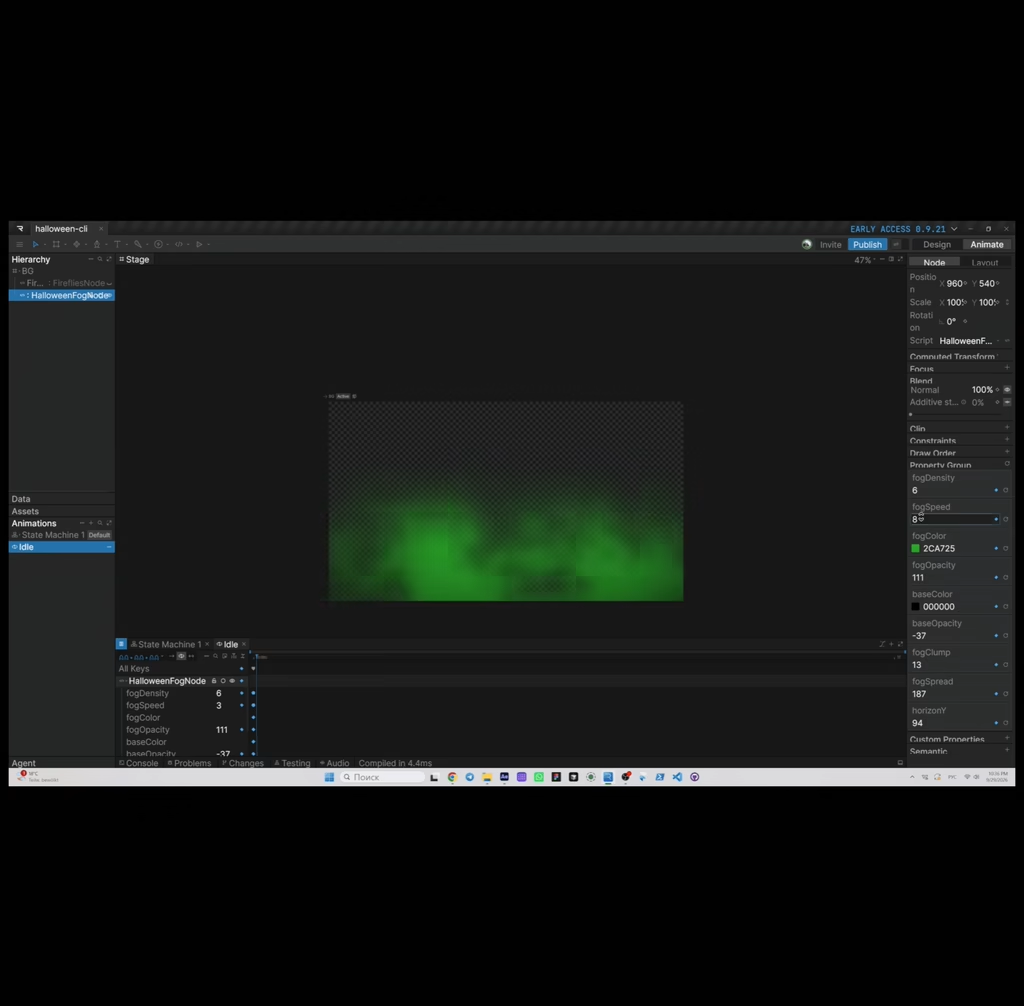
Hellish fog — GPU Canvas shader for Rive Halloween Challenge🚀
Working on shaders for the Rive Halloween Challenge 2026.
First piece: procedural hellish fog — GPU Canvas (WGSL), built in Rive CLI with live preview and inspector-driven params (horizon, density, spread, speed, color, opacity).
Swamp-green necromancer palette, layered noise, clumpy ground mist — atmosphere first, content later.
More Halloween shaders to come.


All Eyes on You!!👀
100 eyes. One cursor. And absolutely nowhere to hide.
Built for the Rive Halloween Challenge with RML, Luau, and WGSL shaders.

looking scary af 🔥