Shaojie Jiao
Research driven engineer specializing in light transport


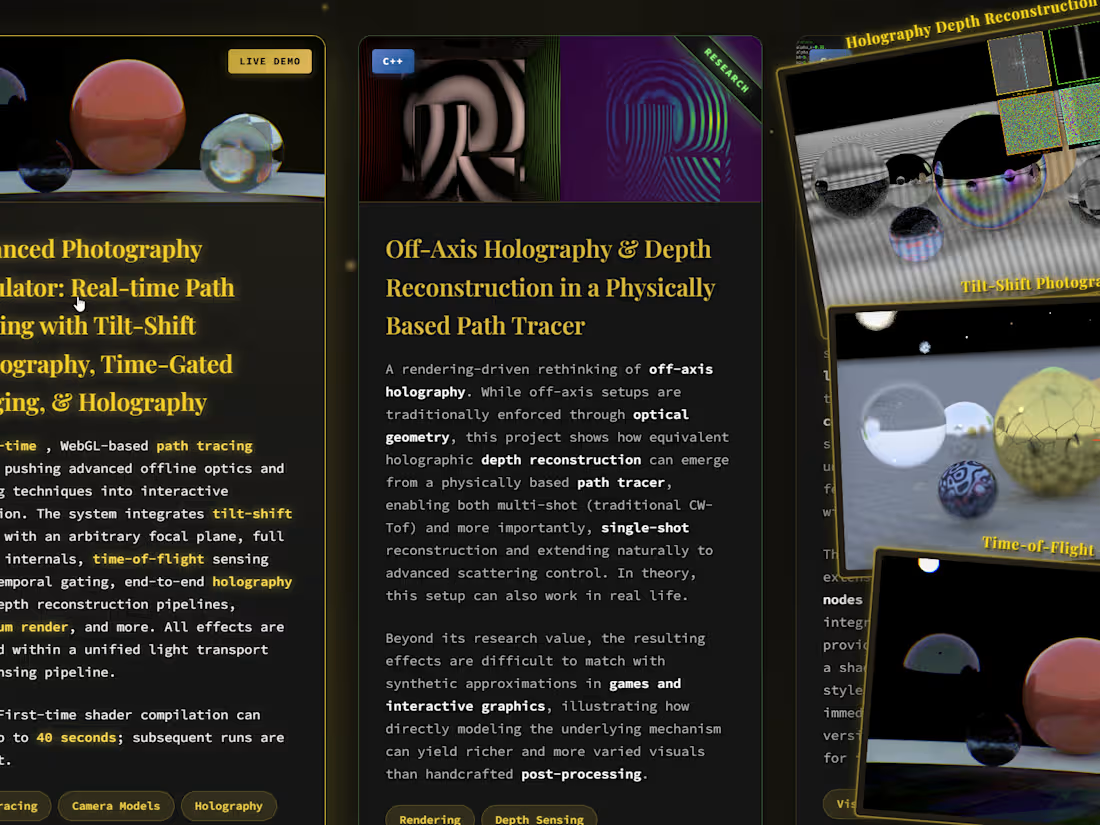
An interactive path tracer implemented in WebGL, bringing techniques rarely used in real-time contexts — such as physically based tilt-shift optics, time-resolved imaging, holography, and spectral dispersion — into an interactive setting.
2
116
A unified GPU programming system written in C++, aimed at rapid experimentation and prototyping with complex GPU workflows.
Shaders and CUDA/OptiX programs coexist as nodes in a data-flow graph, enabling flexible composition, complex feedback loops, and cross-domain data flow between rendering and compute stages.
The system reduces the structural and boilerplate overhead of GPU workflows that are conceptually straightforward but traditionally tedious to set up—such as temporal volumes that record GPU frames over time, where the logic is simple but buffer management and feedback wiring dominate the implementation.
1
114
Coming from a research background, I designed and implemented my portfolio with carefully crafted visuals. It also includes multiple interactive projects.
The visual design was self-taught and approached with the same care as the technical work, since aesthetics matter just as much to me.
1
147
This project explores how far RIVE can be pushed using scripting alone.
The project combines rasterization, real-time stylized ray tracing, ray marching, implicit surfaces, volumetric effects, and more, with consistent visibility and occlusion across techniques.
The main idea is simple: the world is rasterized by default, but if you shine the flashlight on an object, you can see what's hidden inside (ray traced).
I also added a small Easter egg to the background planet: when you look away, the red spot changes position; when you look back, it stays still. But if you stare for long enough, it eventually gives up pretending to be static and starts moving again.
11
10
883