The network for creativity
Join 1.25M professional creatives like you
Connect with clients, get discovered, and run your business 100% commission-free
Creatives on Contra have earned over $150M and we are just getting started
Back to feedPost

❤️ Heart Disease Prediction using Machine Learning
📌 Problem Statement
Can we predict whether a patient has heart disease using clinical features?
Early detection of heart disease can save lives, making this a critical real-world machine learning problem.
📊 Dataset
Source: UCI Heart Disease Dataset
Includes medical attributes such as:
Age
Cholesterol levels
Chest pain type
Maximum heart rate
Blood pressure
⚙️ Project Workflow
Data Exploration (EDA)
Data Preprocessing
Model Training
Model Evaluation
Hyperparameter Tuning
🤖 Models Used
Logistic Regression
K-Nearest Neighbors (KNN)
Random Forest Classifier
📈 Model Performance
MetricScore (%)Accuracy73.47%Precision83.00%Recall74.95%F1 Score73.36%
🔍 Key Insights
Logistic Regression performed best after tuning
Cross-validation revealed a drop in performance → highlighting generalization challenges
High precision suggests the model is effective at identifying positive cases
Real-world medical datasets are complex and rarely achieve extremely high accuracy
🧠 Lessons Learned
Accuracy alone is not enough — precision and recall matter more in healthcare
Overfitting can give misleading results without proper validation
Simpler models (like Logistic Regression) can outperform complex ones
🛠 Tools & Libraries
Python
Pandas
NumPy
Scikit-learn
Matplotlib
Seaborn
🚀 Future Improvements
Feature engineering
Try advanced models (XGBoost, LightGBM)
Improve recall (important for medical predictions)
Deploy model as a web app
📎 Project Notebook
Check the full implementation in the Jupyter Notebook.
🙌 Acknowledgements
UCI Machine Learning Repository
🔬 Feature Importance (Logistic Regression)
The model coefficients reveal which features most influence heart disease prediction.
🔺 Features Increasing Risk
ca (number of major vessels) → Strongest predictor
oldpeak (ST depression) → Indicates heart stress during exercise
exang (exercise-induced angina) → Associated with higher risk
restecg abnormalities → Signals irregular heart activity
🔻 Features Decreasing Risk
Certain chest pain types (non-anginal)
Some dataset-specific patterns
Gender-related differences (model-specific behavior)
💡 Insight
The model heavily relies on cardiovascular stress indicators and blood flow patterns, which aligns with real-world medical understanding of heart disease.



The network for creativity
Join 1.25M professional creatives like you
Connect with clients, get discovered, and run your business 100% commission-free
Creatives on Contra have earned over $150M and we are just getting started
Related posts


Fine-tuning is the hardest part of vibe coding. Spent way more time than expected on a small card hover experiment in Claude to prove it.


I really like your work.

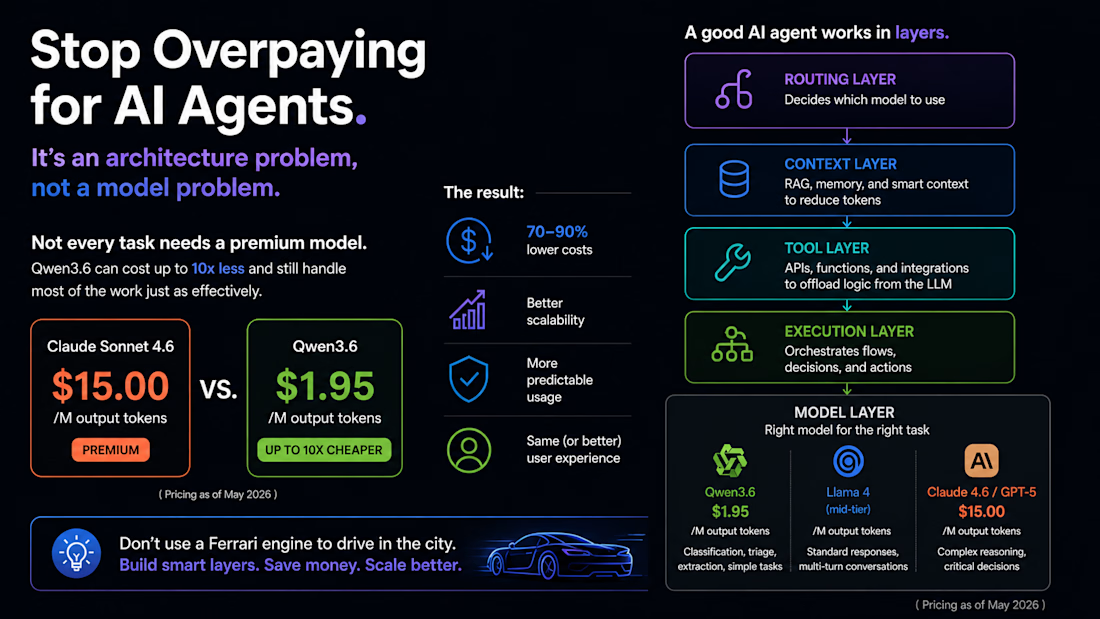
Most AI agents are unnecessarily expensive and the problem is usually architecture, not the model.
One of the biggest pain points when building AI agents is LLM cost. Many teams use high-end models like Claude Sonnet or GPT-5 for everything, even tasks that don’t need that level of reasoning. That quickly becomes unsustainable at scale.
The reality is: not every task needs a premium model. Models like Qwen 3.x can cost up to 10x less and still handle tasks like intent classification, basic responses, structured extraction, and routing decisions with similar efficiency.
A well-designed AI agent isn’t just an LLM wrapper it’s a layered system. Routing decides which model to use, context (RAG/memory) reduces tokens, tools handle logic, and execution orchestrates everything. The LLM is just one component.
The winning strategy is simple: use the right model for the right job.
If your AI agent is expensive, it’s probably an architecture problem.

Brand Pulse is a Brand Health Checker that gives business owners a score out of 100 across 5 brand identity categories, Visual Identity, Messaging, Consistency, Packaging, and First Impressions.
Built as a fully remixable template for brand designers and agencies to use as a client lead generation tool.
Check it out: https://brand-pulse-746.created.app
Twitter: https://x.com/layeredaesthet/status/2051167465187819928?s=20
Template setup and customization instructions available at https://brand-pulse-746.created.app/setup




Trending

Claude
Claude has entered the design space. How are you using Claude Design?

Contra University
Learn from expert creatives how to earn more using next-gen AI tools.
creativeaiflow
Creative AI workflows are evolving. What tools do you use, and what are their strengths and weaknesses?
portfolioreview
The best portfolios tell a story, not just show a grid. Share yours for feedback.
freelancerlife
Freelancer life is wins, pivots, and everything in between. What’s yours right now?