
Tobechukwu Samuel
AI/ML Engineer building intelligent AI systems.
New to Contra
Tobechukwu is building their profile!

🏗️ Bulldozer Price Prediction — End-to-End Machine Learning Project
🚜 Overview
How do you accurately estimate the value of heavy equipment at auction?
In this project, I built a machine learning model to predict the sale price of bulldozers using historical auction data — effectively creating a data-driven “blue book” valuation system.
This project simulates a real-world ML workflow:
Handling messy, real-world data
Engineering meaningful features
Iterating through models and tuning
Evaluating performance using proper metrics
🎯 Problem Statement
Auction prices for heavy equipment can vary significantly based on:
Machine specifications
Usage and configuration
Market conditions over time
The objective is to build a model that can accurately predict the SalePrice, enabling:
Better pricing decisions
Reduced uncertainty in auctions
Data-driven valuation systems
📊 Dataset
The dataset is split into three time-based sets:
Train Set → Data up to 2011
Validation Set → Jan 2012 – April 2012
Test Set → May 2012 – Nov 2012
This structure mimics real-world forecasting, where models are trained on past data and evaluated on future data.
⚠️ Due to size limitations, the dataset is not included in this repository.
👉 Download here:
https://www.kaggle.com/competitions/bluebook-for-bulldozers/data
⚙️ Machine Learning Workflow
🧹 Data Preprocessing
Converted saledate to datetime format
Extracted time-based features:
Year, Month, Day, Day of Week
Handled missing values:
Numerical → median imputation
Categorical → encoded as numerical values
🧠 Feature Engineering
Created time-based features from sale date
Leveraged machine attributes and configuration data
Improved model performance through iterative feature refinement
🌲 Model Used
RandomForestRegressor
Why?
Handles non-linear relationships well
Works great with structured/tabular data
Robust to noise and missing values
📈 Results
Metric Training Validation
MAE 2953.82 5951.25
RMSLE 0.1447 0.2452
R² 0.9588 0.8818
🔁 Iteration Journey (What Actually Happened)
This project wasn’t a straight line — and that’s where the real learning happened.
Stage Validation RMSLE
Baseline Model 0.2936
First Tuning Attempt 0.5638 ❌
Final Optimized Model 0.2452 ✅
💡 Key Takeaway:
Better hyperparameters don’t guarantee better performance — experimentation does.
🔧 Hyperparameter Tuning
Used RandomizedSearchCV (100 iterations) to explore the parameter space.
Best parameters:
n_estimators=40
min_samples_leaf=1
min_samples_split=14
max_features=0.5
💡 Key Insights
Feature engineering had the biggest impact on performance
Poor tuning can significantly degrade model accuracy
Time-based splits are crucial for realistic evaluation
Iteration and experimentation are core ML skills
🚀 Future Improvements
Apply log transformation to improve RMSLE
Experiment with LightGBM / XGBoost
Build a deployment-ready app (Streamlit)
Add feature importance visualization
📁 Project Structure
bulldozer-price-prediction/
│
├── notebook.ipynb
├── README.md
(http://README.md)├── .gitignore
└── requirements.txt
🧑💻 Author
Toby Chuks
GitHub: https://github.com/tobychuks01
(https://github.com/tobychuks01)LinkedIn: https://www.linkedin.com/in/toby-chuks-630b44217
⭐ Final Note
This project reflects more than just building a model —
it demonstrates the importance of iteration, experimentation, and learning from failure in machine learning.
0
7

❤️ Heart Disease Prediction using Machine Learning
📌 Problem Statement
Can we predict whether a patient has heart disease using clinical features?
Early detection of heart disease can save lives, making this a critical real-world machine learning problem.
📊 Dataset
Source: UCI Heart Disease Dataset
Includes medical attributes such as:
Age
Cholesterol levels
Chest pain type
Maximum heart rate
Blood pressure
⚙️ Project Workflow
Data Exploration (EDA)
Data Preprocessing
Model Training
Model Evaluation
Hyperparameter Tuning
🤖 Models Used
Logistic Regression
K-Nearest Neighbors (KNN)
Random Forest Classifier
📈 Model Performance
MetricScore (%)Accuracy73.47%Precision83.00%Recall74.95%F1 Score73.36%
🔍 Key Insights
Logistic Regression performed best after tuning
Cross-validation revealed a drop in performance → highlighting generalization challenges
High precision suggests the model is effective at identifying positive cases
Real-world medical datasets are complex and rarely achieve extremely high accuracy
🧠 Lessons Learned
Accuracy alone is not enough — precision and recall matter more in healthcare
Overfitting can give misleading results without proper validation
Simpler models (like Logistic Regression) can outperform complex ones
🛠 Tools & Libraries
Python
Pandas
NumPy
Scikit-learn
Matplotlib
Seaborn
🚀 Future Improvements
Feature engineering
Try advanced models (XGBoost, LightGBM)
Improve recall (important for medical predictions)
Deploy model as a web app
📎 Project Notebook
Check the full implementation in the Jupyter Notebook.
🙌 Acknowledgements
UCI Machine Learning Repository
🔬 Feature Importance (Logistic Regression)
The model coefficients reveal which features most influence heart disease prediction.
🔺 Features Increasing Risk
ca (number of major vessels) → Strongest predictor
oldpeak (ST depression) → Indicates heart stress during exercise
exang (exercise-induced angina) → Associated with higher risk
restecg abnormalities → Signals irregular heart activity
🔻 Features Decreasing Risk
Certain chest pain types (non-anginal)
Some dataset-specific patterns
Gender-related differences (model-specific behavior)
💡 Insight
The model heavily relies on cardiovascular stress indicators and blood flow patterns, which aligns with real-world medical understanding of heart disease.
0
9

Dog Breed Classification System
🔗 GitHub Repository (https://github.com/tobychuks01/dog-breed-classifier?utm_source=chatgpt.com)
🔗 Live Demo (https://breedy.streamlit.app/?utm_source=chatgpt.com)
Built a deep learning computer vision application capable of classifying 120 dog breeds from uploaded images.
Implemented transfer learning using ResNet and EfficientNet architectures with PyTorch and Torchvision.
Improved model performance from ~3% CNN baseline accuracy to 78.97% ensemble accuracy through optimization and fine-tuning.
Applied advanced deep learning techniques including label smoothing, gradual unfreezing, weight decay, learning rate scheduling, and Test Time Augmentation (TTA).
Deployed a production-ready Streamlit application with real-time image inference and probability predictions.
2
2
41
Credit Card Fraud Detection System
🔗 GitHub Repository (https://github.com/tobychuks01/Credit-card-fraud-Transaction-Model?utm_source=chatgpt.com)
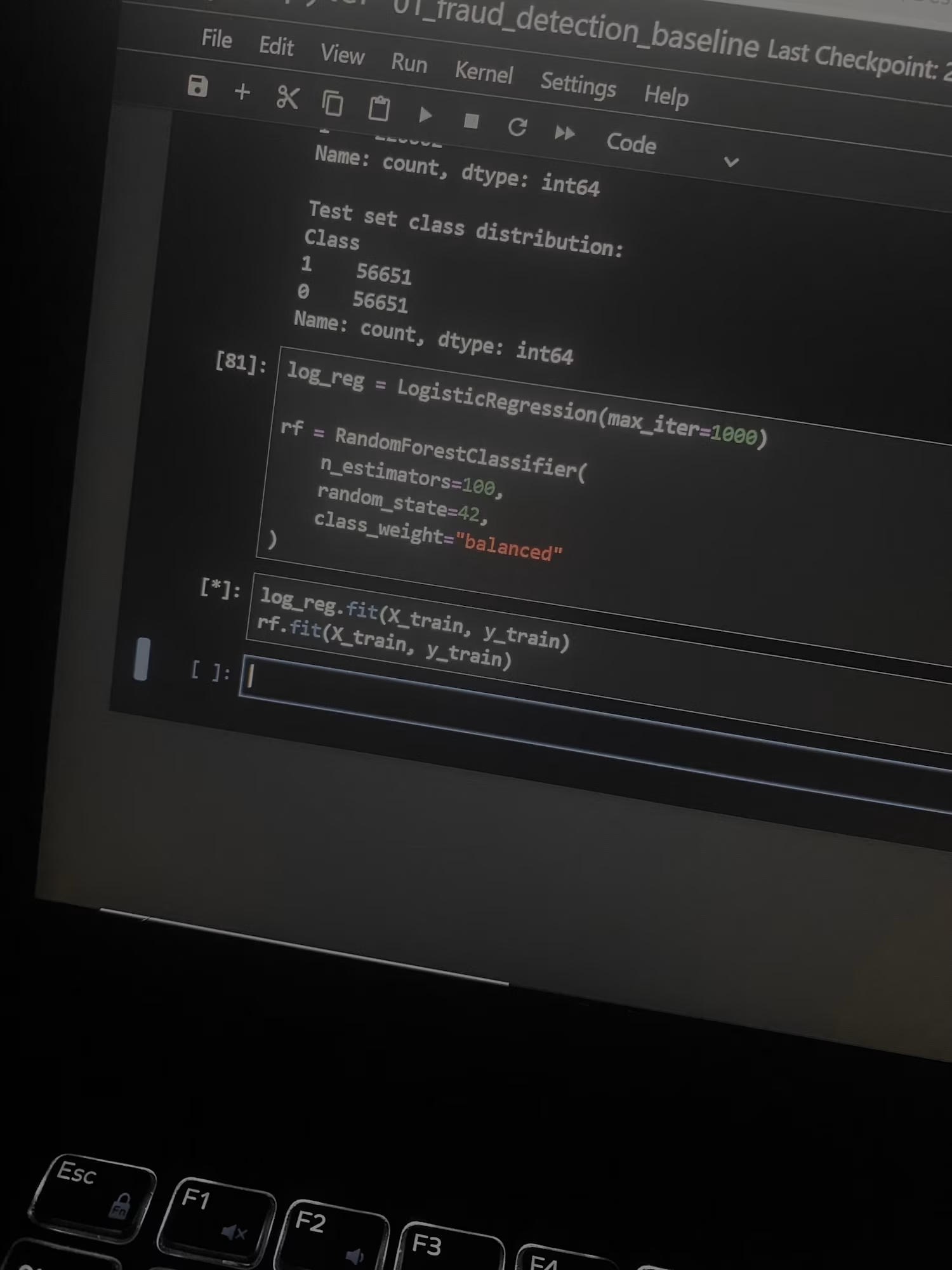
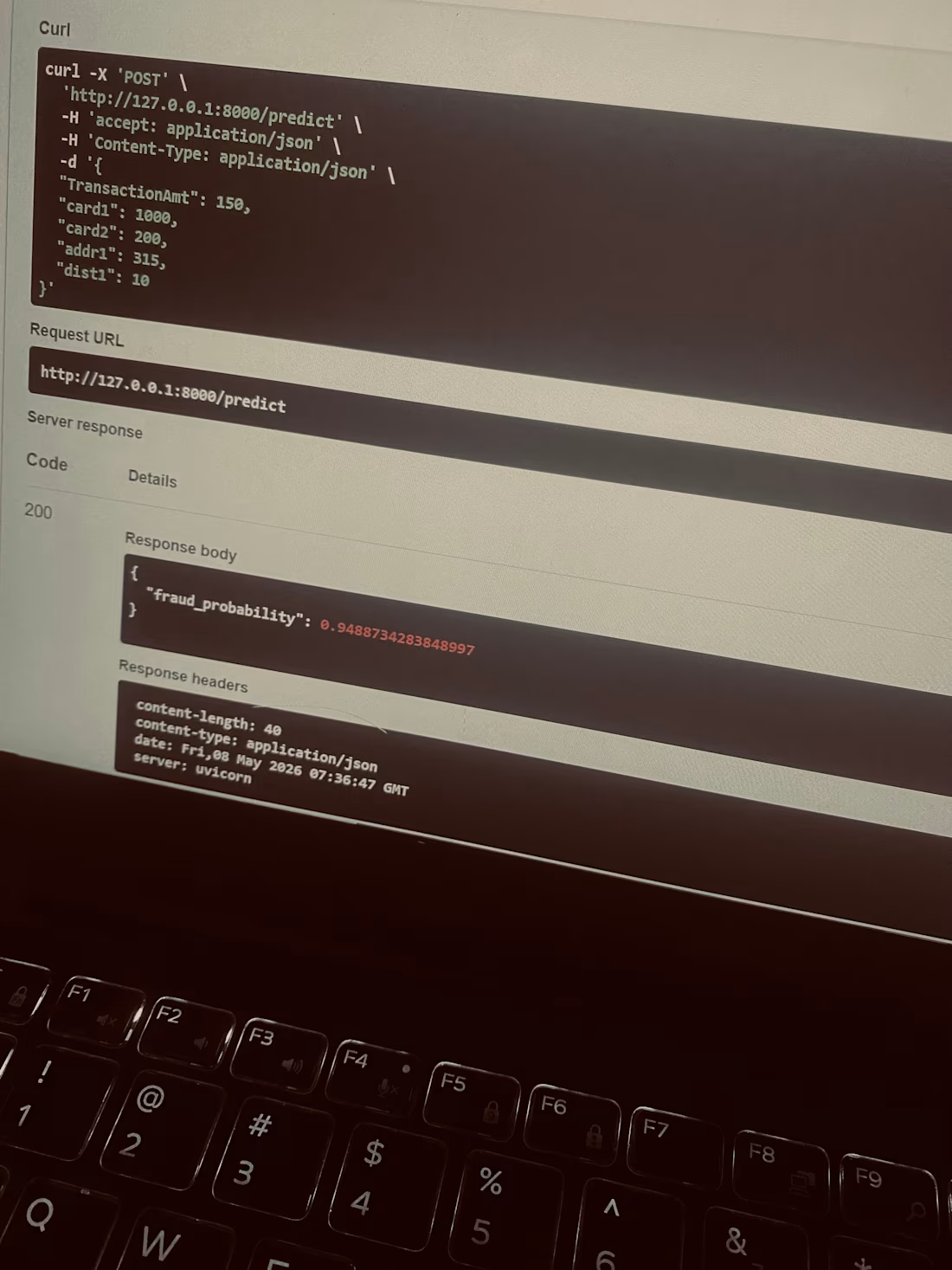
Developed an end-to-end fraud detection pipeline using XGBoost, LightGBM, Random Forest, and Logistic Regression on 284K+ financial transactions.
Solved extreme class imbalance (~0.17% fraud cases) using SMOTE while preventing data leakage through correct training pipeline design.
Achieved ROC-AUC score of 0.985 using XGBoost with strong fraud recall and precision balance for real-world deployment scenarios.
Performed threshold tuning experiments and evaluated business tradeoffs between fraud recall and false positives.
Built a deployment-ready prediction system with Streamlit UI and API integration for real-time fraud prediction.
Applied feature importance analysis to identify key fraud-driving transaction variables.
0
8