The network for creativity
Join 1.25M professional creatives like you
Connect with clients, get discovered, and run your business 100% commission-free
Creatives on Contra have earned over $150M and we are just getting started
Back to feedPost

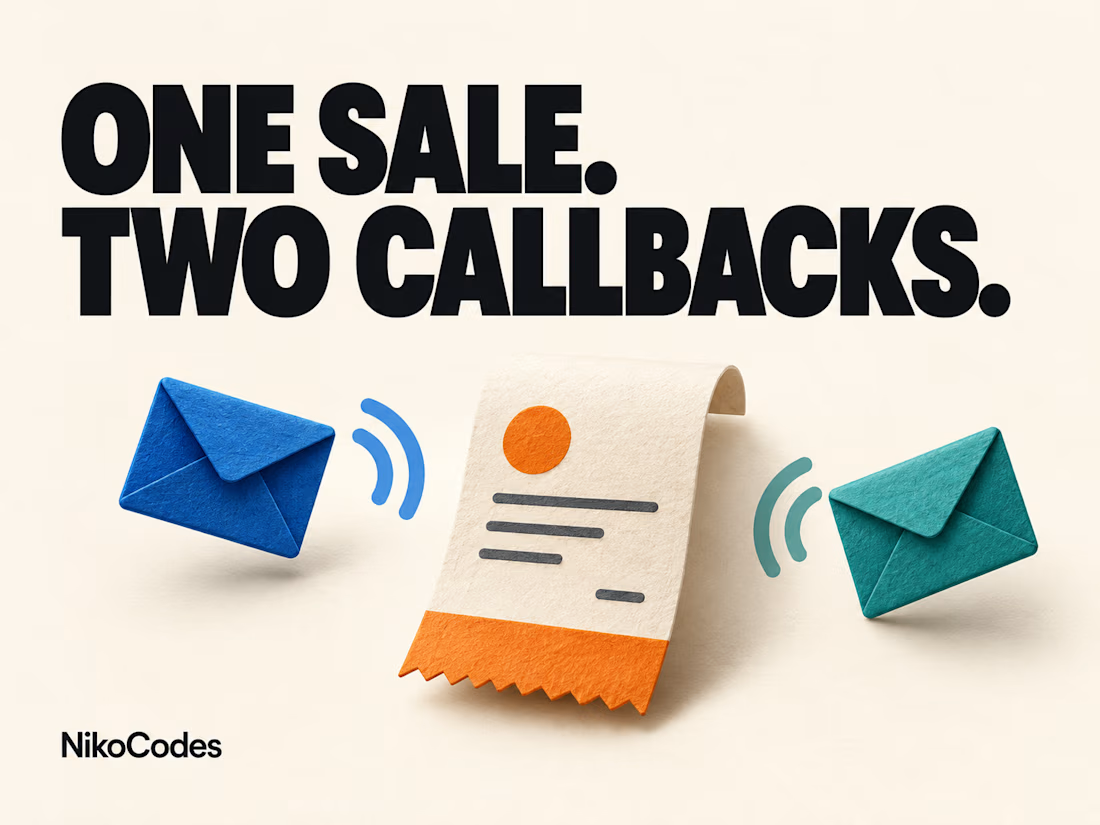
The Webhook Arrived Twice. The Sale Happened Once.
A conversion notification arrives twice. Should your report show two sales?
Imagine an integration saves the first notification, but its acknowledgement never reaches the sender. The sender retries. Both deliveries describe the same event.
Counting every arrival as a new conversion would inflate the report. In another workflow, the same mistake could create a second task or send the customer another confirmation.
I built duplicate checks into my Internal Campaign Tracker, a private working proof of concept for a business partner. Incoming conversions are matched to the original visit. Outgoing callbacks have a persistent queue, retry history and a way to inspect and replay failed deliveries.
That separates two questions: did the business event happen, and did its notification reach the next system?
Before accepting an integration, agree what identifies a repeat. An email address is usually too broad: the same customer can make two legitimate purchases. The identity needs to match the action you are protecting.
Then test three cases:
• Deliver the same event twice, including two attempts arriving close together.
• Retry after a timeout where the receiving system may already have saved the first attempt.
• Send a genuinely new event for the same customer and confirm it is still processed.
The expected result should be written down for each case. A repeated notification should not repeat the protected action; a new purchase should not disappear because its customer is already known.
The operator also needs to see what happened: completed, waiting to retry, or needing attention. For outgoing callbacks, retries and manual replay should keep the same event identity, and the receiving system must handle repeat deliveries safely.
Project details and screenshots on NikoCodes:
https://nikocodes.com/software/internal-campaign-tracker/


Great breakdown. A pattern that holds up even when two deliveries race each other: save the event ID under a unique constraint in the same transaction as the side effect. Then the database decides which one wins, instead of a check-then-insert in app code.
Exactly, for database changes, that closes the race between two deliveries. Outgoing callbacks still need the original event ID preserved across retries and replay, so the receiver can recognize duplicates too.
The network for creativity
Join 1.25M professional creatives like you
Connect with clients, get discovered, and run your business 100% commission-free
Creatives on Contra have earned over $150M and we are just getting started
Challenges
View all


Related posts

Technical performance engineering and Core Web Vitals optimization for comoimportarmicoche.es.
Achieved 92+ performance scores on mobile alongside 100/100 ratings in SEO, Best Practices, and Accessibility on a live production WordPress site by streamlining front-end asset delivery and eliminating backend execution bottlenecks.
Key Engineering Highlights:
• Asset Optimization: Minified, combined, and deferred non-critical CSS/JS, significantly reducing render-blocking resources and critical path latency.
• Next-Gen Media Pipeline: Implemented WebP image conversion, explicit aspect ratio dimensions to eliminate Cumulative Layout Shift (CLS), and native lazy-loading.
• Clean Architecture: Optimized dynamic database queries and custom PHP scripts to maintain near-instant Server Response Time (TTFB) without relying on heavy caching plugins.
• Core Web Vitals Targets: Focused on Largest Contentful Paint (LCP) and Interaction to Next Paint (INP) to deliver sub-1.5s real-world loading times on mobile devices.
Search Engine OptimizationWeb DevelopmentWordPress DevelopmentGoogle Search ConsoleJavaScriptWordPress


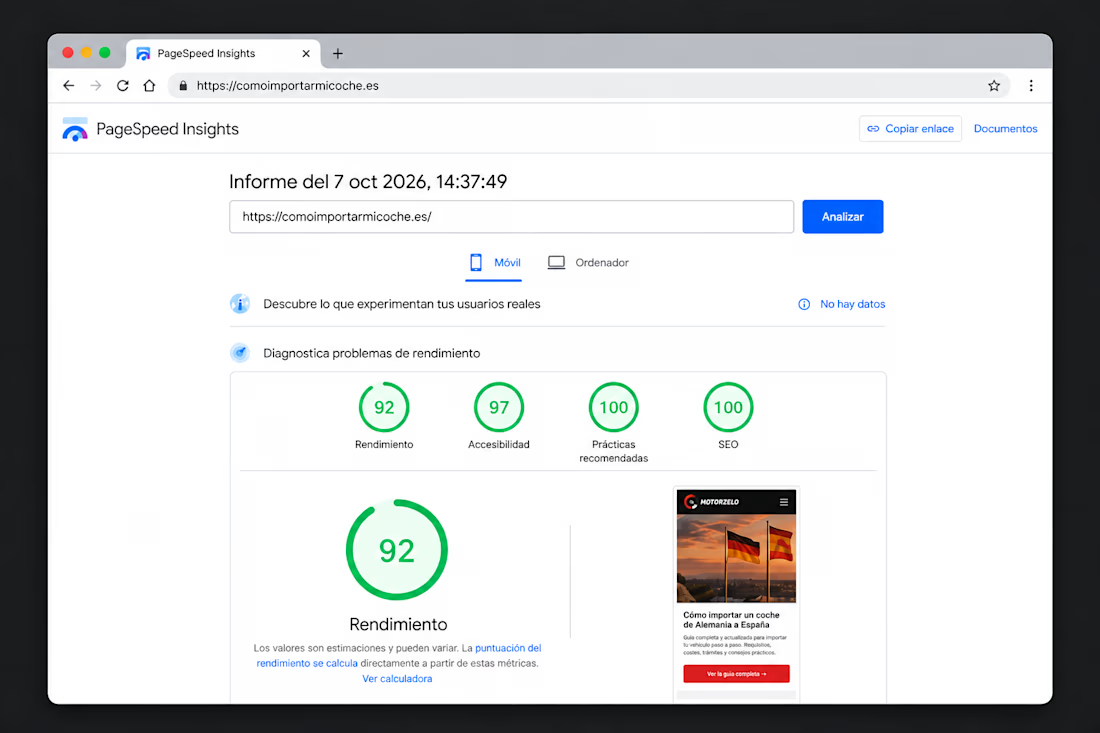
Yeah, this was a cold run in PSI. The DB cleanup was actually huge for TTFB—dropped uncached server response under 200ms, mostly by clearing bloated wp_options and fixing custom loops. Caching handles repeat hits, but the backend fix was the main win.

EMAIL 1 — The problem
Subject: Your business might not have a visibility problem
You’re posting.
You’re showing up.
You’re talking about what you do.
But somehow, people still don’t seem to understand why they should choose you.
That can feel like a visibility problem.
Sometimes, it isn’t.
Sometimes, the real problem is that your message isn’t making the value of your business clear enough.
When someone lands on your website or sees your content, they should be able to quickly understand:
What do you help with?
Who is it for?
And why should they care?
If those answers aren’t clear, posting more won’t necessarily fix the problem.
The message comes first.
Tomorrow, I’ll show you one simple way to check whether your current messaging is doing its job.
[Brand Strategist]
EMAIL 2 — The insight
Subject: Try this before creating another post
Open your website.
Now imagine you’ve never heard of your business before.
Give yourself 10 seconds.
Can you answer these three questions?
What does this business help me do?
Is this actually for someone like me?
Why should I trust them?
If you have to search for the answers, your potential customer probably has to as well.
And when people have to work too hard to understand an offer, they often leave.
Your copy doesn’t need to say everything.
It needs to make the right things clear.
That’s where strong positioning and messaging can change the way people experience your business.
If your message feels harder to explain than your service should be, that’s worth looking at.
[Brand Strategist]
EMAIL 3 — The next step
Subject: Your offer shouldn’t need a decoder
You already know how good your service is.
The challenge is making a stranger understand that quickly.
If your website, content, or offer currently feels like it’s saying a lot without making the main value obvious, it may be time to simplify.
Not by making your business smaller.
By making the message clearer.
If you’d like help figuring out where your messaging is losing clarity, book a consultation here — [CTA]
No complicated pitch.
Just a conversation about what’s working, what’s unclear, and what could be stronger.
[Brand Strategist]
Project description
Brief:
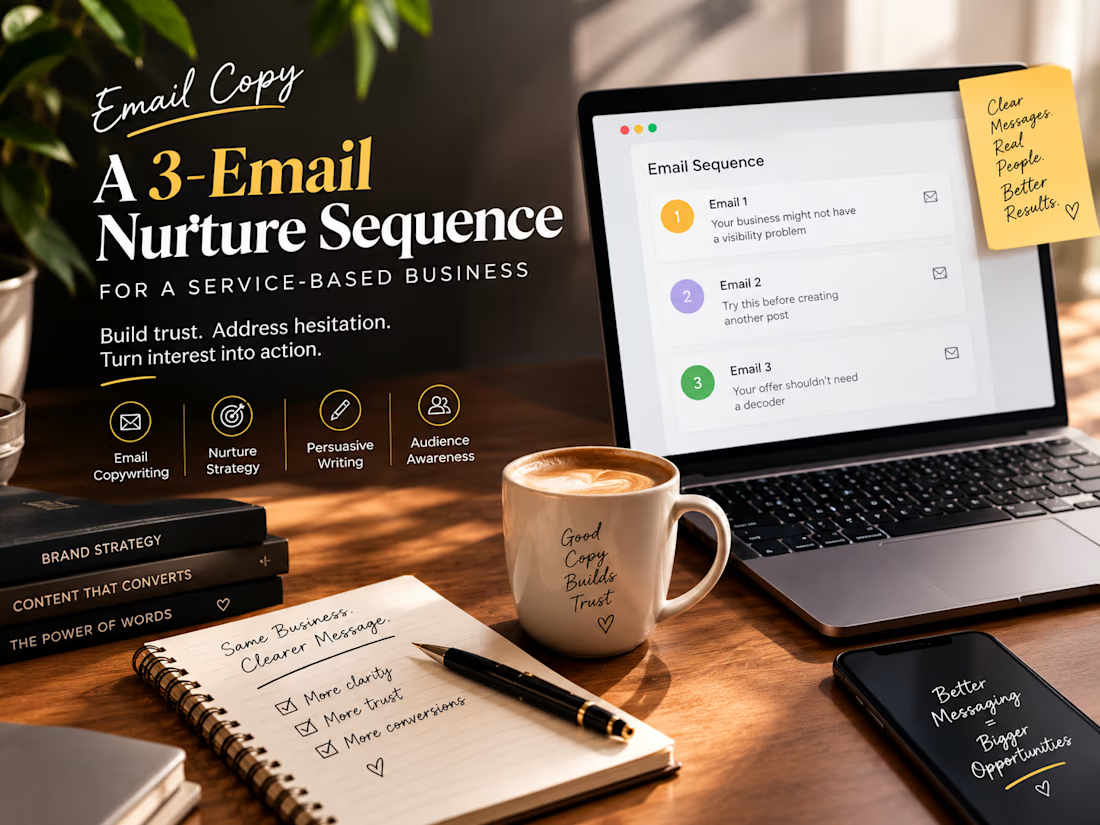
Create a 3 email nurture sequence for a fictional brand strategist whose prospects have shown interest but haven’t taken the next step.
Approach:
The sequence moves from identifying a messaging problem, to providing a useful insight, to presenting a low pressure next step. The copy focuses on clarity and relevance rather than aggressive selling.
Skills demonstrated:
Email copywriting, persuasive writing, audience awareness, nurture strategy, CTA writing.
Project note:
This is a speculative practice project created to demonstrate my email copywriting and strategic thinking. No client performance results are being claimed.


Great nurture sequence. Each email builds trust naturally and makes the next step feel easy.

𝐀𝐈 𝐀𝐮𝐭𝐨𝐦𝐚𝐭𝐢𝐨𝐧 & 𝐁𝐮𝐬𝐢𝐧𝐞𝐬𝐬 𝐎𝐩𝐞𝐫𝐚𝐭𝐢𝐨𝐧𝐬 𝐃𝐚𝐬𝐡𝐛𝐨𝐚𝐫𝐝
Atomie™ is a modern AI-powered automation dashboard designed to help businesses simplify complex workflows, reduce repetitive manual work, and make better operational decisions.
The platform brings AI automation, workflow management, performance analytics, and business insights into one clean and intuitive interface. Instead of managing disconnected tools and repetitive processes, teams can use a centralized dashboard to monitor operations, automate tasks, and understand what is happening across their business.
What I Built
AI-powered business automation dashboard
Workflow and task automation interfaces
Real-time performance and operational insights
Clean, responsive dashboard experience
Intuitive navigation for complex business processes
AI-focused UX designed around simplicity and usability
Scalable interface structure for future automation features
The Goal
The main goal was to make advanced AI automation feel simple and accessible. The interface was designed to reduce complexity while giving businesses a clear overview of their workflows, performance, and automation activity.
Atomie™ demonstrates how AI, automation, and modern product design can come together to create a smarter operating experience for growing businesses.
Focus: AI Automation · Business Operations · SaaS Dashboard · Workflow Automation · Product UI/UX · AI Systems


Nice work