
Alimi Oluwa pelumi
Copywriter +Content creator + Social media content + editing


Portfolio project 01 · Independent speculative work
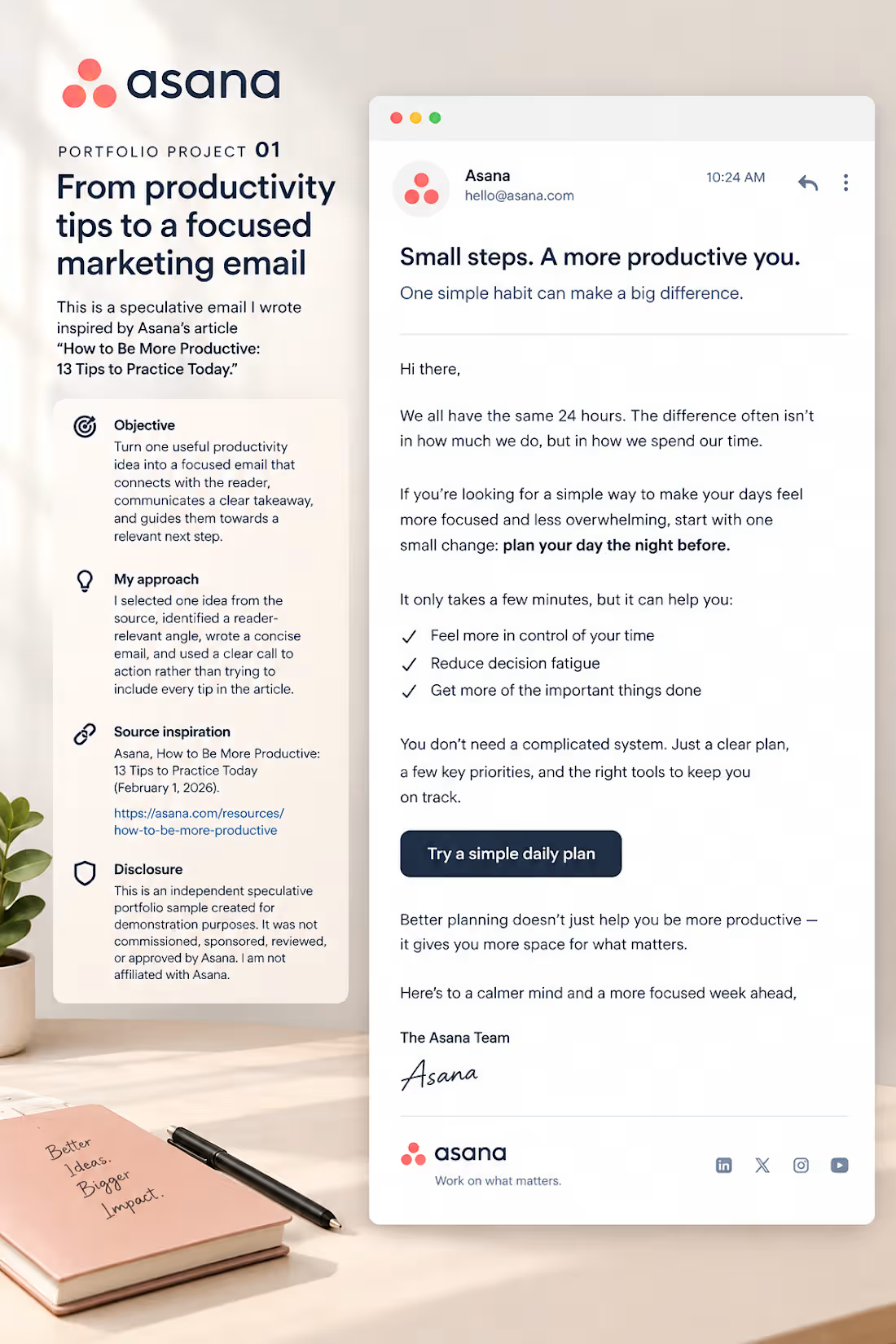
This project demonstrates how I would adapt an existing productivity article into a focused, reader-centred marketing email.
Source inspiration: Asana, How to Be More Productive: 13 Tips to Practice Today (February 1, 2026).
Source article: https://asana.com/resources/how-to-be-more-productive
Objective: Turn one useful productivity idea into an email that connects with the reader, communicates a clear takeaway, and guides them towards a relevant next step.
My approach: Select one idea from the source, identify a reader-relevant angle, write a concise email, and use a clear call to action rather than trying to include every tip in the original article.
Disclosure: This is an independent speculative portfolio sample created for demonstration purposes. It was not commissioned, sponsored, reviewed, or approved by Asana. I am not affiliated with Asana.
1
35
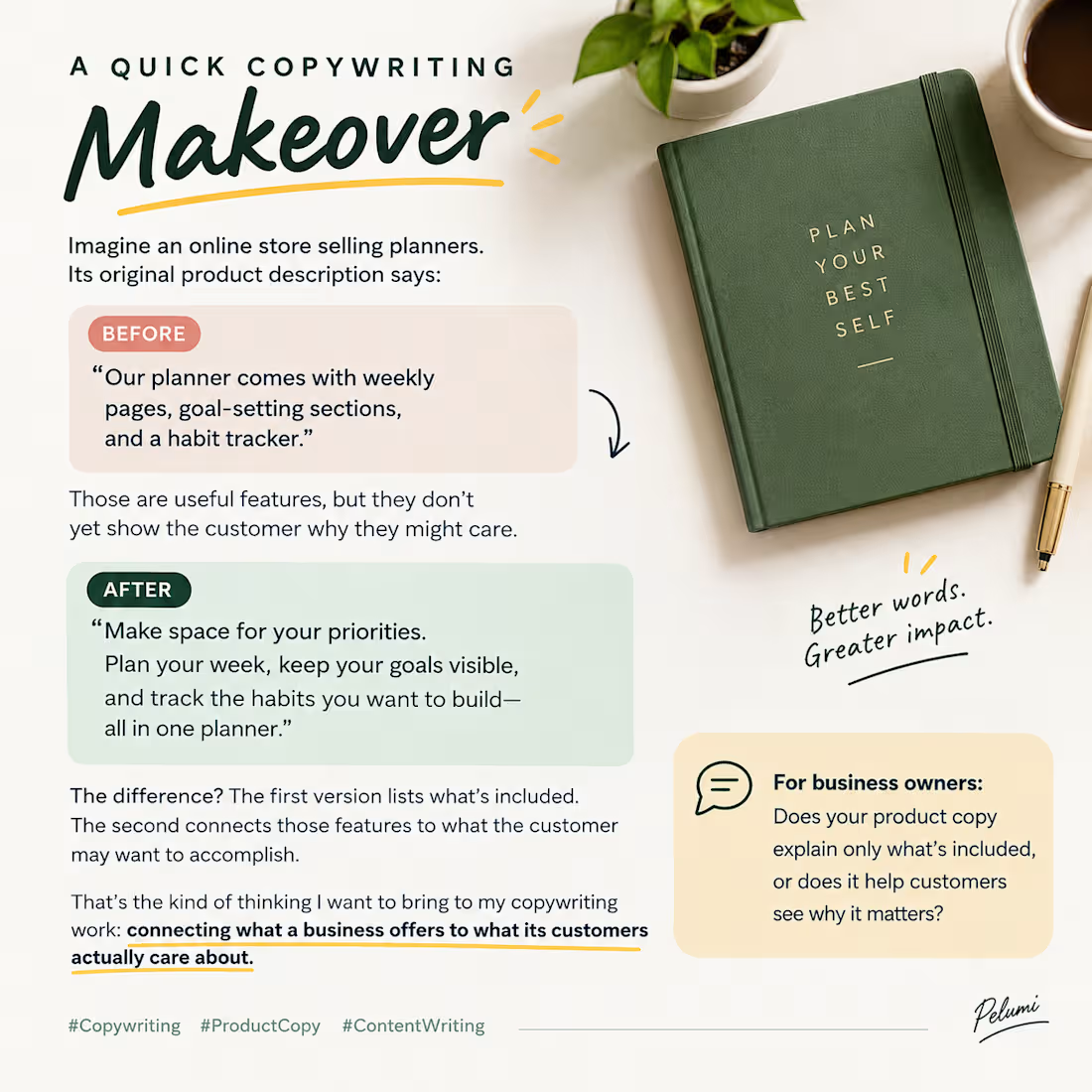
A quick copywriting makeover ✍️
Imagine an online store selling planners.
Its original product description says:
“Our planner comes with weekly pages, goal setting sections, and a habit tracker.”
Those are useful features, but they don’t yet show the customer why they might care.
I’d rewrite it as:
“Make space for your priorities. Plan your week, keep your goals visible, and track the habits you want to build all in one planner.”
The difference? The first version lists what’s included. The second connects those features to what the customer may want to accomplish.
That’s the kind of thinking I want to bring to my copywriting work: connecting what a business offers to what its customers actually care about.
For business owners: Does your product copy explain only what’s included, or does it help customers see why it matters?
#Copywriting #ProductCopy #ContentWriting
1
54
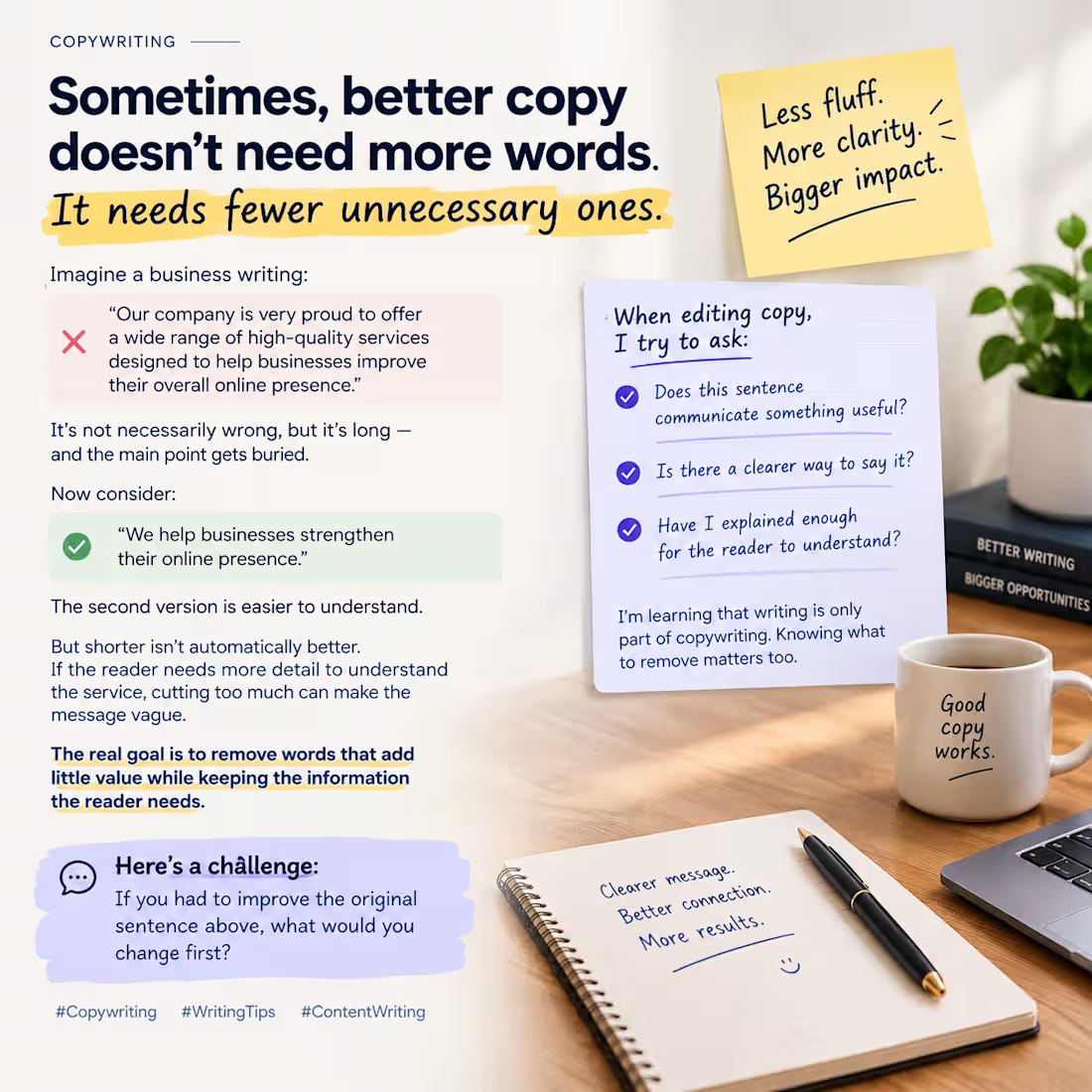
Sometimes, better copy doesn’t need more words. It needs fewer unnecessary ones.
Imagine a business writing:
“Our company is very proud to offer a wide range of high quality services designed to help businesses improve their overall online presence.”
It’s not necessarily wrong, but it’s long and the main point gets buried.
Now consider:
“We help businesses strengthen their online presence.”
The second version is easier to understand.
But shorter isn’t automatically better. If the reader needs more detail to understand the service, cutting too much can make the message vague.
The real goal is to remove words that add little value while keeping the information the reader needs.
When editing copy, I try to ask:
— Does this sentence communicate something useful?
— Is there a clearer way to say it?
— Have I explained enough for the reader to understand?
I’m learning that writing is only part of copywriting. Knowing what to remove matters too.
Here’s a challenge: If you had to improve the original sentence above, what would you change first?
#Copywriting #WritingTips #ContentWriting
0
41
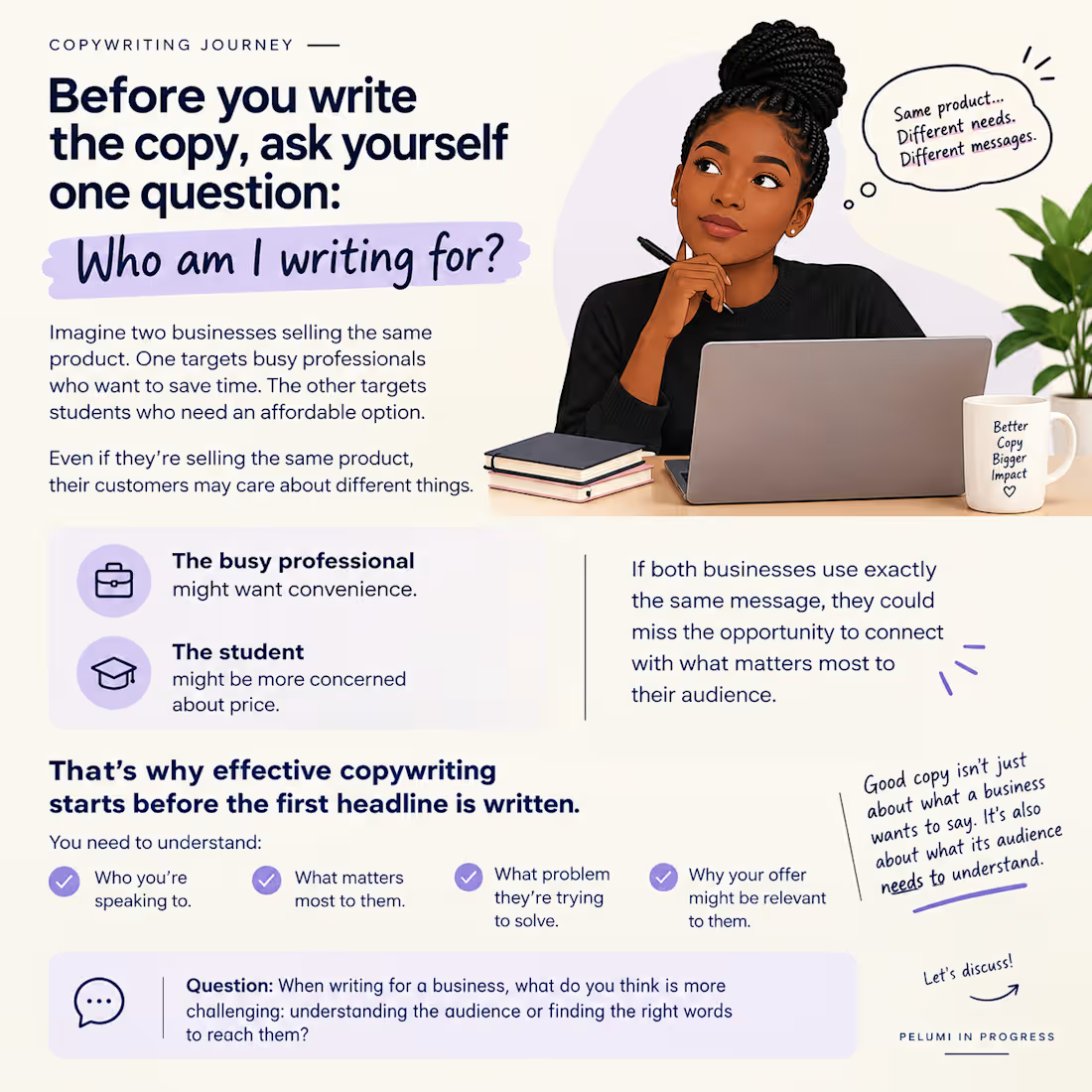
Before you write the copy, ask yourself one question: Who am I writing for?
Imagine two businesses selling the same product.
One targets busy professionals who want to save time.
The other targets students who need an affordable option.
Even if they’re selling the same product, their customers may care about different things.
The busy professional might want convenience.
The student might be more concerned about price.
If both businesses use exactly the same message, they could miss the opportunity to connect with what matters most to their audience.
That’s why effective copywriting starts before the first headline is written.
You need to understand:
— Who you’re speaking to.
— What matters most to them.
— What problem they’re trying to solve.
—Why your offer might be relevant to them.
When you understand the reader, you can make better decisions about the message, the examples you use, and the benefits you highlight.
I’m continuing to practise this in my copywriting journey because good copy isn’t just about what a business wants to say. It’s also about what its audience needs to understand.
Question: When writing for a business, what do you think is more challenging: understanding the audience or finding the right words to reach them?
0
41