The network for creativity
Join 1.25M professional creatives like you
Connect with clients, get discovered, and run your business 100% commission-free
Creatives on Contra have earned over $150M and we are just getting started
Back to feedPost

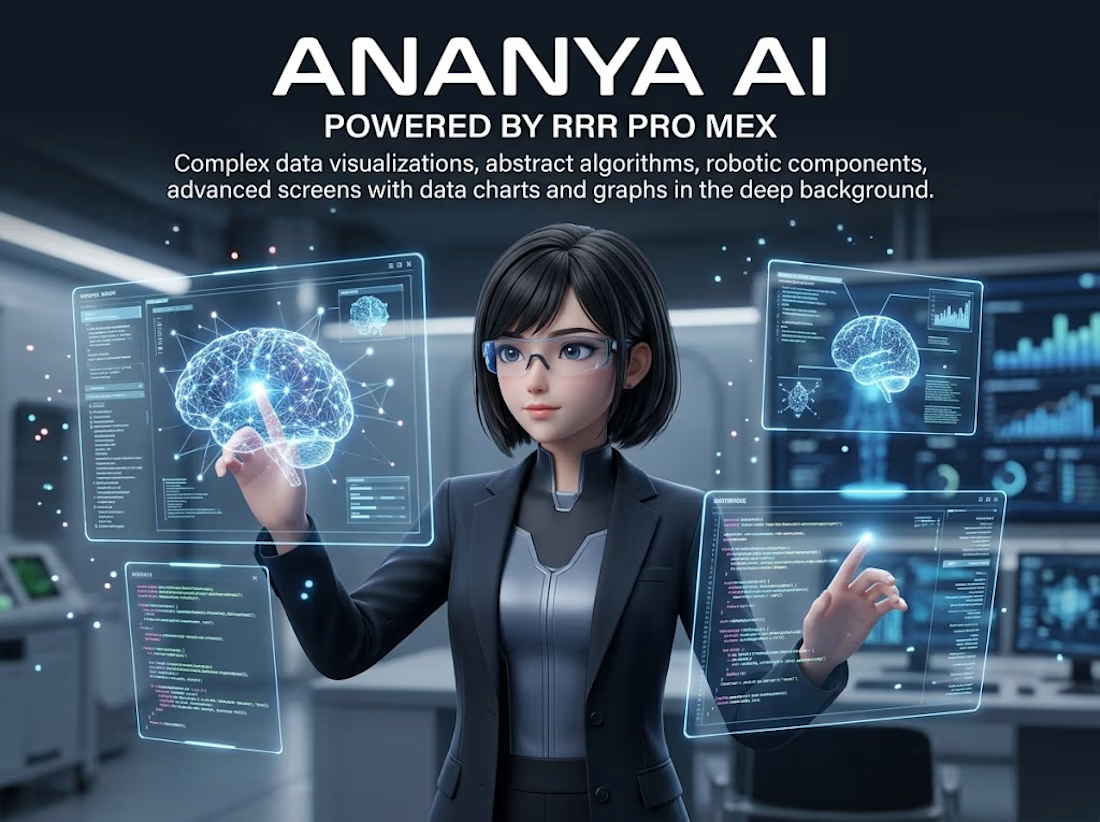
RRR PRO MEX — Powered by ANANYA AI
Exploring What Happens When AI Feels More Human.
Most AI systems are built around prompts, APIs, responses, and task completion.
With ANANYA AI, we wanted to explore something different:
Can an AI interaction feel more emotionally human?
This is an early technical setup where we are experimenting with a layer that connects AI responses with human-like emotional expression, conversational behavior, and realistic voice interaction.
Instead of making the experience feel like a standard API-powered chatbot, ANANYA is designed to make the user experience feel more natural, expressive, and emotionally responsive.
What we are experimenting with
• Human-like emotional response patterns
• Emotion-aware conversational behavior
• Realistic AI voice interaction
• More natural response delivery
• A stronger sense of presence during conversations
The goal is not simply to make an AI that answers.
The idea is to explore an AI that can make the interaction itself feel more human.
This is still an early experiment and a technical foundation for something much bigger.
ANANYA AI — RRR PRO MEX
Exploring the boundary between artificial intelligence and human-like interaction.


The network for creativity
Join 1.25M professional creatives like you
Connect with clients, get discovered, and run your business 100% commission-free
Creatives on Contra have earned over $150M and we are just getting started
Challenges
View all


Related posts

Cool AI work


For me, it’s cultural context. AI can generate references, but it can’t fully replicate lived experience. As a South African creative, so much of my work relies on instinct, memory, language and the nuances of how we actually experience our culture.
When I’m reimagining iconic...

A cinematic AI fashion film with retro tennis aesthetics, controlled camera movement, and slow-motion object choreography.


Retro tennis + slow-motion object choreography is a strong brief for AI fashion — the sport aesthetic gives the camera language structure so it doesn’t feel like generic runway slop.

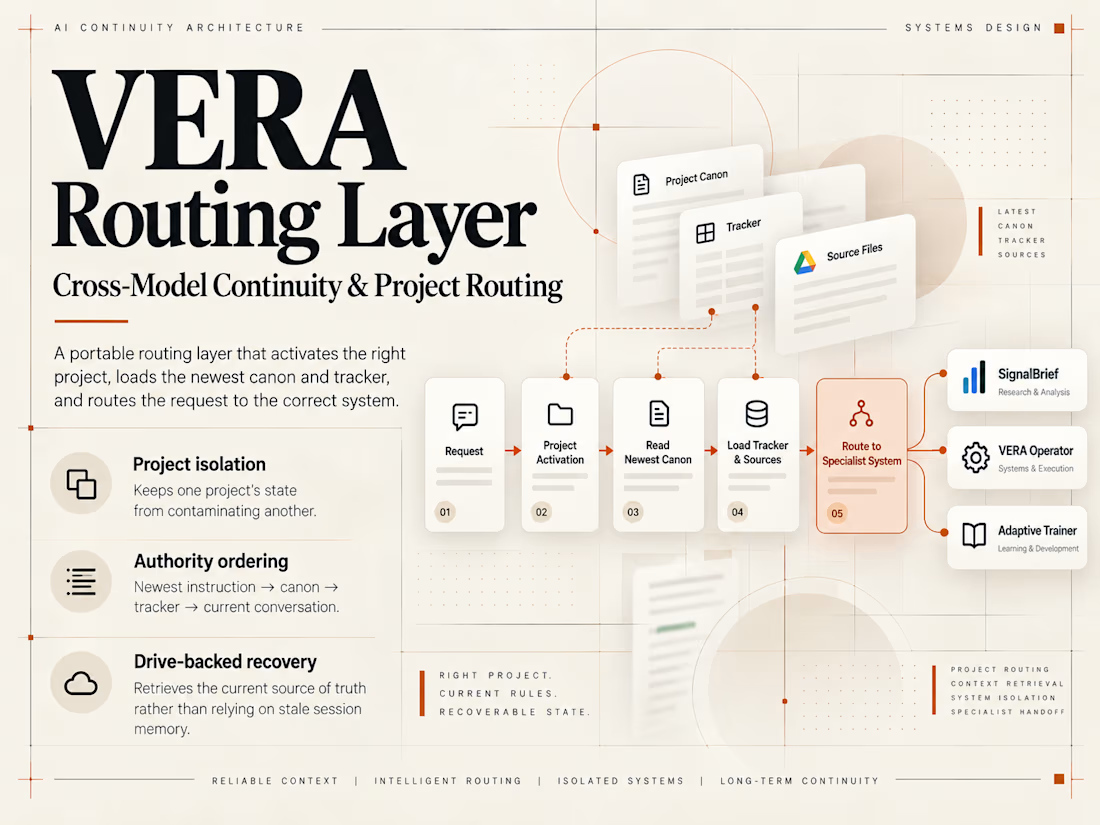
A strong specialist skill is useless if the wrong system gets invoked. Long-running AI work breaks in boring, expensive ways.
That is not a prompting problem. It is a routing and authority problem.
How I can help you:
I build project routers for teams using multiple AI workflows, agents, or specialist assistants so that they work with each other as a team.
I design source-of-truth resolutions so your agents retrieve the current rules instead of improvising or relying on assumptions or stale chat data.
I create reusable skill registries and specialist handoff logic hardened by determined and dedicated flow states reducing the need for model reliance on its own internal and displaced memory context.
I separate project states with individualized canonical states bound by rules living under essential model instructions and routed properly so unrelated workflows do not contaminate one another, but exist with awareness of the role each project plays, enabling a persistently growing ecosystem to develop organically.
I add governance wrappers, escalation hooks, and recovery mirrors around existing AI stacks so that trust is designed at the root, and variance is eliminated with rule based source archiving and implementation.
Trust means closing your eyes at night and sleeping soundly because your agents got your back. And I can put it all together for you, precision results sourced and undisputed because I got tired of doing things the hard way.

Phillip, agree that routing is where it breaks. In our builds the worst bugs came from an agent pulling an old rule from chat history instead of the current source. Pinning one source of truth per project fixed more than any prompt change did.