The network for creativity
Join 1.25M professional creatives like you
Connect with clients, get discovered, and run your business 100% commission-free
Creatives on Contra have earned over $150M and we are just getting started
Back to feedPost

Mindset shift on writing for AEO:
AI systems favor content that answers immediately.
Weak:
“South Carolina offers many compelling advantages for relocation…”
Strong:
"South Carolina is attractive because of its low taxes, mild climate, growing job market, and coastal access."
Then elaborate from there.
#aeowriting #aeoediting
The network for creativity
Join 1.25M professional creatives like you
Connect with clients, get discovered, and run your business 100% commission-free
Creatives on Contra have earned over $150M and we are just getting started







Related posts

A polished explanation can still misdiagnose a learner’s writing.
Illustrative QA case — synthetic content, not a real learner or vendor result.
The learner writes: “I look forward to hearing from you.”
An AI reviewer calls “hearing” a grammar error and changes it to “hear”. The original phrase is appropriate. The suggested correction introduces a problem.
A plausible overall score would not make that feedback acceptable. I would log a false correction, preserve the exact input and output, and add a retest that checks whether the system leaves the valid phrase intact.
Three useful checks for a writing-feedback team:
• Does each claimed error have evidence in the learner’s actual response?
• Does the proposed revision preserve the intended meaning and valid language?
• After a prompt change, do previously accepted cases still pass?
Keep feedback accuracy separate from score agreement. A system can pass one check and fail the other.
For EdTech teams preparing a writing-feature release, I offer a bounded review of rubric alignment, scoring consistency and feedback defects, with an evidence workbook and acceptance tests.
Tell me what your scorer measures, which rubric it follows and what concerns you want to investigate.
contra.com
AI Writing Assessment and Feedback Quality Audit by Suliman Abdelaty
Read more about AI Writing Assessment and Feedback Quality Audit by Suliman Abdelaty on Contra.


When shipping software, AI is leverage when it takes manual work out of a step people already do.
Before the build, I like to ask:
→ What is manual work is required?
→ What steps does the requirement need?
→ What steps can AI takeover or remove?
When AI takes the manual work out of the step, people are more likely to act on it and use it more often.
Growth through subtraction


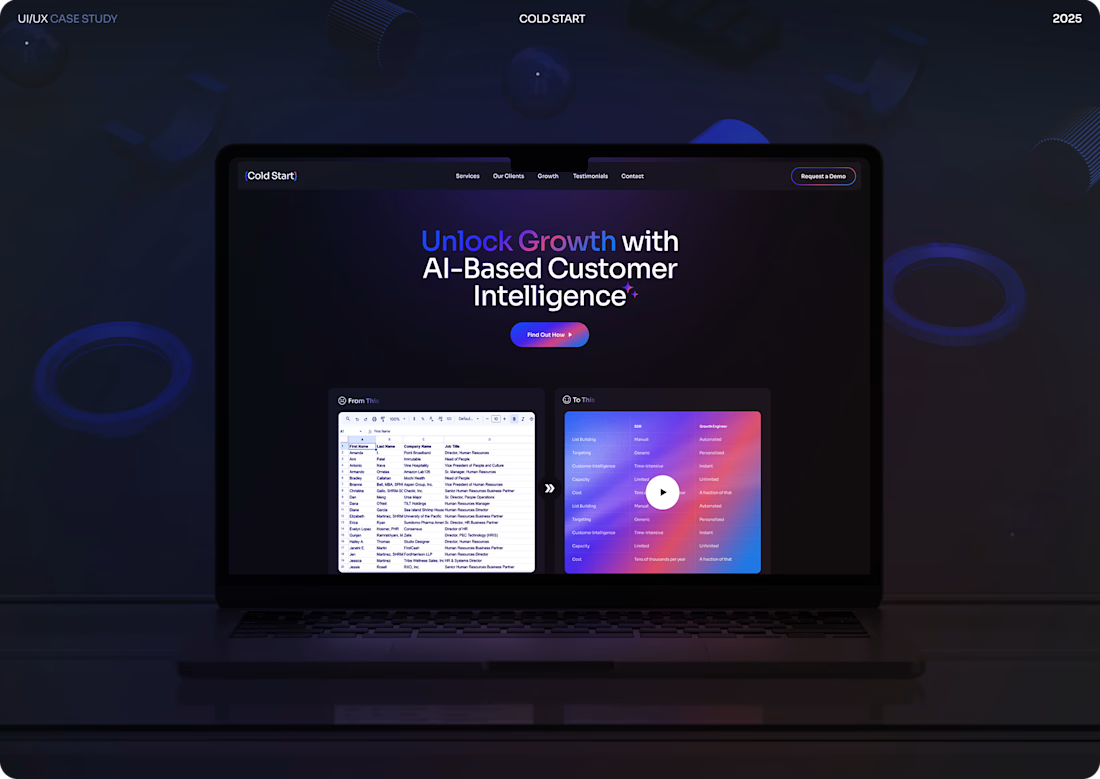
Redesigned an AI customer intelligence landing page with bold visuals, clear messaging, and intuitive layouts to enhance user experience and drive conversions.


Clear messaging matters so much for AI products!