The network for creativity
Join 1.25M professional creatives like you
Connect with clients, get discovered, and run your business 100% commission-free
Creatives on Contra have earned over $150M and we are just getting started
Back to feedPost
Why static default gateways fail in multi-rack datacenters: Silent switch black holes, bridging broadcast storms, and failover latency.
When engineering on-premise infrastructure, private clouds, or co-located server racks, many teams configure host networking using traditional Layer-2 subnets: a static default gateway pointing to a virtual IP (VRRP/HSRP) on top-of-rack switches.
While straightforward for 5 servers in a single rack, this legacy Layer-2 architecture breaks down under multi-rack scale:
1. The Single Gateway Black Hole: If an upstream top-of-rack switch loses its uplink but keeps the physical host link UP, the server continues sending packets to its static gateway. Traffic vanishes into a silent black hole until a human engineer intervenes. 2. Broadcast Sprawl & Spanning Tree: Extending Layer-2 VLANs across multiple switches introduces Spanning Tree Protocol (STP) convergence delays. A single loop or flapping link locks port forwarding across the entire datacenter for 30–50 seconds. 3. Lack of True Equal-Cost Multi-Path (ECMP): Static default gateways can only send traffic out one path at a time. The secondary redundant switch sits 100% idle, cutting available egress network bandwidth in half.
The modern cloud-native approach is **Routing to the Host with BGP (Border Gateway Protocol)** using lightweight routing daemons like **BIRD**: • Dual BGP Peering per Host: Every physical server establishes active BGP peering sessions with both Top-of-Rack (ToR) switches over point-to-point links. • Sub-Second BFD Failover: Bidirectional Forwarding Detection (BFD) continuously tests link integrity with millisecond-level keepalives. If a switch or optic drops, routes converge in under 50 milliseconds—completely transparent to application connections. • Host-Level Anycast & /32 Route Announcements: Services announce their own IP addresses as /32 host routes via BGP. If a service migrates or an ingress proxy crashes, the route is withdrawn instantly from the datacenter routing table. • Active-Active ECMP Throughput: Outgoing traffic is load-balanced simultaneously across both upstream switches, doubling available network throughput with zero link waste.
Build a datacenter network as resilient and dynamic as hyperscale cloud backbones.
Deploy hardened, sovereign core network services with our 1-week Sprint on Contra: https://contra.com/s/mrP3E36W-core-sovereign-network-services-bind9-dnssec-kea-dhcp-and-chrony-ntp
#Networking #Infrastructure #Linux #Architecture #CloudArchitecture #DevOps #SRE


The network for creativity
Join 1.25M professional creatives like you
Connect with clients, get discovered, and run your business 100% commission-free
Creatives on Contra have earned over $150M and we are just getting started





Related posts

Why site-to-site IPsec VPN tunnels flap: Complex IKE state machines, dead peer detection timeouts, and stateful connection tracking.
For decades, IPsec (Internet Protocol Security) was the default choice for connecting distributed datacenters, branch offices, and cloud VPCs. Yet almost every network architect has suffered the dreaded 3 AM page: an IPsec tunnel mysteriously dropped, traffic is black-holed, and only a manual daemon restart clears the stale security association.
Beyond aging cryptographic handshakes, legacy IPsec has inherent architectural pain points:
1. Complex IKEv2 State Negotiations: Phase 1 and Phase 2 negotiations negotiate hundreds of cryptographic proposals (Diffie-Hellman groups, encryption ciphers, hashing algorithms). A single configuration mismatch or transient packet drop during re-keying resets the entire tunnel. 2. NAT & Stateful Firewall Dropping: Stateful border firewalls maintain NAT session tables. When tunnel traffic is idle, stateful firewalls silently purge UDP port 500/4500 session entries, causing subsequent ESP packets to drop without notification. 3. Cryptographic CPU Overhead: Traditional user-space IPsec daemons (strongSwan, Libreswan) context-switch packets across user-space and kernel boundaries, capping throughput on 10GbE inter-datacenter links.
The modern standard is **Kernel-Native WireGuard**, engineered for ultra-fast, stateless site-to-site encrypted meshes: • Stateless Cryptokey Routing: WireGuard eliminates complex multi-phase negotiations. Peers authenticate via static Curve25519 public keys mapped directly to internal IP addresses—similar to SSH authorized_keys. • Zero-Noise Silent Operation: When no traffic is transmitted, WireGuard goes completely silent. It sends zero unauthenticated keepalive noise, resisting network port scanners and automated reconnaissance. • Built-in Persistent Keepalives: A simple ``PersistentKeepalive = 25`` directive maintains NAT firewall pinholes automatically, eliminating stale session timeouts across stateful middleboxes. • In-Kernel Performance: Running inside the native Linux kernel network stack, WireGuard delivers 4x the throughput of OpenVPN and 2x the throughput of IPsec, saturating 10GbE interconnects with minimal CPU load.
Transform your fragile site-to-site connections into an immutable, high-throughput encrypted mesh.
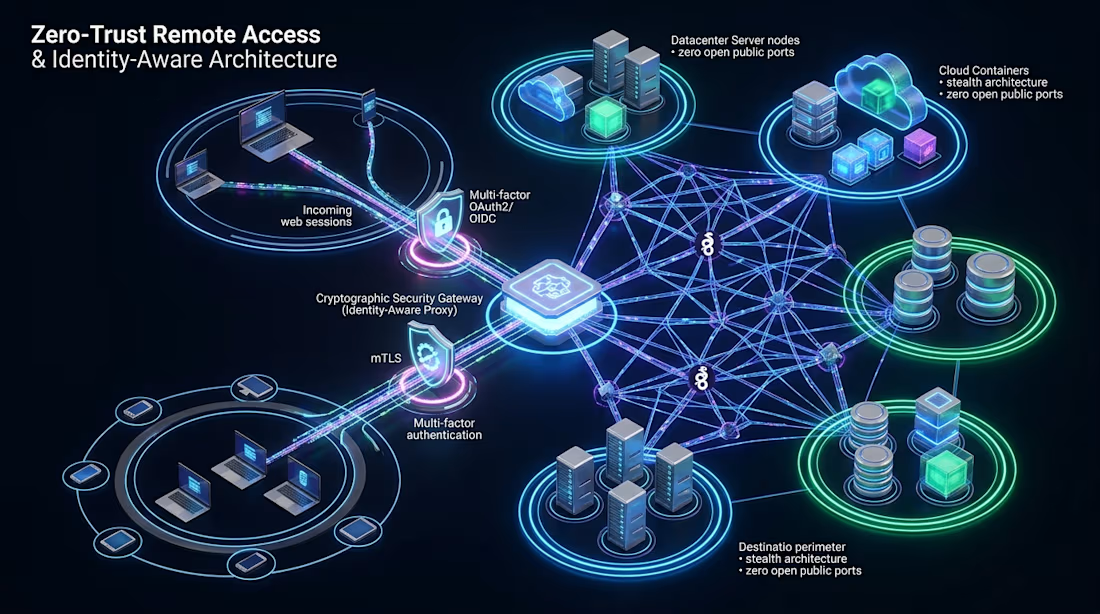
Deploy a zero-trust encrypted network with our 2-week Zero-Trust Remote Access Architecture Sprint on Contra: https://contra.com/s/QocPNgeg-zero-trust-remote-access-and-identity-aware-architecture
#CyberSecurity #Networking #Linux #Infrastructure #DevOps #SRE #Security #Architecture
Why the Linux OOM Killer nukes your database first: A rogue background worker leaked memory, but your core PostgreSQL instance paid the price.
Every production systems engineer has seen this horror story: A developer deploys a new Python background worker or Node.js processing script on a shared application host. The script has a slow memory leak. Hours later, the Linux kernel triggers the Out-Of-Memory (OOM) Killer.
Instead of terminating the leaking script, the kernel violently SIGKILLs your primary PostgreSQL or MariaDB daemon.
Here is the exact kernel logic that causes this catastrophe:
1. The Badness Heuristic: When physical RAM and swap are exhausted, the Linux kernel computes an ``oom_score`` for every running process. The primary input to this score is raw Resident Set Size (RSS)—the total physical memory pages held by that process. 2. The Database Target: A healthy database server deliberately buffers gigabytes of data in memory (shared buffers, cache pages). Even though the database was behaving perfectly, its massive memory footprint gives it the highest ``oom_score`` on the host. 3. The Collateral Damage: The kernel reaps the database process to reclaim the largest block of memory instantaneously. Transactions abort, dirty pages are abandoned, and the database is forced into crash recovery on restart.
Preventing rogue processes from taking down mission-critical daemons requires **systemd cgroups v2 resource slicing**: • Memory Protection with MemoryLow & MemoryMin: Configure systemd service units with ``MemoryMin=`` and ``MemoryLow=``. This instructs the kernel memory reclaimer that the database process's memory pages are strictly protected and must never be swapped or pruned under memory pressure. • Adjusting oom_score_adj: Explicitly protect critical daemons by setting ``OOMScoreAdjust=-900`` in the database service unit file. Conversely, configure untrusted background workers with ``OOMScoreAdjust=800`` so the kernel reaps the offender first. • Hard Slice Enclosure: Isolate workloads into dedicated systemd slices (``system.slice`` vs ``app.slice``). Enforce strict ``MemoryMax=8G`` and ``MemoryHigh=7G`` on application workers, terminating or throttling the leaking container within its own slice before host memory is threatened.
Never leave your production database's survival to default kernel memory heuristics.
Harden your Linux systems and container runtimes with our 2-week Hardened Linux & Container Infrastructure Sprint on Contra: https://contra.com/s/Xbg7ALqN-hardened-linux-and-container-infrastructure
#Linux #Performance #Infrastructure #Database #Architecture #DevOps #SRE

Prometheus high-cardinality explosion: The hidden telemetry trap that crashes your monitoring cluster precisely when a production incident occurs.
Prometheus and Grafana are the gold standard for production monitoring. Yet almost every scaling engineering organization eventually watches their central Prometheus instance crash with an Out-Of-Memory (OOM) error right in the middle of a high-traffic launch or outage.
The culprit is almost never data volume; it is **uncontrolled label cardinality**.
Here is the exact mechanics of a cardinality collapse:
1. The Unsanitized Label Injection: A developer instruments an API metric: ``http_requests_total{method="POST", path="/api/v1/users/12345/checkout"}``. Instead of grouping by the parameterized route template (``/api/v1/users/:id/checkout``), the raw user ID or transaction UUID is injected into the label. 2. The TSDB Index Churn: In Prometheus's Time-Series Database (TSDB), every unique combination of key-value label pairs creates an entirely new time-series stream. 50,000 unique customer IDs mean 50,000 separate in-memory series heads. 3. The Memory Avalanche: Prometheus maintains an in-memory inverted index of all active series. RAM consumption jumps from 4GB to 32GB in minutes. Compaction fails, WAL (Write-Ahead Log) replays stall on restart, and the entire monitoring node falls into an infinite crash loop.
Engineering a resilient, enterprise observability architecture requires proactive cardinality governance: • Aggressive Metric Relabeling: Use Prometheus ``metric_relabel_configs`` to drop high-cardinality label keys at scrape time before they ever enter the TSDB head block. • Parameterized Path Normalization: Enforce strict application-level middleware that normalizes dynamic URL paths and masks user identifiers before exposing ``/metrics``. • Pre-Aggregating Recording Rules: Calculate expensive rate and histogram metrics (e.g. 5-minute request rates) via recording rules, allowing high-frequency dashboards to query pre-computed series rather than millions of raw samples. • Horizontal Long-Term Storage with Thanos: Decouple real-time monitoring from historical retention. Use lightweight Prometheus sidecars shipping immutable 2-hour TSDB blocks to sovereign object storage (Ceph/S3), querying decades of telemetry via Thanos Query with zero local memory risk.
Your monitoring system must be the most resilient component in your infrastructure—never the first to crash.
Deploy a production-hardened observability telemetry platform with our 1–2 week Sprint on Contra: https://contra.com/s/r6k2QLPl-production-observability-and-sre-telemetry-platform
#Observability #Prometheus #Grafana #Monitoring #Infrastructure #DevOps #SRE