The network for creativity
Join 1.25M professional creatives like you
Connect with clients, get discovered, and run your business 100% commission-free
Creatives on Contra have earned over $150M and we are just getting started
Back to feedPost

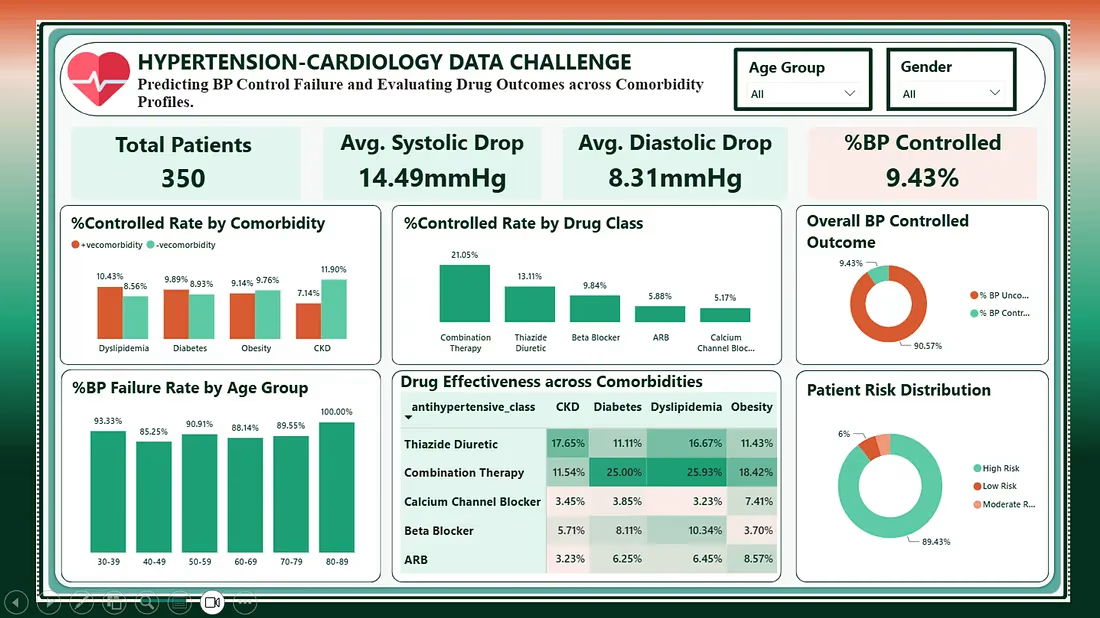
Hypertension-Cardiology Data Challenge: Predicting BP Control Failure and Evaluating Drug Outcomes Across Comorbidity Profiles
This project answers two questions hospital leadership needs: what predicts BP control failure at 3 months, and which antihypertensive drug class works best for specific comorbidity profiles. Both matter because treatment should be tailored, since a drug that helps a diabetic patient may do little for someone with chronic kidney disease.


The network for creativity
Join 1.25M professional creatives like you
Connect with clients, get discovered, and run your business 100% commission-free
Creatives on Contra have earned over $150M and we are just getting started





Related posts

A full-stack RAG application that answers questions from a team's own documents, with every answer cited to the source document and page. I designed, built, tested and deployed it end to end:
document ingestion with content-based file validation;
semantic search with PostgreSQL + pgvector;
streaming answers over Server-Sent Events, with server-side citation verification;
multi-tenant workspaces with role-based access;
usage metering with quotas and a cost dashboard;
a crash-safe PostgreSQL job queue.
Deployed as a public demo on free tiers (Vercel, Render, Supabase) with hard caps on AI spend.
Citations verified against the retrieved passages; unsupported answers return "not found"
Tenant isolation in every query; Supabase Data API locked down (verified on production)
Durable ingestion queue (SKIP LOCKED, leases, retries): kill -9 under load lost nothing
Costs reserved before every AI call; per-user, per-workspace and deployment-wide caps
Data-driven model migration (5 configurations evaluated; about 74% cheaper per answer)
1,099 backend + 393 frontend tests; load-tested; encrypted, restore-verified backups
https://knowledgepilot-ai-olive.vercel.app/


The reservation before the AI call is the detail most teams miss: you can add cost metering later, but you cannot un-spend the money after a runaway loop. On the crash-safe queue, with SKIP LOCKED plus leases, what happens to a lease held by a worker that is alive but stuck, do...

Brief: FitForge gym wanted posters and social media posts to promote their fitness services and create a bold, energetic look.
I designed two posters, three social media posts, and one postcard for FitForge, using strong typography, clear visual hierarchy, and a consistent black-and-white plus brand color palette.
Process: Started with logo direction, then carried the same look into the posters to keep the brand consistent. Used typography to create clear hierarchy so the main message reads first, with details following naturally.
Deliverables: Two posters, Three social media posts, One postcard, plus mockups showing how the design would look in a real gym space.
Outcome: a bold, clean, and cohesive set of materials that reflect the gym's energetic feel





The challenge:
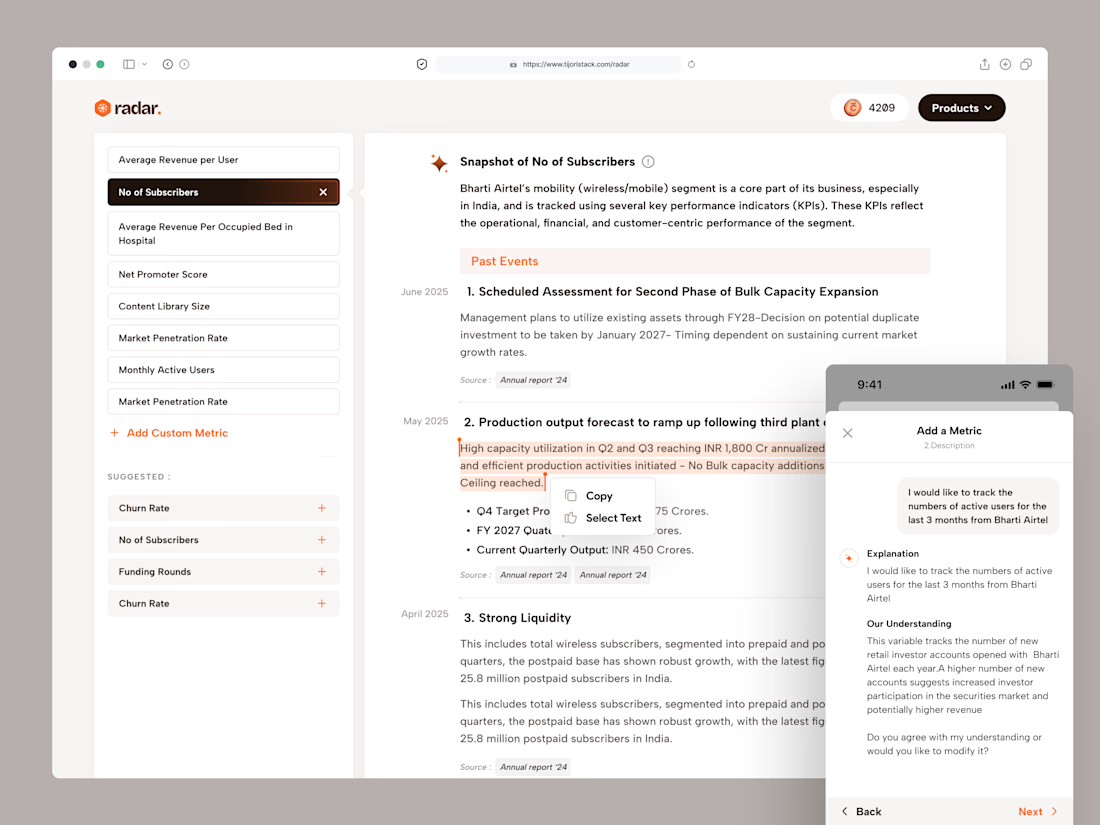
The KPIs that move a stock — subscribers, ARPU, capacity utilisation — are buried in annual reports and earnings calls. Screeners only show generic ratios. Tijoristack wanted investors to ask for any metric and get it back with dates and sources.
What I did:
As lead product designer, I ran research with investors, analysts and the founders, mapped the "add a metric" and "read a snapshot" journeys, and designed the web and mobile experience. I then worked with Tijoristack's developers through the build.
Key decisions:
• The AI restates its understanding of a new metric before tracking it, so one misread doesn't spoil every snapshot after it.
• Snapshots read as a dated timeline of events, not a lone number.
• A source chip on every claim, because investors won't act on what they can't trace.
Result
Shipped and live at tijoristack.ai/radar.
Building an AI or fintech product? I design complex workflows people actually get. Book a 30-min call
Check it out


The AI restating its understanding before tracking a metric is such a smart trust move. I design a GenAI analytics assistant and we hit the same problem: one silent misread and users stop trusting every answer after it. Did investors ever edit that restatement, or mostly just confirm it?