The network for creativity
Join 1.25M professional creatives like you
Connect with clients, get discovered, and run your business 100% commission-free
Creatives on Contra have earned over $150M and we are just getting started
Back to feedPost
The NVMe I/O scheduler mistake: Why running legacy disk elevator algorithms on modern enterprise SSDs cripples database IOPS and inflates p99 latencies.
Over the past decade, enterprise storage transitioned from spinning disks (HDDs) to high-speed NVMe and PCIe solid-state drives capable of millions of IOPS and hardware parallel queuing (up to 64,000 queues with 64,000 commands per queue). However, many Linux operating system installations—including default distributions and generic cloud AMIs—still apply legacy rotational scheduling logic to fast non-volatile block devices:
1. The Single-Queue Elevator Bottleneck: Traditional elevators like ``bfq`` (Budget Fair Queueing) or legacy ``cfq`` were engineered for spinning platters, calculating head-seek mechanics and reordering sequential requests. On an NVMe drive with zero rotational seek latency, this scheduling layer introduces severe CPU lock contention and software serialization. 2. Latency Spikes on Write-Heavy Workloads: In high-concurrency database workloads (PostgreSQL, MariaDB, Redis snapshots), CPU cores spend significant time waiting on kernel elevator spinlocks instead of dispatching commands directly to the NVMe controller queues. 3. Inconsistent I/O Distribution: Overly complex queue schedulers create artificial queue depths, turning microsecond hardware flash responses into millisecond p99 latency regressions.
Modern enterprise NVMe storage demands a deterministic, multi-queue block layer configuration: • Enforce the "none" Scheduler for NVMe: For fast PCIe NVMe storage devices, the optimal I/O scheduler is ``none`` (noop). This bypasses software elevator queuing entirely, allowing the Linux kernel block layer to map CPU threads directly to hardware NVMe submission queues with near-zero CPU overhead. • Use mq-deadline for SATA/SAS SSDs: For slower SATA SSDs or managed cloud block volumes (where queue depth is restricted by hypervisor throttling), enforce ``mq-deadline`` to guarantee fair latency bounds without the heavy CPU overhead of ``bfq``. • Automate Persistent Tuning via Udev: Never rely on manual runtime sysfs commands. Deploy an automated udev rule in ``/etc/udev/rules.d/60-ioschedulers.rules`` matching the NVMe subsystem (``ACTION=="add|change", KERNEL=="nvme[0-9]*", ATTR{queue/scheduler}="none"``) and rotational flags for SATA/virtio SSDs (``ATTR{queue/rotational}=="0", ATTR{queue/scheduler}="mq-deadline"``). • Optimize Queue Depth & Read-Ahead: Pair zero-overhead scheduling with balanced read-ahead parameters (e.g., 64KB for random OLTP database workloads) to avoid cache pollution.
Unlock the full hardware throughput of your enterprise flash arrays and eliminate artificial storage bottlenecks.
Audit and optimize your production Linux infrastructure with our 2-week Hardened Linux & Container Infrastructure Sprint on Contra: https://contra.com/s/Xbg7ALqN-hardened-linux-and-container-infrastructure
#Linux #Database #Performance #Infrastructure #SRE #DevOps #Storage


The network for creativity
Join 1.25M professional creatives like you
Connect with clients, get discovered, and run your business 100% commission-free
Creatives on Contra have earned over $150M and we are just getting started







Related posts

Built an n8n automation that recovers missed customer calls, starts an AI conversation, checks CRM context, routes urgent requests, and tracks callback SLAs until the customer is handled.


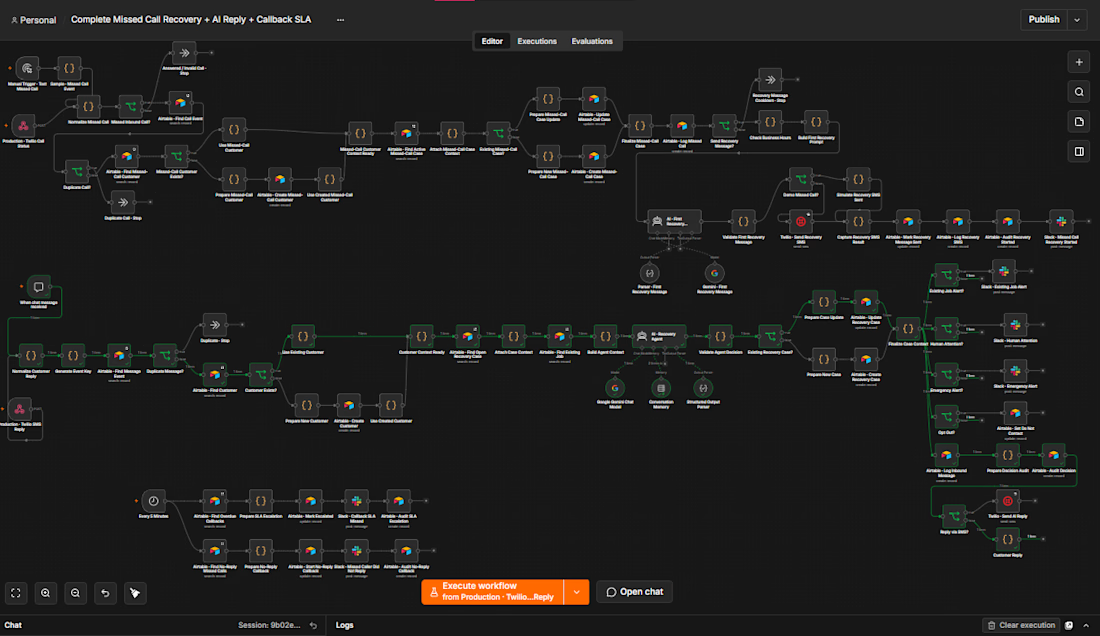

nice that it tracks the callback until someone actually handles it. which businesses is this built for, trades or more like clinics

The 128MB buffer pool trap: Why provisioning a 64GB database server does nothing for query speed if default storage parameters remain untouched.
When database response times slow down, engineering teams often respond by throwing cloud hardware at the problem: upgrading virtual machines from 8GB to 64GB or 128GB of RAM. Yet after the upgrade and reboot, query latencies remain sluggish, disk read IOPS remain pegged at hardware maximums, and disk read latency dominates execution profiles.
The root cause is almost always an unconfigured database storage engine:
In MySQL and MariaDB, the InnoDB storage engine caches table data and secondary indexes in memory via the **InnoDB Buffer Pool**. By historical default, distributions ship with: ``innodb_buffer_pool_size = 128M``.
If you run a 64GB server with this default setting: 1. Artificial Disk Choke: The database allocates a tiny 128MB chunk of RAM for caching data pages. Even though the host has 60GB+ of free, unused memory, every query that touches more than 128MB of data must read physical pages from disk storage. 2. Constant Cache Eviction: As concurrent transactions read records, InnoDB constantly evicts dirty pages to disk to load new ones, causing massive read/write amplification on your storage volumes. 3. Wasteful Cloud Infrastructure Spend: Companies pay thousands of dollars per month for high-RAM cloud instances while their database utilizes only 1% of allocated memory.
Unlocking real in-memory performance requires deliberate, production-aligned buffer pool architecture: • Allocate 70%–80% of Host RAM: On dedicated database instances, size ``innodb_buffer_pool_size`` to consume 70% to 80% of total physical memory (e.g., 48GB–50GB on a 64GB node), reserving the remainder for OS kernel buffers, connection threads, and query sorting. • Enable Multiple Buffer Pool Instances: For buffer pools larger than 1GB, configure ``innodb_buffer_pool_instances = 8`` (or higher) to divide the cache into separate memory regions, eliminating mutex contention between concurrent CPU threads. • Dump and Restore Cache on Restart: Enable ``innodb_buffer_pool_dump_at_shutdown = ON`` and ``innodb_buffer_pool_load_at_startup = ON`` so the database automatically pre-warms its working cache upon reboot, avoiding cold-start latency spikes. • Monitor Buffer Pool Hit Rate: Track ``Innodb_buffer_pool_read_requests`` vs ``Innodb_buffer_pool_reads``; a healthy production cluster maintains a cache hit ratio exceeding 99.5%.
Turn sluggish database disks into blazing in-memory engines.
Deploy hardened, high-availability database infrastructure with our 2-week Database Clustering & Hardening Sprint on Contra: https://contra.com/s/QbN6svWo-high-availability-database-cluster-deployment-and-hardening
#Database #MariaDB #Performance #Backend #DevOps #SRE #Infrastructure


The Let's Encrypt 429 lockout: Why automatic ACME issuance in ephemeral testing environments paralyzes releases and how centralized storage prevents outages.
Modern web servers like Caddy have revolutionized HTTPS by enabling automatic, zero-configuration TLS certificate issuance through Let's Encrypt and ZeroSSL. You point a domain name to your server, start the daemon, and within seconds, production-grade TLS 1.3 certificates are provisioned and renewed automatically.
However, when engineering teams introduce automated ACME servers into dynamic CI/CD staging environments, ephemeral Kubernetes clusters, or multi-node container stacks, a catastrophic failure mode frequently occurs: **the Let's Encrypt rate limit lockout**.
1. The Ephemeral Container Trap: In ephemeral staging or testing clusters, containers spin up and tear down constantly. If certificate storage is not persistently mounted to disk, every newly spawned container requests fresh certificates from Let's Encrypt production endpoints upon startup. 2. The 5-Certificate-per-Week Ceiling: Let's Encrypt enforces strict production rate limits: a maximum of 5 duplicate certificates per exact domain per week, and 50 new certificates per registered domain per week. Once exceeded, Let's Encrypt returns HTTP 429: ``too many certificates already issued for exact set of domains``. 3. Blocked Production Deployments: The rate limit cannot be manually reset or cleared by support tickets. Your domain is locked out for an entire 7-day rolling window. If this happens to a production domain or wild-card sub-domain during a scheduled release, the deployment halts completely.
Hardened enterprise TLS architecture isolates staging environments and centralizes certificate storage: • Use the Let's Encrypt Staging Environment for Testing: Configure test environments, PR preview apps, and staging clusters to point explicitly to the ACME staging endpoint (in Caddy: ``acme_ca https://acme-staging-v02.api.letsencrypt.org/directory``). Staging endpoints enforce massively higher rate limits, allowing unlimited test deployments without consuming production quotas. • Shared Storage Backends for Clustered Ingress: In multi-node proxy deployments, never allow individual instances to request certificates independently. Configure shared storage modules (e.g., PostgreSQL, Redis, or S3 storage plugins) so that all proxy instances share a single authoritative certificate cache and distributed mutex lock. • Implement Internal Enterprise CA for Staging: For non-public internal domains and staging environments, bypass public ACME entirely. Issue certificates using an internal FreeIPA or step-ca Private PKI, eliminating third-party rate limits and external dependency risks. • Graceful Fallback Strategies: Ensure ingress proxies maintain valid fallback certificates and cache existing valid keys on disk before attempting renewal.
Eliminate TLS lockout risks and guarantee seamless, automated certificate lifecycles across all environments.
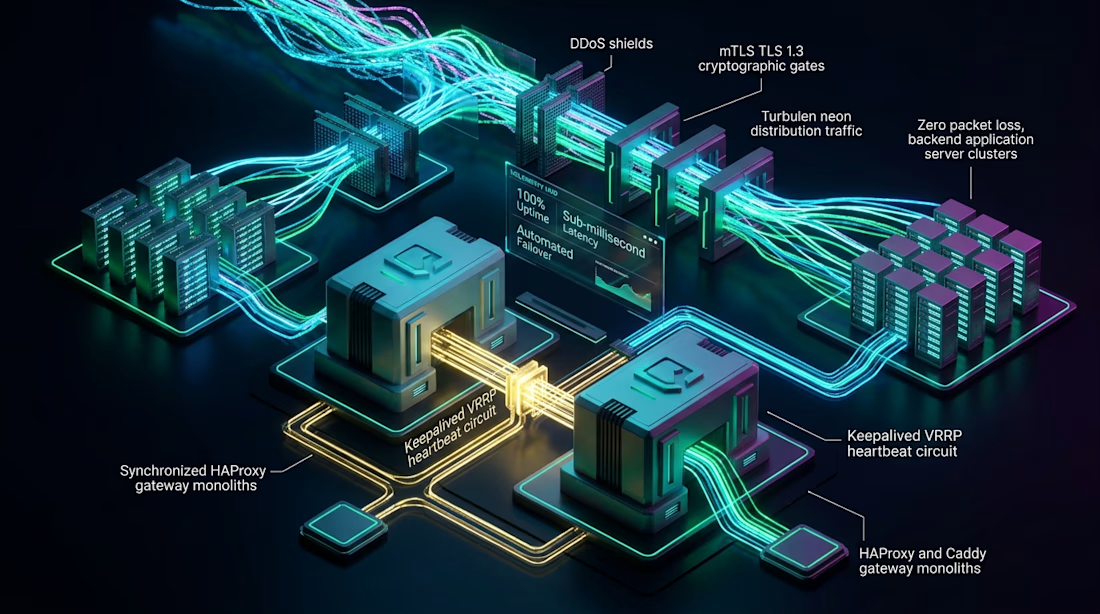
Deploy hardened, high-availability ingress with our 1-week High-Availability Ingress & Hardened Reverse Proxies Sprint on Contra: https://contra.com/s/Ec6sEAUW-high-availability-ingress-and-hardened-reverse-proxies-ha-proxy-and-caddy
#Security #Infrastructure #DevOps #Architecture #SRE #Networking #Cloud