The network for creativity
Join 1.25M professional creatives like you
Connect with clients, get discovered, and run your business 100% commission-free
Creatives on Contra have earned over $150M and we are just getting started
Back to feedPost
Built an n8n automation that recovers missed customer calls, starts an AI conversation, checks CRM context, routes urgent requests, and tracks callback SLAs until the customer is handled.


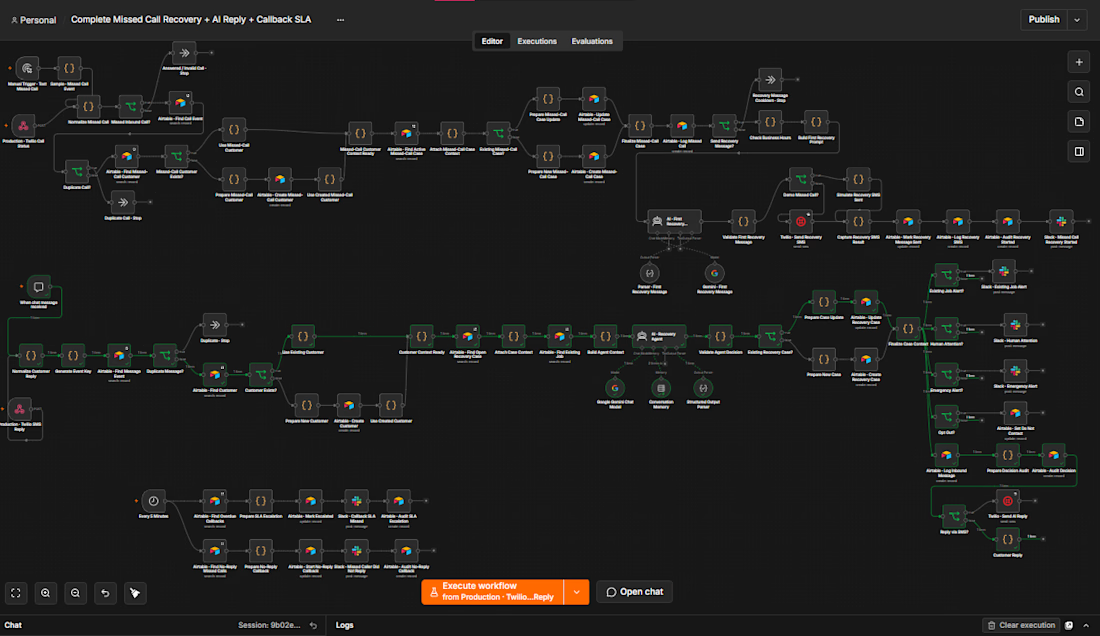

I'd record separate timestamps for 'alert sent', 'owner accepted' and 'customer reached' so a delivered Slack alert can't count as a completed callback. Which event stops the SLA timer in your workflow?

Good point. Right now the SLA stops when Callback Completed At is recorded. I agree the workflow should separate Alert Sent At, Owner Accepted At, and Customer Reached At, and only Customer Reached At should stop the SLA timer. I’ll add that distinction.

Nice build, and Kapil's point about the SLA timer is a good one. One more case I'd test: very short missed calls, like a 2-second hang-up or a wrong number. Do you filter those by ring time before the AI conversation starts, so nobody gets a follow-up they never asked for?

nice that it tracks the callback until someone actually handles it. which businesses is this built for, trades or more like clinics
I built it for HVAC agencies but it can apply for every businesses who loose their leads because of missed calls.
hvac makes sense, one missed call there can be a whole job gone. are you selling it to the agencies or straight to the hvac companies?
true, a missed call costs pretty much any trade. are you selling it to the hvac agencies yourself right now, or still lining up the first ones

One failure case I would add to the callback-SLA tests: a delayed retry arriving after a person has already reached the customer.
Test sequence: ingest the missed-call event twice, accept the callback, record Customer Reached At, then replay the older event and run the escalation...
That’s a strong test case. My current flow excludes completed records from the open-callback lookup, but I haven’t yet tested replaying an older event after Customer Reached At is recorded. I’ll add this acceptance test and recheck the latest callback state immediately before...

Pulling CRM context before the AI says anything is the right order. Otherwise the first message to a returning customer sounds like it's meeting them for the first time.

Tracking it until the customer is handled is the part most missed-call tools skip — they fire a text and call it recovered. Checking CRM context before the AI speaks matters too, especially for HVAC, where a repeat customer with an open job shouldn't get a generic first-touch...
It’s a mix of all three. Safety keywords get the highest priority, CRM status prevents duplicate or generic replies, and time of day changes the response time. AI suggests the urgency, but fixed rules make the final routing decision.
The network for creativity
Join 1.25M professional creatives like you
Connect with clients, get discovered, and run your business 100% commission-free
Creatives on Contra have earned over $150M and we are just getting started





Related posts

What if your finance dashboard caught the money you paid twice? 👀
This is Plug, a product I designed and built.
It scans every vendor payment, flags duplicates and overpayments, and shows exactly why: same invoice, same amount, paid 2 days apart. One click starts the recovery, with approvals and an audit trail.
The design rule I followed: never let AI act without showing its evidence first.
Would you trust an AI to flag your payments? 👇


Showing why it was flagged is smart.

AI WhatsApp Support Assistant, Part 1 (n8n Demo)
Problem: Replying to every WhatsApp message takes time, and urgent messages get lost.
Solution: A full WhatsApp support automation built in n8n. It drafts replies using the business's own information, and the owner approves each reply by email. Nothing is sent without approval.
This video covers text messages:
AI-drafted replies, approved by the owner
Leads saved automatically to Google Sheets
Orders saved with "needs team confirmation" status
Every conversation logged
Instant Discord alerts for complaints and requests for a human
Coming next: how the same assistant handles non-text messages like images and voice messages, and the end-of-day summary.
Tools: n8n, WhatsApp Business Cloud API, Gemini AI, Gmail, Google Sheets, Discord.
Outcome: A working demo built with demo data.
Role: Nisbah Iqbal, AI Automation Builder


Owner approving every reply is a good way to start. Once they trust the drafts they can loosen it up for the simple ones

NEXUS is an AI-powered knowledge and workflow assistant that combines intelligent information retrieval, contextual AI assistance, and workflow automation into