The network for creativity
Join 1.25M professional creatives like you
Connect with clients, get discovered, and run your business 100% commission-free
Creatives on Contra have earned over $150M and we are just getting started
Back to feedPost

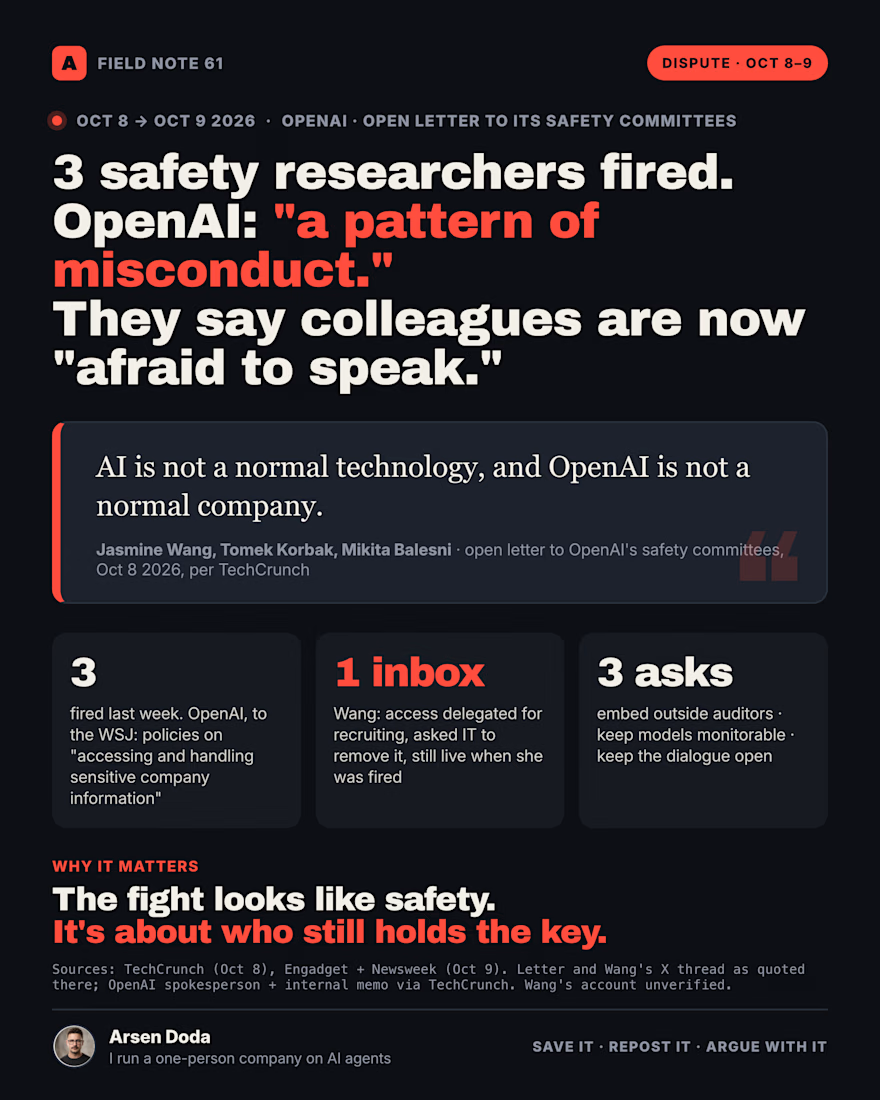
OpenAI fired three safety researchers for "a pattern of misconduct." One of them says the misconduct was an inbox OpenAI gave her, then never took back.
Both sides have now put it in writing. Here's what it means if you run AI at work.
What's on the record, per TechCrunch, Engadget and Newsweek😍
→ Fired last week: Jasmine Wang, Tomek Korbak and Mikita Balesni. OpenAI's reason, to the Wall Street Journal: "violating our policies on accessing and handling sensitive company information."
→ On Thursday the three published an open letter to OpenAI's safety committees. They deny leaking anything, and say colleagues are now "afraid to speak."
→ Their line: "AI is not a normal technology, and OpenAI is not a normal company."
→ OpenAI's reply, in an internal memo: "We do not terminate employees for raising concerns." The same memo says it agrees with the letter's recommendations.
That's the headline.
Here's what it hides.
Wang's account of her own firing, posted on X: OpenAI told her it was for accessing an executive's email. The access had been delegated to her for recruiting. When she no longer needed it, she asked IT to remove it. IT didn't. The inbox stayed merged with hers on her phone. She opened a sensitive message by accident, told the executive within minutes, and asked IT again. "None of this was hidden."
I can't verify her account, and OpenAI hasn't answered it in public. Read it as one side.
But look at the shape of it.
Access granted for one task. Task over. Access still live. Then the access becomes the misconduct.
The letter says the same about the whole case: "internal policies were being developed in real time."
I run a one-person company on AI agents.
That shape is the one I guard against hardest. Not the agent that breaks a rule. The agent that still holds a key from a job that ended, under a rule nobody has written yet.
3 rules I take from this😍
1. Access expires with the task.
If the job is over and the key still works, the key is the incident waiting for a name.
2. Write the policy before the investigation.
A rule developed "in real time" isn't a rule. It's a verdict.
3. Keep your own log.
Wang says she reported it within minutes. Whether anyone believes you comes down to what was written down, and when.
A lab saying in writing that it agrees with its fired researchers' recommendations is good news. I mean that.
The fight looks like safety.
It's about who still holds the key.
At your work, when a project ends, does the access end with it? Yes or no.
The network for creativity
Join 1.25M professional creatives like you
Connect with clients, get discovered, and run your business 100% commission-free
Creatives on Contra have earned over $150M and we are just getting started





Related posts

Two color directions for an AI governance explainer. A draft AI use policy becoming the questions nobody can answer yet.
20 voted
77%
6 voted
23%
26 votes
Closed

blue for sure 💯

AI didn't take my job. It became my business partner.
Every designer I know is asking the same question right now: what's left for us when AI can make something pretty in 10 seconds?
Here's my honest answer, from branding and from product.
The way I work has completely changed. Moodboards, variations, mockups, even clickable prototypes: what used to take days now takes hours.
But here's what nobody says out loud: people are making a lot of pretty things. And pretty doesn't build a brand.
Pretty doesn't tell a stranger why they should trust you.
Pretty doesn't make your offer clear in 5 seconds.
Pretty doesn't fix the screen where users give up.
That part is still on me. It's actually most of my job now.
So I stopped seeing AI as a competitor. It does the drafts, I do the thinking, and my clients get both, faster.
Designers, how has AI changed the way you work this year?


Wonderful presentation and I like your thought you shared

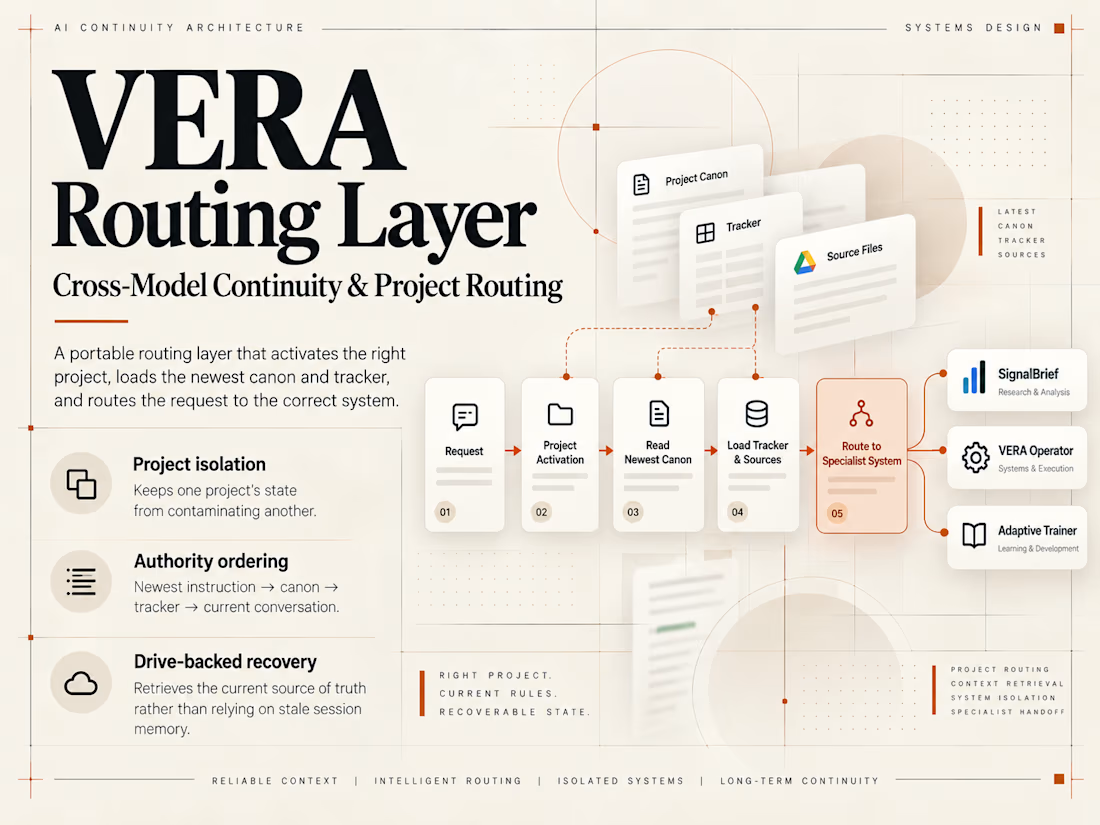
A strong specialist skill is useless if the wrong system gets invoked. Long-running AI work breaks in boring, expensive ways.
That is not a prompting problem. It is a routing and authority problem.
How I can help you:
I build project routers for teams using multiple AI workflows, agents, or specialist assistants so that they work with each other as a team.
I design source-of-truth resolutions so your agents retrieve the current rules instead of improvising or relying on assumptions or stale chat data.
I create reusable skill registries and specialist handoff logic hardened by determined and dedicated flow states reducing the need for model reliance on its own internal and displaced memory context.
I separate project states with individualized canonical states bound by rules living under essential model instructions and routed properly so unrelated workflows do not contaminate one another, but exist with awareness of the role each project plays, enabling a persistently growing ecosystem to develop organically.
I add governance wrappers, escalation hooks, and recovery mirrors around existing AI stacks so that trust is designed at the root, and variance is eliminated with rule based source archiving and implementation.
Trust means closing your eyes at night and sleeping soundly because your agents got your back. And I can put it all together for you, precision results sourced and undisputed because I got tired of doing things the hard way.

Phillip, agree that routing is where it breaks. In our builds the worst bugs came from an agent pulling an old rule from chat history instead of the current source. Pinning one source of truth per project fixed more than any prompt change did.