The network for creativity
Join 1.25M professional creatives like you
Connect with clients, get discovered, and run your business 100% commission-free
Creatives on Contra have earned over $150M and we are just getting started
Back to feedPost

🌱 WHY DOES THIS PLANT CLOSE ITS LEAVES WHEN YOU TOUCH IT?
Meet Mimosa pudica, commonly called the sensitive plant or touch-me-not plant.
It looks like an ordinary plant—until you touch it. Then something fascinating happens: its leaflets quickly fold inward and droop.
But is the plant feeling pain? No.
Here’s what is happening:
1️⃣ TOUCH IS DETECTED
When the plant is touched, the stimulus is detected by specialized cells.
2️⃣ A SIGNAL TRAVELS THROUGH THE PLANT
The touch triggers an electrical signal that moves through the plant.
3️⃣ WATER MOVES OUT OF SPECIALIZED CELLS
The signal reaches a structure called the pulvinus, located at the base of the leaflets. Ions move, causing water to leave certain cells.
4️⃣ THE CELLS LOSE TURGOR PRESSURE
As the cells lose water, they become less firm.
5️⃣ THE LEAVES FOLD
The change in pressure causes the leaflets to close and the leaf to droop.
🌿 But why does it do this?
Scientists believe this rapid movement can help the plant respond to threats such as herbivores. The sudden movement may make the plant less attractive or harder to eat.
The movement is called thigmonasty—a plant movement triggered by touch.
✨ The amazing part?
A plant doesn't have a brain or nervous system like humans, yet it can detect a physical stimulus and respond remarkably quickly.
Nature doesn't always need a brain to be fascinating. 🌱
The network for creativity
Join 1.25M professional creatives like you
Connect with clients, get discovered, and run your business 100% commission-free
Creatives on Contra have earned over $150M and we are just getting started

Challenges
View all


Related posts


Why does a dashboard full of numbers still feel calm?
Bento grids are everywhere, and done right it's not a trend, it's information design. Each cell = one number, one meaning. The grid does the hierarchy for you.
Our three rules for a bento that works:
One idea per cell. Progress, glucose, one task. If a card needs two sentences, it needs two cards.
Mix the scale. One hero cell, a few mediums, one tiny stat, same gap everywhere.
One warm cell. A single card runs warm against the cool, dark screen; it carries the eye, and the rest stay quiet. No neon needed. Grids are calm. Content is loud. That's the whole trick.


Love the three rules. How do you handle this grid when it collapses to mobile without losing the hierarchy?

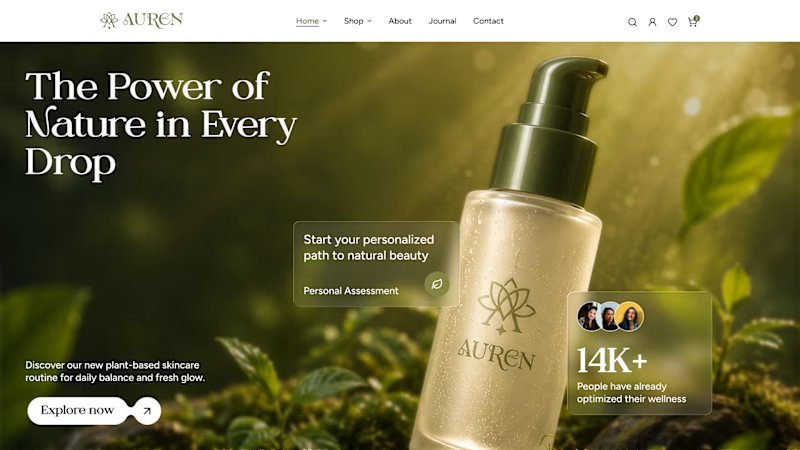
Same skincare brand. Two completely different moods. 👀
If you land as the customer, which direction would you trust more?
① Soft Editorial
Clean, luminous & beauty-led
② Botanical Luxury
Dark, immersive & ingredient-led
0 voted
0%

2 voted
100%
2 votes
Closed

How do you turn a sense into a symbol?
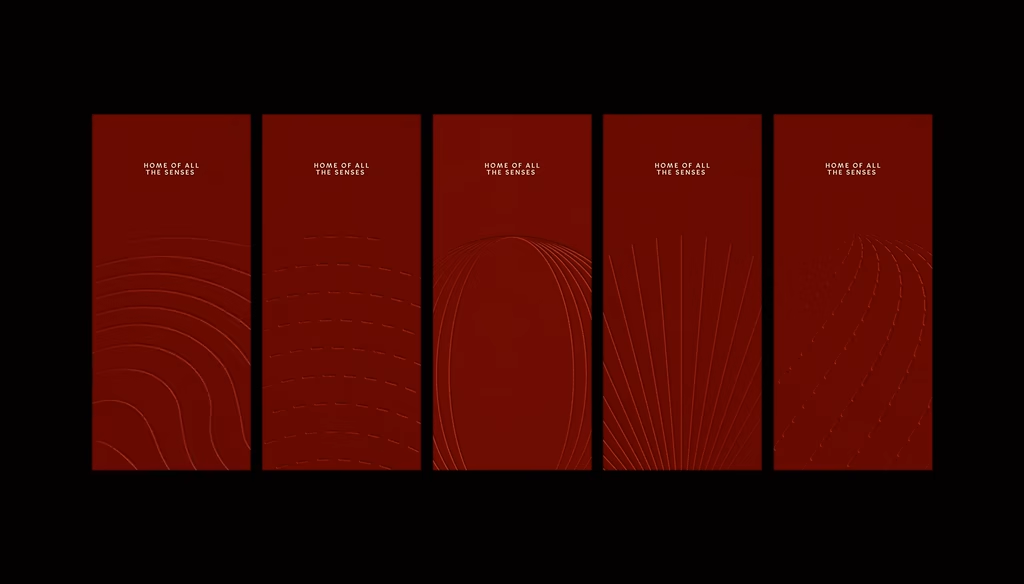
Sensorium is a luxury wellness brand from Dubai built around the connection between the senses, the body and emotional wellbeing.
For this project, I created a visual language around the five senses, with a unique symbol for each one. Each symbol is built within the same circular structure, giving the elements shared proportions and a cohesive relationship, while keeping enough movement to work across different scales, textures and applications.
How important is visual cohesion to you when building or evaluating a brand system, and how do you approach it?

This is a beautiful way to turn an abstract sense into a system—the shared geometry makes the five symbols feel related without flattening their individual character. The balance between repetition and movement should give the identity a lot of range across touchpoints.