The network for creativity
Join 1.25M professional creatives like you
Connect with clients, get discovered, and run your business 100% commission-free
Creatives on Contra have earned over $150M and we are just getting started
Back to feedPost

A few months ago I shipped my first production RAG pipeline. Simple idea: upload a document, ask questions, get answers with citations.
The part nobody warns you about is everything after "it works on my laptop." ChromaDB breaking on cloud deployment. Secrets formatting silently failing. API timeouts I had to tune by hand.
That gap between a working demo and a deployed system is where most of the actual engineering happens. It's also the part most tutorials skip entirely.
Since then I've built an AI-powered browser extension that automates form-filling inside an enterprise ERP system, and I'm currently building an AI equity research tool for Pakistan Stock Exchange companies using LangGraph.
I'm an AI Engineering student, and I'm now taking on freelance work in RAG systems, LLM integrations, and AI automation. If you're building something in this space, or know someone who is, I'd love to talk.
The network for creativity
Join 1.25M professional creatives like you
Connect with clients, get discovered, and run your business 100% commission-free
Creatives on Contra have earned over $150M and we are just getting started



Related posts

Most AI chatbots have the same problem: they can sound convincing even when they're wrong.
I wanted to build one that doesn't simply generate answers—but actually has evidence behind them.
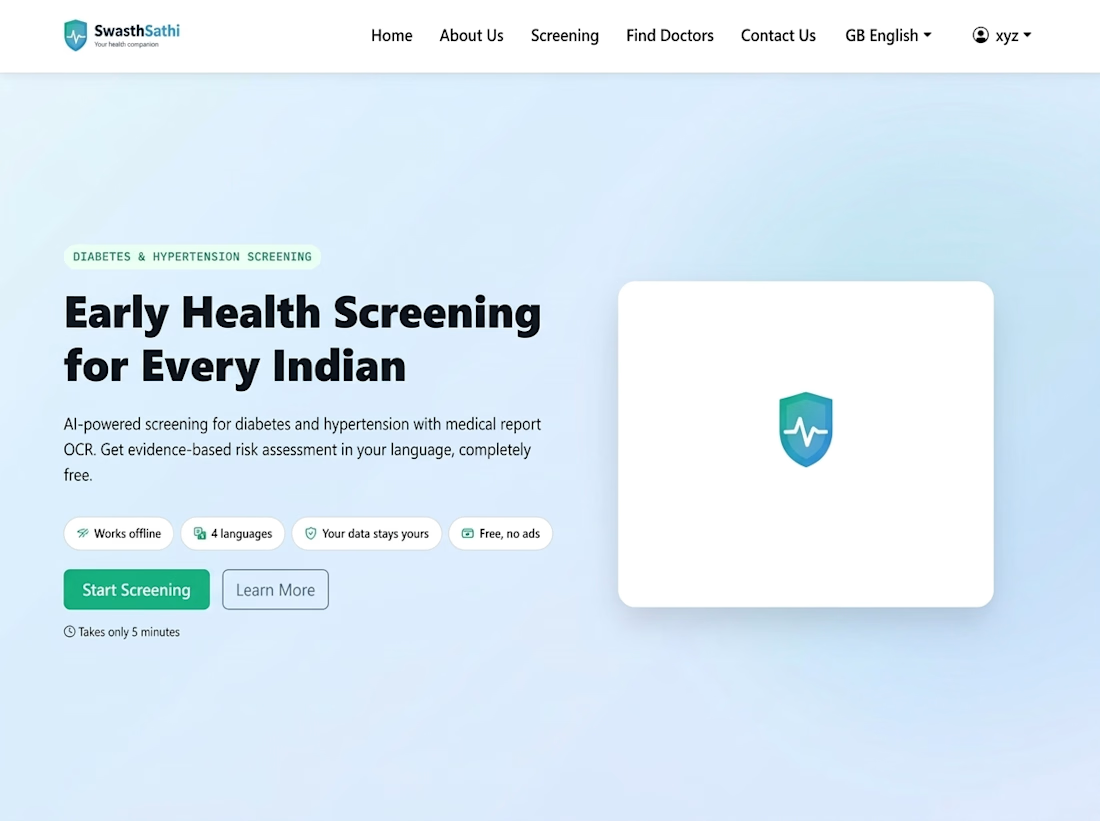
That's one of the things I worked on with SwasthSathi, a health-screening platform that received a ₹10,000 prototype development grant.
For its AI assistant, I implemented a pipeline that:
→ Extracts information from uploaded medical reports using OCR
→ Retrieves relevant medical guidelines using embeddings and pgvector
→ Generates responses grounded in retrieved information
→ Uses layered cost controls to prevent unnecessary API usage
The goal wasn't to make AI sound smarter. It was to make its answers more grounded, useful, and responsible.
And in a healthcare context, knowing when the system shouldn't confidently answer is just as important as generating a good response.
SwasthSathi provides health information and screening support—not diagnoses.
Working on this made me more interested in building AI features that solve actual problems rather than adding a chatbot just because a product can have one.
I'm now open to AI engineering projects involving:
• RAG over company documents and knowledge bases
• AI features integrated into existing web applications
• Document processing and intelligent workflows
• AI-powered MVPs and prototypes
Not every problem needs RAG, though. Sometimes a simpler solution is better. I'd rather figure that out with you before writing code.
If you're building a product that works with documents, data, or complex workflows, what would you want AI to actually do in it?
Want to see it in action?


I provide professional AI engineering, AI automation, chatbot development, and full-stack web development services.
Project Services:
Custom AI Chatbots & AI Assistants
AI-Powered Web Applications
Business Process Automation
n8n Workflow Development & Integration
Full-Stack Website Development
API Integration & Backend Development
Custom Software Solutions
My Approach:
I focus on building practical, scalable, and user-friendly solutions that help businesses automate operations, improve productivity, and grow faster.
I prioritize clean development, reliable functionality, transparent communication, and on-time delivery.
Let's turn your ideas into powerful digital solutions.
Gourav Sharma
AI Engineer | Founder | Full-Stack Developer
APEX AI


The brief asked for five test clips. I went past it on purpose.
The question: can AI reach "blue chip" quality, the gold standard of nature documentary? The clips were meant to be unconnected, 3 to 5 seconds each, each one testing a shot AI usually gets wrong.
But five loose clips only prove the pictures. "Blue chip" is also a feeling. So I gave the audience someone to follow: a weathered 19th-century explorer, on an expedition into the Maya world of 1200 AD.
Then, on my own, I made a second film in Cleopatra's Egypt.
Over the next four posts I'll show you how: the four hard shots, keeping one man the same in every frame, recasting an AI actor, and every tool I used.
Part 1 of 5. Follow for part 2: the four shots where AI video usually breaks.

impressive