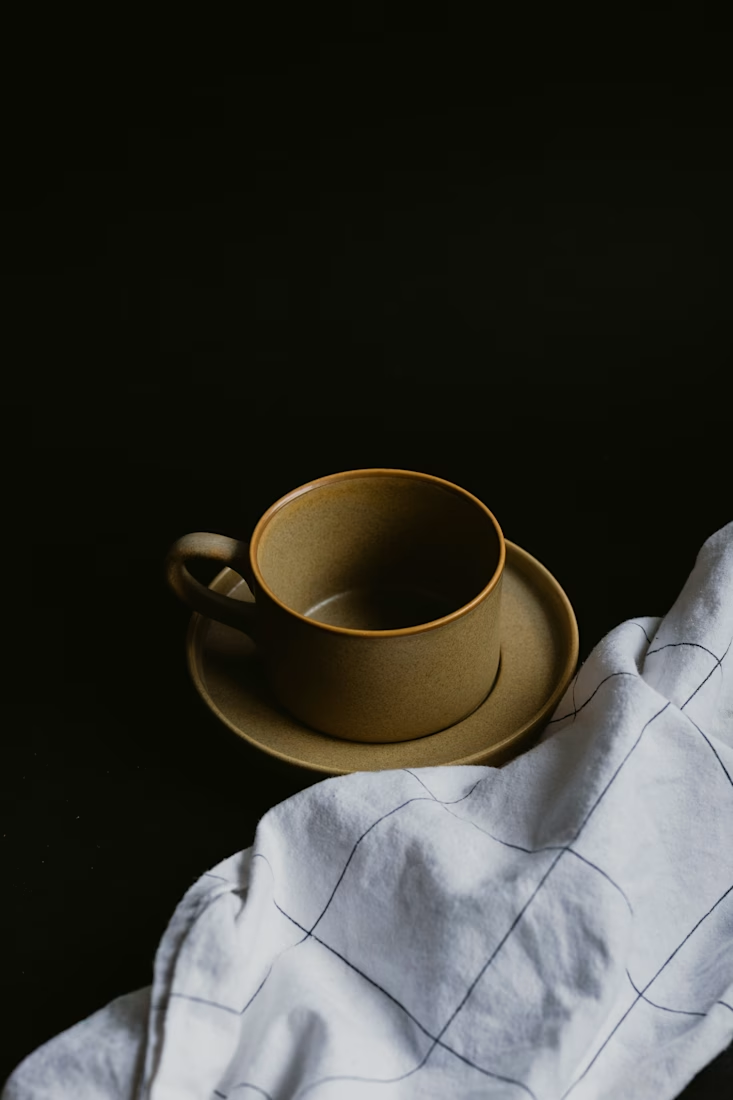
Three weeks running on fumes, pretending it was fuel.
Writing takes more than people think. Anything that asks you to pour yourself out takes more. I've been feeling every ounce of that weight. Tired. Empty. Needing to fill up.
It's shown up in my inability to write. Not because I have nothing to say. Because I've neglected the simple things that help me run well.
I've said it before: when words won't come, go for a walk. Read. Fill up so you can pour out. But what I forgot is you can't pour out if there's no energy left to pour.
The system only works as a whole.
I've mastered the part of feeding my mind—reading, observing, collecting. But rest? Still learning that. I'm still learning to retreat. Having the energy to pour out well.
It's a learning curve. Comes with time. Comes with action.
Can I call this productive procrastination? 👀
Was playing with kinetic type while working on another post and liked these too much not to share them separately.
Made in my aftrglo
No timeline. No keyframes. Free to try ✨
Your turn to play!
Nocturne is a self-initiated fragrance house I built from the ground up, treated with the same process I'd bring to any client: strategy first, then design.
The brief was familiar: a fragrance inspired by the city after dark. Most fragrance branding solves that with common approaches such as moonlight, mystery, or gold foil details. I wanted to solve it with something more specific: what does after dark actually look like in an urban environment? Concrete, streetlight, wet pavement, the quiet stretch between one train and the next.
That question shaped everything downstream. An archetype chosen deliberately against category convention, Creator and Explorer rather than the more expected Lover or Magician. A material-first approach to the bottle and packaging. Sandblasted glass, a textured concrete-like cap, no gold, no ornament. And a running checklist I held every decision against throughout the project.
The case study covers the strategy behind Nocturne, not just the finished system: positioning, personality, the reasoning behind each material and typography choice, and how those decisions translated into the bottle, packaging, and campaign work.
I'd love to hear what you think, especially if you enjoy seeing the thinking behind a visual identity as much as the final result.
Have you ever wondered why some writers can write incredible pieces of text while others can barely form a string of words?
It has nothing to do with inner talent. While some people may be gifted with the ability to write fascinating prose, many great writers have built their writing careers on something else.
Is it hard work? In a broader sense, yes. However, once you understand this secret, your writing will improve overnight.
Edit Your Own Work
Write the piece and let it set still for one day. After that, open it and read it out loud. Some parts won't sound the way you wanted them to sound. That's okay, because you have a skill that will improve any piece of writing instantly.
I am talking, of course, about editing.
You see, most writers don't just sit at a chair, open a laptop, and start typing. No, for every great article you stumble upon on the internet, a person has written and rewritten that very piece.
Editing is what makes writing great, and if you take it seriously, it will help you deliver better work.
Do This Right
After you finish writing an article, set it aside for one day. Now, what you need to do is start editing it. But how?
Here are a couple of my methods of working on a piece of text.
1. Cut the unnecessary words from your text.
2. Choose concrete & precise language.
3. Prefer the active voice.
4. Shorten your sentences, and remove repeated words.
5. Start each paragraph with the most important information.
6. Read your work out loud.
These are the minimum requirements for good editing. Do this, and your writing will improve constantly.