The network for creativity
Join 1.25M professional creatives like you
Connect with clients, get discovered, and run your business 100% commission-free
Creatives on Contra have earned over $150M and we are just getting started
Back to feedPost

Building Tether — From Noisy Telemetry to Deterministic Operations
Role: Lead Architect & Full-Stack Developer
Tech Stack: React, Cloudflare (Pages, Workers, R2, Zero Trust), Google Cloud Platform (Cloud Run, Cloud Storage), Python, FastAPI, Scikit-Learn.
The Challenge: The Hospitality Data Gap
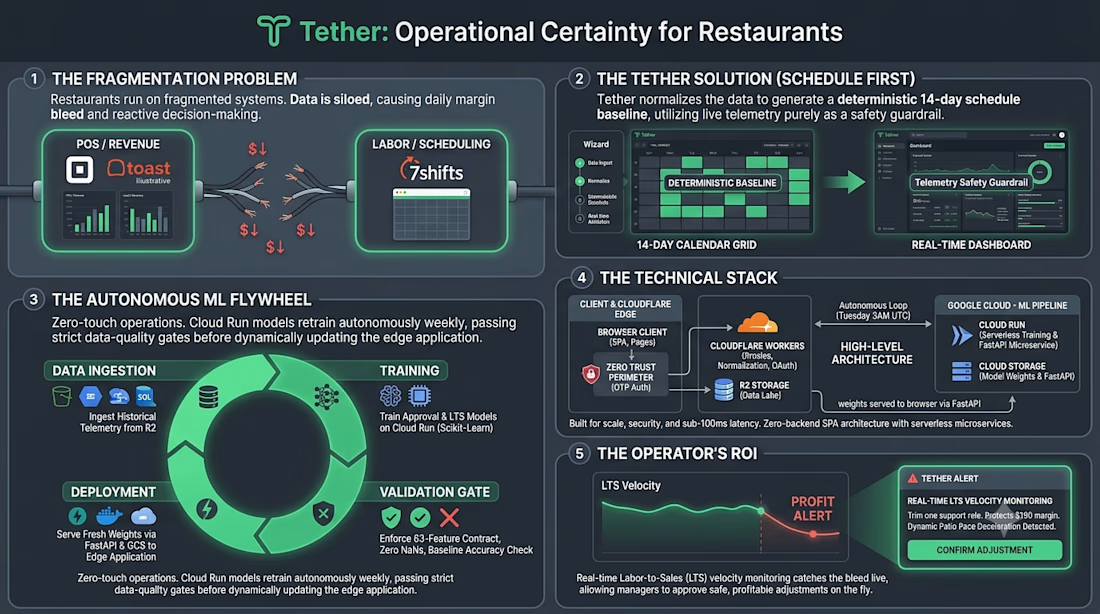
Modern hospitality operators are drowning in data but starving for actionable intelligence. A restaurant's two most critical systems—the Point of Sale (revenue) and the scheduling platform (labor)—operate in complete isolation. Because these systems do not dynamically communicate, managers are forced to make high-stakes labor cuts on the fly based on delayed reporting and gut feeling.
This disconnect results in thousands of dollars of weekly margin bleed. The challenge was clear: build a system that bridges these fragmented APIs, normalizes the data, and provides real-time operational certainty.
The Solution & The Product Pivot
I engineered Tether to be an AI-native operational layer for restaurant management. However, the true breakthrough of this project wasn't just technical—it was architectural.
Initially, I designed Tether as a "Live Data Prediction Tool" that used active telemetry to drive real-time floor decisions. Through testing and auditing the data streams, I identified a critical UX flaw: live data is inherently noisy and reactive. To solve this, I executed a complete priority inversion, refactoring the application state to a "Schedule-First" philosophy.
Instead of chasing live data, Tether now ingests historical data to generate a deterministic, highly optimized 14-day schedule baseline. The machine learning models were strategically demoted from "decision makers" to "real-time guardrails." Once the floor opens, Tether acts as a safety net, validating execution against the baseline and alerting managers to profit leaks before they compound.
Technical Execution: A Masterclass in Edge ML
To ensure security, scale, and sub-100ms latency, I architected Tether as a zero-backend Single Page Application (SPA) driven by serverless microservices.
Edge Infrastructure & Security: The frontend is deployed via Cloudflare Pages and secured behind a Cloudflare Zero Trust perimeter, requiring One-Time PIN (OTP) authentication for operator access.
Data Normalization: I developed Cloudflare Worker proxies to securely handle OAuth handshakes, ingest data from POS systems (Square, Toast) and labor platforms (7shifts), and normalize the varied streams into a unified, sanitized client schema.
Autonomous ML Pipeline: I engineered a fully autonomous, serverless retraining loop hosted on Google Cloud Run. Every Tuesday at 3:00 AM UTC, the pipeline wakes up, pulls historical telemetry from Cloudflare R2, and retrains the primary Approval and Labor-to-Sales (LTS) models (using Ridge and Logistic Regression).
Strict Data Contracts: The ML pipeline strictly enforces a 63-feature data contract. It validates baseline accuracy and ensures zero NaNs before allowing any model to pass into production, guaranteeing operational stability.
Highly Optimized Model Distribution: Fresh model weights are served to the browser via a Dockerized FastAPI microservice (kept aggressively lean at ~500MB) and distributed globally through Google Cloud Storage (GCS).
The Business Impact
Tether replaces the anxiety of restaurant management with mathematical certainty.
By automating the schedule generation and monitoring real-time Labor-to-Sales (LTS) velocity, Tether catches margin bleed live—such as a sudden drop in patio sales pace due to weather. It translates complex ML predictions into simple, actionable alerts (e.g., "Trim one support role. Protects $190 margin.").
The result is protected daily profit margins, guaranteed labor compliance, and management teams empowered to run their floors with absolute confidence.


The network for creativity
Join 1.25M professional creatives like you
Connect with clients, get discovered, and run your business 100% commission-free
Creatives on Contra have earned over $150M and we are just getting started

Challenges
View all


Related posts

Agent products resist normal product marketing. There's no single interface to screenshot and the category vocabulary has gone generic, so a feature list communicates almost nothing.
We built Heron's explanation as a four-beat scroll that runs the agent's actual loop. The model appears and is watched. Violations surface with plain language and a real IBC clause. An edit is applied after approval. The system learns the firm's standards.
Pacing was the main design problem. Each beat needed enough scroll distance to register as a separate action, without the section becoming so long that people bail before the payoff. The sequence carries the technical detail that would otherwise sit in a spec table.


The four-beat scroll is a smart way to make the agent’s loop feel tangible—much clearer than a static feature list. The restrained visual system gives the interaction room to breathe.


First contract on Contra finished!


How was it?


Digital: Full-Stack Engineering and Product Design Showcase
I created Digital as an integrated portfolio and engineering hub built to showcase modern software development, intelligent systems, and end-to-end product craft. Rather than separating visual design from code execution, I designed the platform to highlight the intersection of both: building scalable full-stack web applications, architecting responsive UI systems, and deploying production-grade AI solutions that drive real results.
The visual direction centers on a deep, cinematic dark aesthetic accented by clean glowing highlights and refined glassmorphic surfaces. This palette keeps technical information comfortable to scan while establishing a sharp, developer-first identity. Balanced typography, crisp borders, and generous breathing room ensure that code architectures, project metrics, and visual interfaces maintain an effortless visual hierarchy.
The hero experience sets an immediate standard of technical authority. It articulates a clear vision around full-stack development, agentic workflows, and intuitive product design. Direct calls to action invite collaborators, founders, and engineering teams to explore live builds, review technical stacks, and initiate new product partnerships without unnecessary friction.
The core capability breakdown organizes engineering disciplines into structured, high-value modules. It highlights competencies across scalable web apps, modern front-end frameworks, robust backend API architecture, and intelligent automation pipelines. Each area emphasizes clean code, speed, and real-world business impact over surface-level buzzwords.
The featured projects section walks through complete digital experiences from concept to deployment. Visitors can inspect live application interfaces, explore design system implementations, and review how complex technical requirements are translated into simple, elegant user journeys.
Across every section, I focused on layout balance, modern scannability, and high-performance craft. The final result is a portfolio platform that feels forward-thinking, polished, and engineered to prove technical capability through clean execution.


Good Work!!!!