The network for creativity
Join 1.25M professional creatives like you
Connect with clients, get discovered, and run your business 100% commission-free
Creatives on Contra have earned over $150M and we are just getting started
Back to feedPost
This is my submission for the Flowstep Challenge. I built a multi-page digital archive that treats painting styles as a practical design reference rather than just art history. The project is organized as a cohesive system with multiple screens and clear entry points through Gallery, Movements, Palettes, About, Artists, and Search. It is still a working draft that will continue to evolve, but even at this stage it already shows how artistic movements can be turned into a useful design tool.
I used Flowstep not as a random prompt generator, but as part of a more complete design-engineering workflow. From the start, I worked with a defined structure across four input files — icp.md, sitemap.md, content-plan.md, and design.md (pinned as the design guidelines) — so the system, not a single mockup, was the starting point.
To speed up the process, I also connected Claude via MCP. This is where I made a mistake: Flowstep gives clear recommendations on when to generate a single screen versus a full multi-screen flow (6 screens), and I didn't pass those recommendations to the agent. As a result, it generated 45 pages, with several duplicating each other because the multi-page guidelines weren't included from the start. It was a useful lesson: even with a defined structure, the agent still needs the platform's own generation rules spelled out explicitly, or the output drifts.
The next challenge was the imagery. On some pages, placeholder images still needed to be replaced with real visuals, and it became clear that this was better handled in code rather than through another round of generation. I took the code from the already-built version, swapped the placeholders for the selected real images directly in the code, redeployed, cleaned up anything unnecessary, and brought the finished pages back into Flowstep for comparison.
The result is a live archive site, not static mockups — a multi-page system with a complex structure, but all within one consistent style and one coherent language. It is not yet a 100% finished final solution, but it is a strong and fast starting point for further work. What mattered most to me in this process was testing not only the visual side, but the full product-thinking approach: structure, logic, error correction, and final assembly.
Final prototype: https://painting-movements-archive.pages.dev
Walkthrough video:

fascinating 😍 Incredible work and best of luck in the challenge! 🚀

Thank you so much, really appreciate it! 🙏Planning to finish it right after the contest😊
The network for creativity
Join 1.25M professional creatives like you
Connect with clients, get discovered, and run your business 100% commission-free
Creatives on Contra have earned over $150M and we are just getting started





Related posts

🚀 Weekend challenge:
1. Go look at some templates and demos at no-code.supply
2. Tell me what looks like "ai slop" and why
One rule: don't say "looks generic"
The best argument gets the All-Access pass for free.
no-code.supply
no-code.supply — code templates for no-code builders
HTML and React templates built for no-code and low-code builders: two editions, AI-ready docs, no third-party requests.

This is so true! Even in 3D product animation, I always start with rough sketches on paper before jumping into Blender.
It saves hours of rework and the ideas flow more human. AI can't replace that feeling.
Great process Filip!

Is sketching part of your creative workflow or we've forgotten what it feels to be human?
Depending on the projec's scope, I normally like to explore my ideas on paper before I come up with the best solution.
And no, they're not perfect.
They are rough and messy, my goal is so...


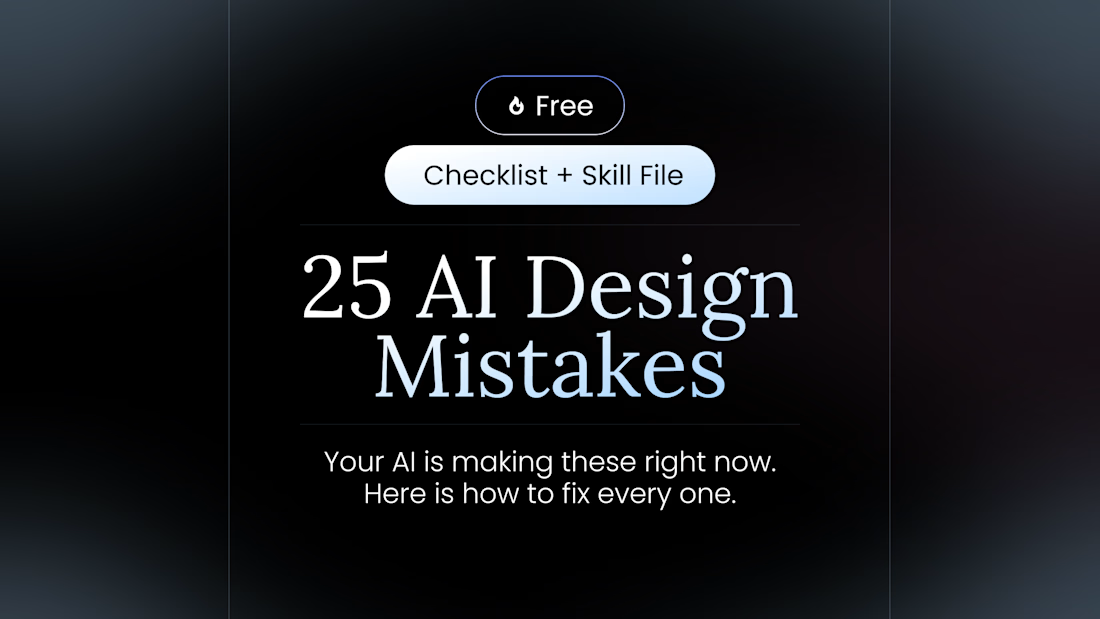
100+ people already use my free skill file to stop their AI from making the same 25 design mistakes.
Drop it into your project and your agent gets better at typography, spacing, color, and dark mode. Link in the comments.