
Bright Jasper
Content writer | SEO specialist | Technical writer
- 1
- Followers

Why B2B SaaS Landing Pages Lose High-Intent Technical Buyers
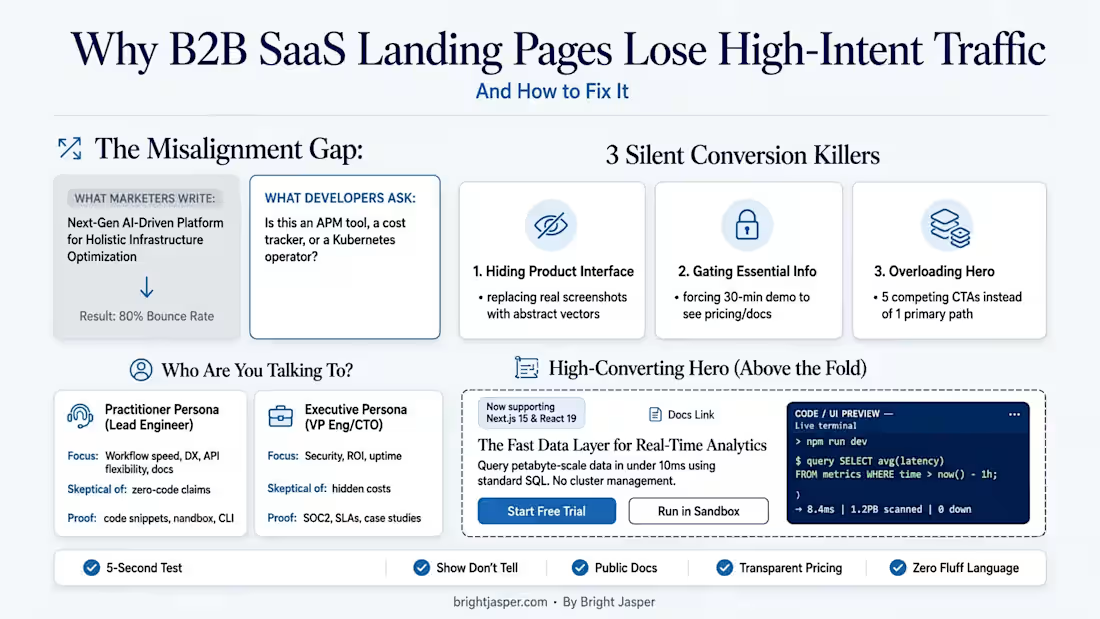
When a developer, engineering manager, or technical lead lands on your website, they aren't looking for corporate buzzwords like "Empower your enterprise synergies."
They want answers to three basic questions in under 10 seconds:
1. What does this tool actually do?
2. How does it integrate into my stack?
3. How much does it cost?
If your landing page hides these answers behind vague marketing speak, abstract graphics, or a "Book a Demo" button, you are bleeding high-intent traffic.
The Three Silent Conversion Killers
- Hiding the Product UI: Replacing real code snippets or product dashboards with abstract vector illustrations.
- Gating Essential Info: Forcing engineers into a 30-minute sales call just to view basic pricing tiers or documentation.
- Jargon Overload: Using phrases like "Next-Gen AI-Driven Platform" instead of stating the actual mechanism (e.g., "Query petabyte-scale data in under 10ms using standard SQL").
Practitioner vs. Executive Positioning
High-converting technical landing pages address both personas simultaneously:
Practitioners (Engineers/Architects): Want workflow speed, clean developer experience (DX), explicit CLI/API capabilities, and interactive code blocks.
Executive Buyers (CTOs/VPs): Want security compliance (SOC2), cost predictability, uptime SLAs, and clear ROI.
Stop making technical buyers guess what your product does. Replace marketing fluff with concrete engineering facts.
🔗 Read the full landing page teardown and audit checklist on brightjasper.com (http://brightjasper.com):
Why B2B SaaS Landing Pages Lose High-Intent Traffic (And How to Fix It) (https://www.google.com/url?sa=E&source=gmail&q=https://brightjasper.com/blog/why-b2b-saas-landing-pages-lose-high-intent-traffic)
2
219
Why Your Autonomous AI Agents Keep Failing in Production
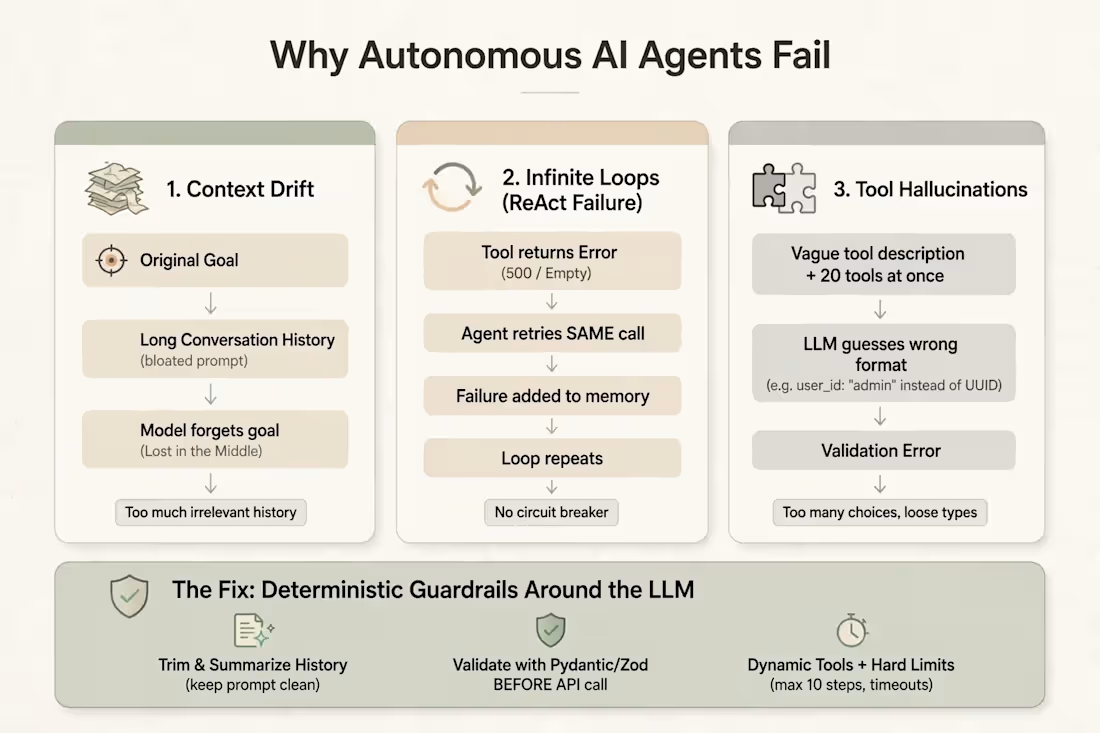
You set up a ReAct loop, wire up tool calls, and everything works during local testing. But run that same agent on a 15-step task, and it systematically degrades into invalid tool executions or infinite retries.
The core problem isn't model weakness—it's System Architecture.
Why Agents Fail
The Infinite ReAct Loop: When an external API returns an unhandled error or empty payload, the agent panics and retries the exact same action repeatedly without changing its inputs.
Context Drift: As token counts grow, LLMs suffer from attention dilution (the Lost in the Middle effect). The model prioritizes recent operational logs over core system instructions, causing it to hallucinate tool arguments.
Tool Overload & Weak Typing: Passing 20 raw API specs into a single prompt forces the model to guess argument formats.
The Reliability Fix
Building reliable agents requires wrapping probabilistic models in deterministic code guardrails:
State Compression: Summarize execution turns into a structured JSON state every $N$ steps to keep the context window clean.
Strict Schema Guardrails: Validate all LLM outputs using Pydantic or Zod before triggering actual tools.
Dynamic Tool Retrieval (Tool-RAG): Fetch and pass only the top 2–3 relevant tools needed for the immediate execution step.
🔗 Read the full engineering deep dive with state diagrams on brightjasper.com (http://brightjasper.com):
Why Do Autonomous AI Agents Fail? The Architecture Bottlenecks (https://www.google.com/url?sa=E&source=gmail&q=https://brightjasper.com/blog/why-do-autonomous-ai-agents-fail)
0
35
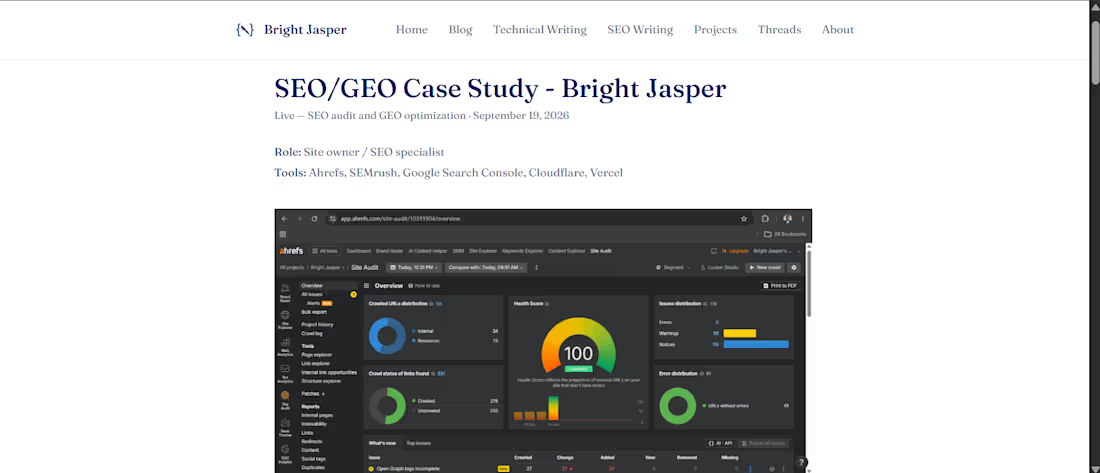
I bought a domain on 16th and it got an AI overview by 19th
1
4