
Tiffany Langellier
Expert HR Compliance, Employee Relations & Labor Law
Profile in progress
Tiffany is building their profile!


Organizational Design and Role Clarity for an Engineering Firm Preparing to Scale
The Business Problem
A California based engineering firm preparing for rapid headcount growth lacked the organizational structure to support it. Roles were informally defined, accountability overlapped across functions, and the hiring strategy was reactive rather than planned. Without structural intervention, the firm risked hiring into chaos — creating the culture and operational confusion that undermines retention and performance at scale.
✅ What I Did
Facilitated an organizational design engagement with the senior leadership team to map current structure, surface accountability gaps, and define the target state
Built Success Profiles for each critical role, defining the competencies, performance expectations, and 30/60/90-day milestones used to evaluate both candidates and new hires
Designed a structured hiring process aligned to each Success Profile, enabling more consistent, objective candidate evaluation across hiring managers
Developed a 90-day onboarding framework connecting new hires to clear expectations, key relationships, and early performance indicators from the start
Advised leadership on sequencing hires strategically — identifying which roles created the most organizational leverage and which could wait
⭐ Outcome
Leadership entered the growth phase with a clear organizational blueprint instead of building structure reactively around whoever was hired
Hiring decisions became faster and more consistent, with managers aligned on what "great" looked like for each role
Early performance issues surfaced sooner due to defined 90-day milestones, enabling faster intervention
The firm built a repeatable talent infrastructure capable of supporting growth from 50 to 150+ employees without structural rebuilds
Scope
Industry: Engineering
Location: Multi-state
Company Size: 40–80 employees
Focus: Growth-stage organizational design with hiring strategy integration
© The HR Department | Strategic HR Consulting
1
13

Workplace Investigation That Preserved Leadership Credibility and Organizational Trust
The Business Problem
A healthcare organization received a formal complaint alleging management misconduct that, if mishandled, could have escalated into an agency charge, civil litigation, and significant reputational damage. The internal team lacked the investigative experience to conduct a defensible inquiry, and any perception of bias — in either direction — would undermine the outcome. Leadership needed an independent, structured process they could stand behind.
✅ What I Did
Assumed full investigative authority, conducting structured witness interviews with consistent, legally sound questioning frameworks
Built a comprehensive investigation timeline documenting all relevant events, communications, and witness accounts in chronological sequence
Analyzed conflicting witness statements, identified corroborating evidence, and assessed credibility using a structured, documented methodology
Delivered a written findings report that provided leadership with clear, factual conclusions and actionable recommendations — without crossing into legal advice
Advised leadership on remediation options, escalation thresholds, and how to communicate outcomes to involved parties in a way that was compliant, transparent, and legally protective
⭐ Outcome
Leadership received an independent, defensible investigative record that demonstrated procedural integrity
The findings report provided a clear path forward, removing ambiguity and enabling a confident leadership decision
The organization avoided both the appearance and the reality of a biased or retaliatory process
Documentation was structured to withstand DFEH/EEOC scrutiny and civil discovery if the matter escalated
Scope
Industry: Healthcare
Location: North Carolina
Company Size: 50–150 employees
Focus: Single-complaint investigation with multi-party witness management
© The HR Department | Strategic HR Consulting
1
14

Building HR Infrastructure for a Scaling Professional Services Firm
Description:
A fast-growing professional services firm had scaled to 40+ employees without a single formalized HR process. Onboarding was inconsistent, policies were communicated verbally, and there was no framework for performance management, role clarity, or employee documentation. Leadership recognized that continued growth without infrastructure would create compounding operational and legal risk.
✅ What I Did:
Assessed the full HR lifecycle — from hiring through offboarding — to identify structural gaps and prioritize by risk and business impact
Designed and deployed a complete HR infrastructure: employee handbook, onboarding workflow, offer letter templates, job description framework, and separation checklist
Built role-specific Success Profiles that defined performance expectations, competencies, and 90-day milestones for the firm's core positions
Created a structured onboarding program that aligned new hires to expectations from day one and reduced the time it took managers to identify performance concerns
Advised the leadership team on documentation practices, ensuring that management decisions were recorded in a consistent, legally sound format
⭐ Outcome:
Transformed an ad hoc, personality-dependent people operation into a structured, repeatable system
Reduced new hire ramp time and early turnover by setting clear expectations before Day 1
Leadership reported immediate gains in management confidence and consistency across locations
The organization was positioned to scale through 100+ employees without rebuilding HR processes from scratch
Scope: Professional services firm, 40–80 employees, multi-functional workforce, growth-stage scaling focus
1
25
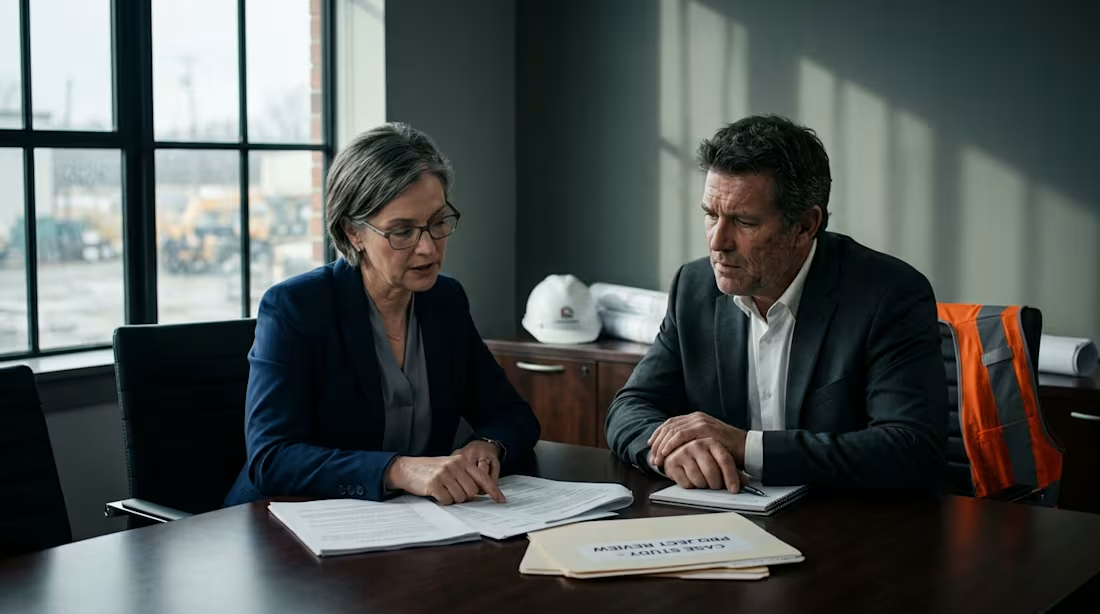
High-Risk Termination Strategy That Protected a Construction Firm From Litigation
Description:
A mid-sized construction company needed to separate a long-tenured employee who had filed an internal complaint weeks prior. The timing created significant retaliation risk, and the leadership team — lacking HR infrastructure — was prepared to proceed in a way that would have been indefensible. The potential exposure included wrongful termination and retaliation claims in a jurisdiction with aggressive plaintiff-side employment law.
✅ What I Did:
Stepped in as a strategic advisor before any action was taken, conducting a rapid risk assessment of the separation's timing, documentation trail, and legal exposure
Worked with leadership to reconstruct and strengthen the performance documentation record, ensuring the business rationale was clear, consistent, and predated the complaint
Designed the separation process from the ground up — scripting the conversation, structuring the final documentation package, and advising on severance strategy
Guided leadership on what to say, what not to say, and how to respond if the employee escalated to an agency or attorney
Established a post-separation communication protocol for the team to prevent retaliation claims from extending beyond the individual
⭐ Outcome:
The separation was executed cleanly, with no subsequent legal action or agency complaint
Leadership moved from reactive and exposed to confident and prepared within 72 hours
The organization emerged with a documented, defensible termination process they could apply to future separations
Retaliation risk was neutralized through deliberate process design rather than avoidance
Scope: California-based construction firm, 75–200 employees, single high-risk separation with litigation prevention focus
1
26

California Compliance Overhaul for a Multi-Site Healthcare Organization.
A growing healthcare organization operating across California had never undergone a formal HR compliance review. Their employee handbook was outdated by several years, lacked required California-specific provisions, and reflected policies that created direct wage-and-hour exposure. Leadership had no visibility into the scope of their liability until engaging The HR Department.
✅ What I Did:
- Conducted a comprehensive audit of existing policies against current California Labor Code, DFEH/CRD requirements, and federal standards
- Identified critical gaps including missing meal and rest break policies, non-compliant arbitration language, and absent leave law provisions (CFRA, PDL, bereavement)
- Rewrote the handbook from the ground up, structuring policies to be legally defensible, operationally practical, and written in plain language leadership could actually use
- Advised the executive team on implementation sequencing, employee acknowledgment strategy, and how to communicate changes without creating confusion or alarm
- Built a compliance calendar to support ongoing adherence to California's rapidly evolving employment law landscape
⭐ Outcome:
Eliminated significant wage-and-hour and discrimination claim exposure through policy realignment
Leadership gained a defensible, audit-ready handbook they could stand behind in litigation or agency review
Reduced legal consultation spend by resolving preventable compliance gaps proactively
Created a repeatable framework for updating policies as law changes — removing the dependence on reactive, costly legal reviews
Scope: Multi-site California healthcare organization, 50–150 employees, single-state compliance focus with federal overlay
1
29