
Thomas Shellby
I am a web designer - Love to explore more




AI Social Media Managers: Helping Small Businesses Work Smarter
Social media has become one of the most powerful marketing channels for small businesses. Whether you're promoting products, building brand awareness, or engaging with customers, maintaining an active presence across platforms like Facebook, Instagram, LinkedIn, and TikTok is no longer optional. However, consistently creating quality content, responding to customers, and tracking performance requires significant time and effort.
This is why AI Social Media Managers are becoming an increasingly valuable solution for small businesses. Rather than replacing marketers or business owners, AI acts as an intelligent assistant that automates repetitive tasks, simplifies content creation, and helps businesses stay consistent across multiple social media platforms.
One of the biggest challenges for small businesses is finding enough time to manage social media while handling day-to-day operations. Business owners often juggle customer service, inventory, sales, finance, and marketing at the same time. As a result, social media planning frequently becomes inconsistent, leading to missed opportunities to engage customers and build brand recognition.
For startups and entrepreneurs interested in AI Social Media App Development (https://tripleminds.co/ai/ai-social-media-app-development/), there is also significant potential to create specialized AI-powered solutions. Instead of developing generic scheduling platforms, businesses can build applications focused on content generation, community management, analytics, customer engagement, or personalized recommendations. As more companies adopt AI, demand continues to grow for tools that solve specific marketing challenges rather than offering one-size-fits-all solutions.
AI helps solve this challenge by making social media management more efficient. Instead of starting every post from scratch, businesses can use AI to generate content ideas, write engaging captions, recommend hashtags, and organize publishing schedules. This significantly reduces the time spent on routine marketing tasks while allowing owners to focus on growing their businesses.
Content planning is another area where AI delivers real value. Maintaining a regular posting schedule is essential for improving visibility and audience engagement, but many small businesses struggle with consistency. AI-powered tools can help create weekly or monthly content calendars, suggest post ideas based on industry trends, and recommend the best times to publish content. With better planning, businesses can maintain a steady online presence without the daily pressure of deciding what to post.
Beyond content creation, AI also improves audience engagement. Customers expect quick responses to comments and direct messages, but replying manually to every interaction isn't always practical for smaller teams. AI can organize conversations, prioritize customer inquiries, and even suggest responses to frequently asked questions. While human interaction remains essential for building genuine relationships, AI helps reduce response times and improves overall efficiency.
Performance analysis is another area where artificial intelligence simplifies social media management. Traditional analytics dashboards often overwhelm small business owners with complex metrics and reports. AI transforms this data into easy-to-understand insights by highlighting top-performing posts, identifying engagement trends, and recommending practical improvements. These insights enable businesses to make better marketing decisions without requiring advanced analytical expertise.
Despite these advantages, AI should never be viewed as a replacement for creativity. Customers connect with authentic stories, personal experiences, and genuine interactions—not automated content alone. AI can generate ideas and accelerate content production, but businesses should always review and personalize every post to ensure it reflects their unique brand voice and values.
The most successful social media strategies combine automation with human creativity. AI handles repetitive work like scheduling, drafting captions, and organizing campaigns, while business owners focus on storytelling, customer relationships, and strategic decision-making. This balance allows businesses to remain efficient without sacrificing authenticity.
When choosing an AI social media solution, businesses should focus on ease of use, automation capabilities, content quality, analytics, and platform compatibility. The right solution should simplify workflows while giving users complete control over their content before it is published. AI should support better decision-making rather than replacing it.
Another important advantage is cost efficiency. Hiring a dedicated social media team can be expensive for many small businesses, while AI allows existing teams to accomplish more with fewer resources. By reducing manual effort, businesses can improve productivity without significantly increasing marketing costs.
Companies like Triple Minds are helping businesses adopt AI-driven social media solutions that improve efficiency while maintaining authentic customer engagement. By combining intelligent automation with strategic marketing expertise, businesses can create stronger online communities, maintain consistent branding, and achieve sustainable digital growth.
As AI technology continues to evolve, its role in social media management will become even more significant. Businesses that embrace AI as a collaborative tool—not a replacement for human creativity—will be better positioned to improve customer engagement, streamline marketing operations, and remain competitive in an increasingly digital marketplace.
1
2
206

🚀 AI can help you build an MVP in days—but production-ready software still requires human judgment.
Over the past year, AI coding tools have completely changed the way developers build software. Whether you're using ChatGPT, Cursor, Claude, GitHub Copilot, or another assistant, it's now possible to go from an idea to a working prototype faster than ever before. That speed is exciting, especially for indie hackers, startups, and small teams trying to validate ideas quickly.
However, I've noticed a recurring pattern: the code that gets you to an MVP isn't always the code you should ship to production.
AI-generated code often contains subtle issues that don't become obvious until real users start interacting with your application. Duplicate logic, inconsistent naming conventions, weak error handling, unnecessary dependencies, security oversights, unoptimized database queries, and dead code can quietly accumulate throughout the project. Individually these problems may seem minor, but together they can impact performance, maintainability, and the overall user experience.
That's why I believe the final stage of any AI-assisted project shouldn't be adding more features—it should be cleaning up what AI has already generated.
To help developers and founders avoid common post-launch issues, I put together a practical guide covering 10 critical cleanup tasks I recommend completing before deploying an AI-built application. It's based on patterns I've consistently encountered while working with AI-assisted development workflows.
📖 Read the full article here:
https://medium.com/@thomasshellby.tm/vibe-coding-cleanup-before-launch-10-problems-you-shouldnt-ignore-b42406a93e02
I'd love to hear how others approach this. Do you have a checklist for reviewing AI-generated code before shipping, or have you learned any lessons the hard way? Let's share experiences and help build better AI-powered software together.
0
41
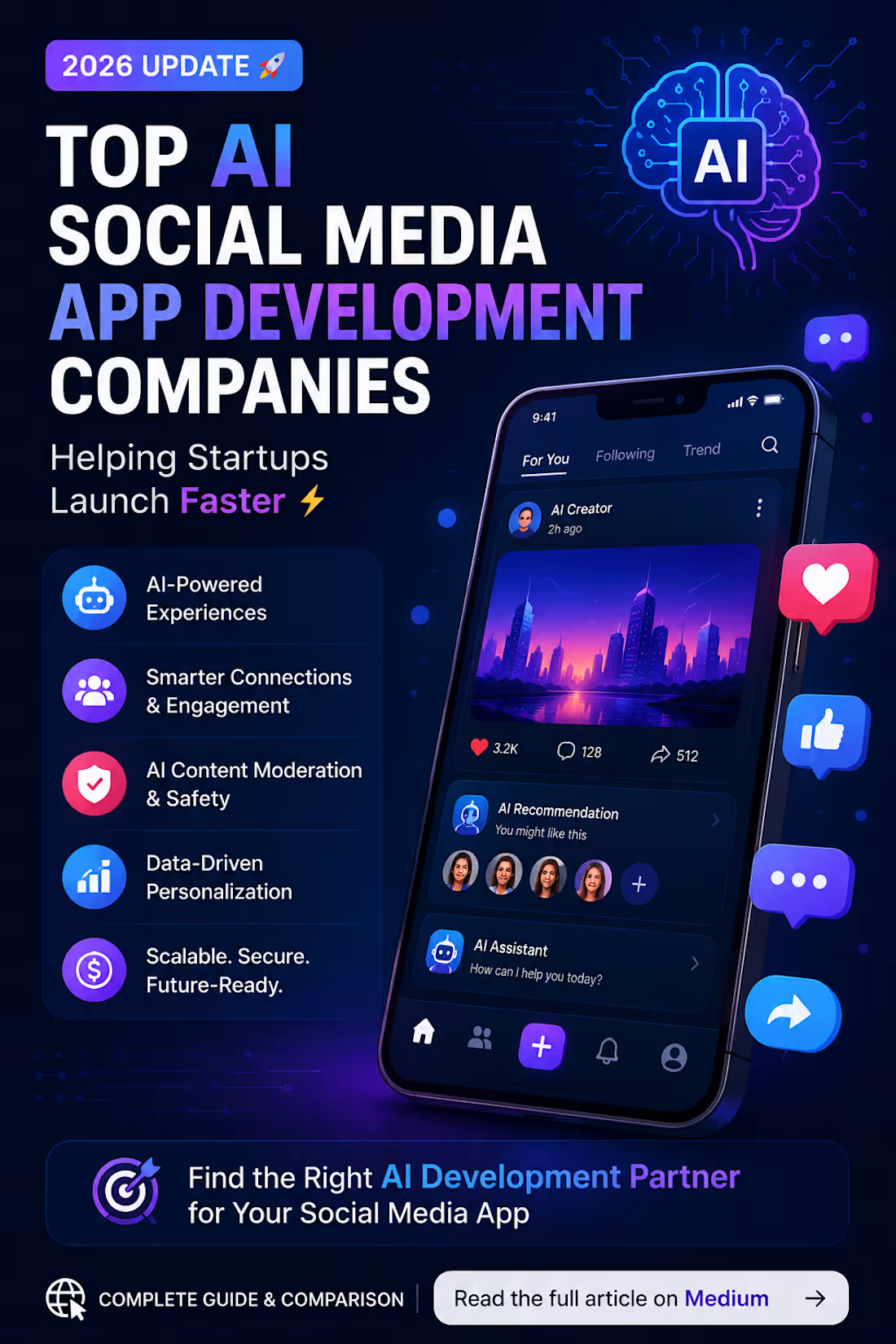
🚀 Every successful AI-powered social media app starts with one important decision:
choosing the right development partner.
It's not just about writing code—it's about building a platform that can scale, engage users, and adapt to rapidly evolving AI technologies.
Here are a few things every startup should evaluate before hiring an AI app development company:
✅ Experience with AI/ML integrations
✅ Scalable cloud architecture
✅ Strong UI/UX capabilities
✅ Expertise in recommendation engines
✅ AI-powered content moderation
✅ Long-term maintenance & support
The right team can help you launch faster, reduce costly mistakes, and build a product that's ready for future growth.
💬 If you're planning an AI-driven social platform, what feature is at the top of your priority list?
I'd love to hear your thoughts.
For anyone researching development partners, I recently put together a detailed comparison of some of the leading AI social media app development companies:
https://medium.com/@thomasshellby.tm/top-ai-social-media-app-development-companies-helping-startups-launch-faster-238dc66aab8f
#AI #ArtificialIntelligence #Startup #AppDevelopment #SocialMedia #MachineLearning #Tech #Innovation #SaaS #Entrepreneurship
0
15

How Much Harder Is Maintaining an App Than Building It?
Building a mobile app is usually treated as the main challenge.
There’s planning, design, development, testing, integrations, and finally the launch.
But launch isn't the finish line.
Once users start using the app, a different kind of work begins: fixing unexpected bugs, adapting to OS updates, maintaining APIs, improving performance, handling security issues, supporting new devices, and continuously responding to user feedback.
The interesting part is that development has a clear destination: you are building toward a launch.
Maintenance doesn't really have an endpoint.
An app can be technically complete and still require constant work to remain reliable, secure, and relevant.
So which one is actually harder?
Building an app from scratch, or keeping an existing app healthy for the next 3–5 years?
I'd be interested to hear how other developers, founders, and product teams see it.
But i found that Dubai based IT companies like Burj Code (https://burjcode.ae/), their methods give proper results for businesses.
2
1
107