Trying to push myself outside my comfort zone by designing and building landing pages in completely different styles.
Today's experiment: PANEL
A comic-book inspired digital publishing platform exploring editorial layouts, oversized typography, halftone textures, collectible cards, and a graphic novel aesthetic.
I think some of the best growth happens when you stop building what you're comfortable with and start building what you're curious about.
Could definitely do with some motion refinement, but right now I'm focusing on learning, experimenting, and exploring new visual directions rather than chasing perfection.
Built with Next.js, TailwindCSS, and GSAP.
https://panel-lyart-sigma.vercel.app
Took a detour from landing pages to build something I actually wanted to exist.
Grid Forecast. A fan-made F1 analytics dashboard. Live standings and race results from the Jolpica and OpenF1 APIs, auto-updating after each round. Championship projections, Monaco circuit intelligence, a full driver market and transfer rumour tracker.
Stack: Next.js 15, TypeScript, Recharts, Framer Motion
Independent fan project, not affiliated with F1 or the FIA.
https://grid-forcast.vercel.app/
1
65
AREA is a fictional creative technology studio exploring how AI-native workflows can shape modern digital identity design.
I used Google Stitch to explore and refine the brand direction through typography studies, interaction concepts, motion systems, colour exploration, and in-place AI edits before rebuilding the final experience in Next.js with Framer Motion and deploying it on Vercel.
The final site focuses on cinematic pacing, editorial restraint, atmospheric motion, and immersive interaction design inspired by modern creative studio websites.
Live Site:
https://area-snowy.vercel.app
Stitch was strongest as a rapid creative direction and identity exploration tool. The in-place editing workflow made it easy to iteratively refine layouts, spacing, typography, and atmosphere while maintaining creative momentum.
The workflow became most powerful when paired with production tooling, using Stitch to establish the creative system first, then translating the final direction into code for deeper interaction and motion refinement.
5
20
1.9K
Title
Brand DNA Engine — ÆTHER
A workflow-native creative direction system for building coherent luxury brand ecosystems with AI.
Brand DNA Engine is an AI-native creative direction system built entirely in Melius that transforms vague startup ideas into coherent, launch-ready luxury brand ecosystems.
Using connected AI workflows and multiple node types, the system analyzes positioning, emotional tone, visual language, and audience intent before generating unified identity systems, UI concepts, campaign visuals, messaging systems, and cinematic brand outputs.
The workflow emphasizes collaborative refinement between human creative direction and AI orchestration, allowing the entire ecosystem to evolve coherently through iterative feedback loops.
For this project, I created ÆTHER, a fictional luxury AI wellness intelligence brand designed for high-performing creatives.
Process Overview
Creative Briefing Inputs
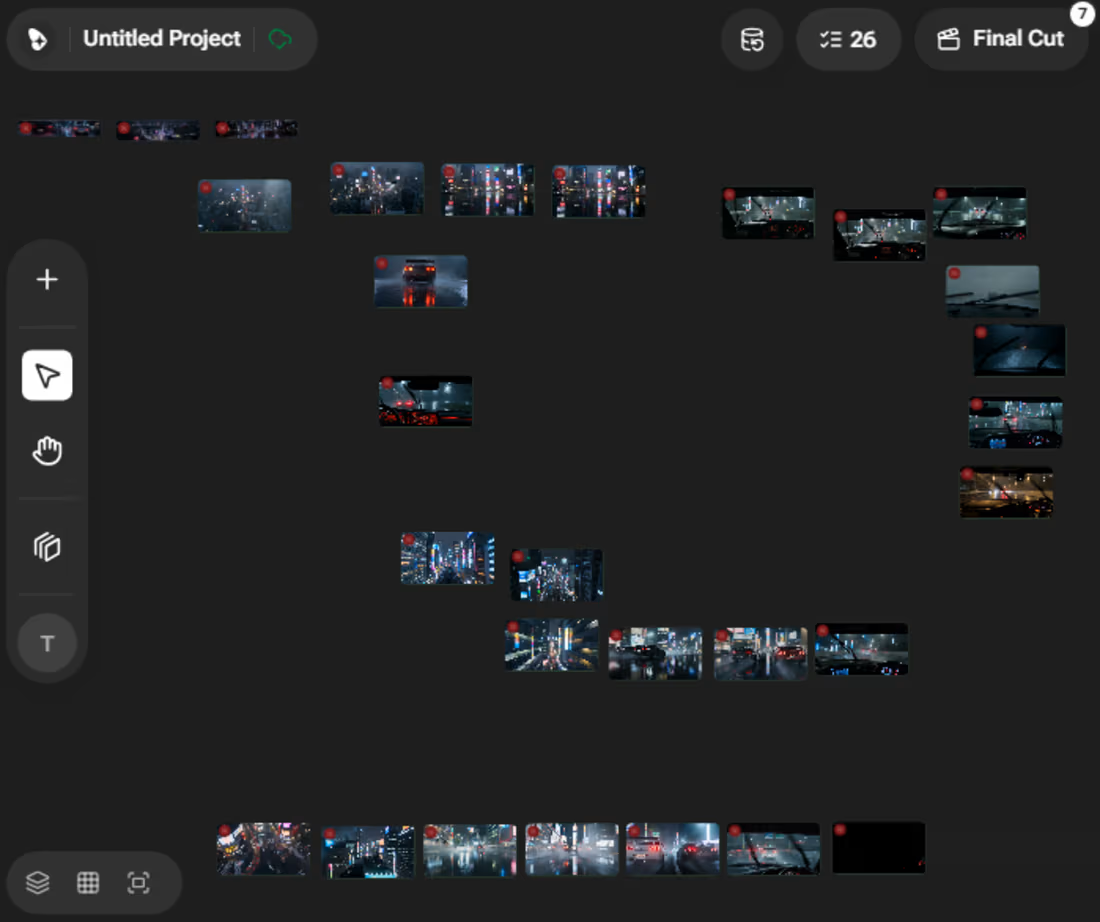
I began by creating structured input nodes for the startup concept, audience, emotional tone, and visual direction of the fictional brand ÆTHER.
AI Analysis Layer
Using Melius AI agents, I created workflow nodes that analyzed:
emotional positioning
visual language
luxury references
campaign tone
typography direction
architectural/editorial aesthetics
Brand DNA Synthesis
The workflow then synthesized these analyses into a central “Brand DNA” system that acted as the creative intelligence layer for all downstream outputs.
Parallel Creative Generation
From the Brand DNA system, the workflow branched into multiple generation systems:
Identity System
UI System
Campaign System
Messaging System
Refinement Loops
The most important stage was collaborative refinement. I introduced creative direction shifts such as:
“Push the system toward brutalist editorial luxury.”
The workflow then evolved the entire ecosystem coherently across campaigns, UI, typography, messaging, and visual tone.
Final Outputs
The final workflow generated cinematic launch posters, editorial campaigns, luxury landing page concepts, and a final “Brand Universe” visual, all designed to feel part of the same cohesive creative world.
Building with Melius
What stood out most while building this project was how naturally Melius supports workflow-native creative thinking instead of isolated prompting.
The visual canvas made it possible to structure creative direction as a connected system rather than generating disconnected outputs. The ability to branch workflows, connect reasoning layers, and iterate through refinement loops made the experience feel much closer to a real creative agency process.
The strongest part of the platform for me was the ability to visually orchestrate AI collaboration. Instead of a single prompt leading to a final result, the workflow became a living creative system where positioning, visual language, campaigns, UI, and messaging could evolve together coherently.
I also found the visual nature of the workflow particularly useful for storytelling and presentation. Seeing the progression from briefing > analysis > synthesis > refinement made the creative process feel much more transparent and intentional.
https://app.melius.com/projects/2148b6f0-ee80-4557-be48-7c60c624284a/canvas/6b9717c7-8034-4102-8812-400f7a63778b
14
35
1.5K
Spent some free time building LUMA Homes, a premium proptech concept exploring a calmer way to discover properties through guided curation.
Built with Next.js, React, TypeScript, TailwindCSS, Framer Motion, and i18n-ready architecture.
Trying to push deeper into product-led UI, stronger frontend systems, and startup-grade user experiences.
https://lumahomes.vercel.app
Designed and developed the website for D.Luxe (http://D.Luxe) Aesthetics (https://www.dluxeaesthetics.co.uk?utm_source=chatgpt.com) a premium aesthetics and skin clinic focused on creating a calm, modern, luxury digital experience that reflects the brand’s clinical professionalism and high-end positioning.
The project focused heavily on:
Premium visual direction and brand presentation
Mobile-first responsive design
Conversion-focused service layouts
Editorial-inspired typography and spacing
Smooth interactions and polished UI details
Clear treatment navigation and trust-building UX
I handled both the design and development process end-to-end, creating a website experience that balances luxury aesthetics with usability, performance, and accessibility.
The final result delivers a modern clinic experience that feels refined, trustworthy, and intentionally designed, helping elevate the brand beyond a typical aesthetics website.
0
140
Built FORGE.inspect, a UI analysis and design-system auditing tool focused on helping teams identify inconsistency, improve scalability, and better understand the structure of their interfaces.
The platform analyzes websites and interfaces to surface insights such as:
Colour palette extraction
Typography and spacing systems
Component usage patterns
Design inconsistencies
UI quality and consistency scoring
The goal is to turn complex interface analysis into something visual, actionable, and developer-friendly, while also bridging the gap between design systems and real-world implementation.
Designed with a strong focus on product UX, data visualization, and developer tooling, combining front-end engineering with design-system thinking and interface diagnostics.
0
146
Built Infinite, an experimental interactive playground focused on motion, atmosphere, and immersive web experiences.
The project explores creative front-end development through animated 2D scenes, transitions, visual effects, and interaction systems, acting as a public space to push my skills in motion design, creative development, and real-time UI experiences.
Designed and developed using modern web technologies including React, Next.js, TypeScript, Canvas-based rendering, animation systems, and interactive UI techniques.
The focus of the project is not just visuals, but creating interfaces and digital experiences that feel alive, tactile, and emotionally driven.
0
144
Built FORGE, a modern design engineering ecosystem for production-ready UI systems, motion primitives, and developer tooling. Designed and developed end-to-end with React, Next.js, TypeScript, Tailwind, and Framer Motion, focusing on owned-code architecture, strong UX, and scalable interface systems.