Talia Przybyszewski's Work | ContraWork by Talia Przybyszewski
Talia Przybyszewski
pro

Talia Przybyszewski

Creative developer crafting premium digital products

    5.00
    Rating
    40
    Followers
I've been working on something over the past week, that started as job board exploration but the more I built the more I realised the valuable part wasn't the jobs, its everything that happens after you apply. So FOUND slowly evolved into something closer to a job search operating system with: • Application tracker • Kanban board • Calendar view • Interview timeline • Notes workspace • Reminders & follow-ups • Momentum tracking Whether opportunities come from LinkedIn, referrals, recruiters, startup websites, or job boards, everything lives in one place. Still a work in progress, but it's been a fun reminder that sometimes the best product ideas appear while you're building. Built with Next.js, TypeScript, TailwindCSS, Framer Motion, and Supabase.
2
50
Last Seen - Places disappear. Their stories don't have to. Last Seen is an archive of lost places and the memories people left behind. A living record of the places that shaped us, before they disappear from memory as completely as they have from maps. The research Before writing a line of code I posted to Reddit. "What closed place do you still think about?" Three subreddits. Three cities. 217,000 views. 1,652 replies. The Astoria. Shunt Vaults. CBGB. Florent. The problem was real before I built anything. The Figma workflow Figma Weave generated the visual language, aged paper textures, film grain overlays, archival map treatments. The Design Agent built the complete design system from a single prompt, colour styles, typography, eight components, page layouts, brand guidelines. The result is a 16-frame horizontal brand identity deck published to the Figma Community. Two Figma Make widgets built and published to Community, Memory of the Day and Still Here, pulling real memories from a live Supabase database in real time. The product Next.js, TypeScript, Tailwind, Supabase, Mapbox GL JS, Vercel. 103 places across five cities. A heatmap showing where memory concentrates across continents. Real memories from real people. An admin queue, rate limiting, auto-geocoding, profanity filtering, i18n across six languages. 825 unique visitors in three days. The archive keeps growing. The workflow Reddit validation, Figma Weave, Design Agent, Figma Make, live product. In 24 hours. Design System - https://www.figma.com/design/Kn81kFZfmAOf9OJkzUGohk/Last-Seen?node-id=0-1&t=JJ7SBoTiIzpf07OZ-1 Figma Make - https://glassy-sky-12636665.figma.site Project link - https://www.lastseen.city
13
22
2.8K
Cover image for TANIT Interiors
TANIT Interiors
1
3
AREA is a fictional creative technology studio exploring how AI-native workflows can shape modern digital identity design. I used Google Stitch to explore and refine the brand direction through typography studies, interaction concepts, motion systems, colour exploration, and in-place AI edits before rebuilding the final experience in Next.js with Framer Motion and deploying it on Vercel. The final site focuses on cinematic pacing, editorial restraint, atmospheric motion, and immersive interaction design inspired by modern creative studio websites. Live Site: https://area-snowy.vercel.app Stitch was strongest as a rapid creative direction and identity exploration tool. The in-place editing workflow made it easy to iteratively refine layouts, spacing, typography, and atmosphere while maintaining creative momentum. The workflow became most powerful when paired with production tooling, using Stitch to establish the creative system first, then translating the final direction into code for deeper interaction and motion refinement.
13
33
3.2K
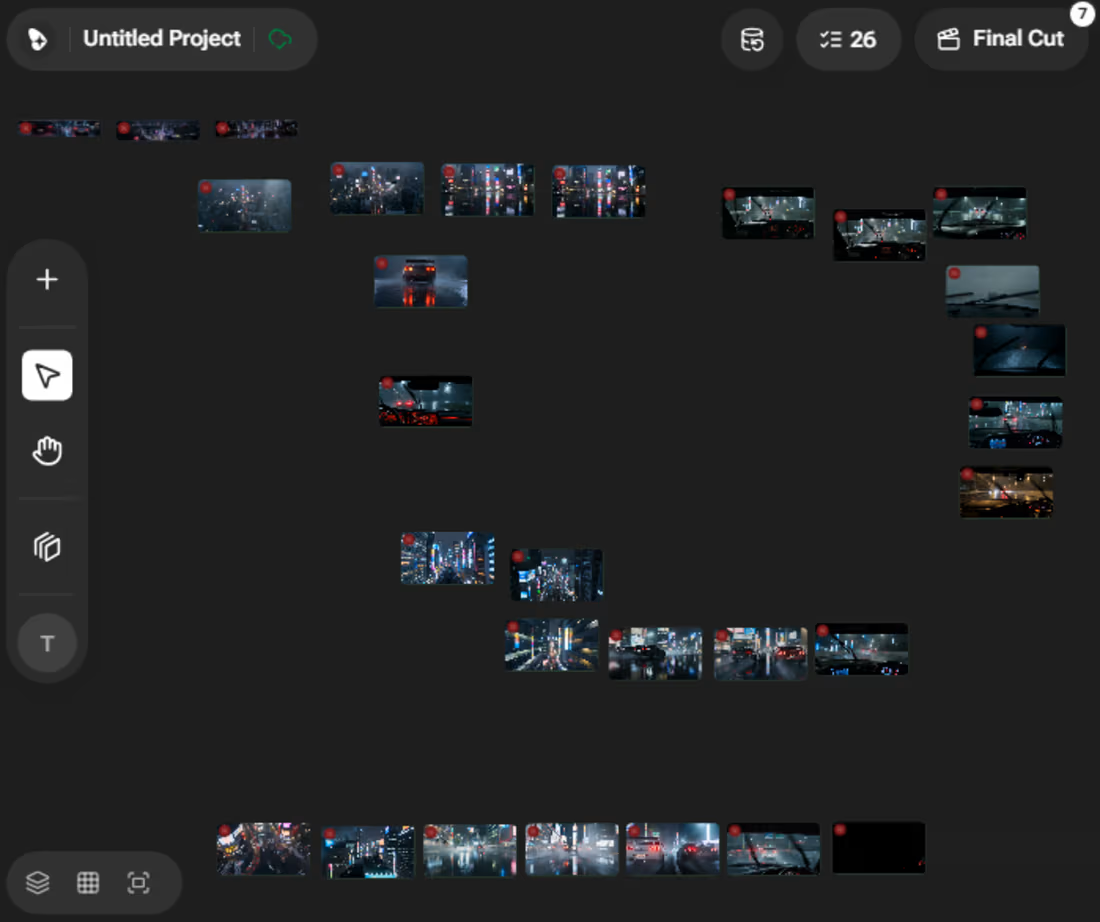
Title Brand DNA Engine — ÆTHER A workflow-native creative direction system for building coherent luxury brand ecosystems with AI. Brand DNA Engine is an AI-native creative direction system built entirely in Melius that transforms vague startup ideas into coherent, launch-ready luxury brand ecosystems. Using connected AI workflows and multiple node types, the system analyzes positioning, emotional tone, visual language, and audience intent before generating unified identity systems, UI concepts, campaign visuals, messaging systems, and cinematic brand outputs. The workflow emphasizes collaborative refinement between human creative direction and AI orchestration, allowing the entire ecosystem to evolve coherently through iterative feedback loops. For this project, I created ÆTHER, a fictional luxury AI wellness intelligence brand designed for high-performing creatives. Process Overview Creative Briefing Inputs I began by creating structured input nodes for the startup concept, audience, emotional tone, and visual direction of the fictional brand ÆTHER. AI Analysis Layer Using Melius AI agents, I created workflow nodes that analyzed: emotional positioning visual language luxury references campaign tone typography direction architectural/editorial aesthetics Brand DNA Synthesis The workflow then synthesized these analyses into a central “Brand DNA” system that acted as the creative intelligence layer for all downstream outputs. Parallel Creative Generation From the Brand DNA system, the workflow branched into multiple generation systems: Identity System UI System Campaign System Messaging System Refinement Loops The most important stage was collaborative refinement. I introduced creative direction shifts such as: “Push the system toward brutalist editorial luxury.” The workflow then evolved the entire ecosystem coherently across campaigns, UI, typography, messaging, and visual tone. Final Outputs The final workflow generated cinematic launch posters, editorial campaigns, luxury landing page concepts, and a final “Brand Universe” visual, all designed to feel part of the same cohesive creative world. Building with Melius What stood out most while building this project was how naturally Melius supports workflow-native creative thinking instead of isolated prompting. The visual canvas made it possible to structure creative direction as a connected system rather than generating disconnected outputs. The ability to branch workflows, connect reasoning layers, and iterate through refinement loops made the experience feel much closer to a real creative agency process. The strongest part of the platform for me was the ability to visually orchestrate AI collaboration. Instead of a single prompt leading to a final result, the workflow became a living creative system where positioning, visual language, campaigns, UI, and messaging could evolve together coherently. I also found the visual nature of the workflow particularly useful for storytelling and presentation. Seeing the progression from briefing > analysis > synthesis > refinement made the creative process feel much more transparent and intentional. https://app.melius.com/projects/2148b6f0-ee80-4557-be48-7c60c624284a/canvas/6b9717c7-8034-4102-8812-400f7a63778b
15
36
1.7K
Cover image for FORGE: UI & Motion System for Modern Interfaces
FORGE: UI & Motion System for Modern Interfaces
0
4
Cover image for LUMA Homes: Premium PropTech Discovery Experience
LUMA Homes: Premium PropTech Discovery Experience
0
4
Cover image for FORGE Inspect: UI Consistency & Design Audit Tool
FORGE Inspect: UI Consistency & Design Audit Tool
0
3
Cover image for D.Luxe Aesthetics: Premium Clinic Website Redesign
D.Luxe Aesthetics: Premium Clinic Website Redesign
0
2
Cover image for ÆTHER: AI-Powered Brand DNA Engine
ÆTHER: AI-Powered Brand DNA Engine
0
3
Cover image for Built FORGE.inspect, a UI analysis
Built FORGE.inspect, a UI analysis and design-system auditing tool focused on helping teams identify inconsistency, improve scalability, and better understand the structure of their interfaces. The platform analyzes websites and interfaces to surface insights such as: Colour palette extraction Typography and spacing systems Component usage patterns Design inconsistencies UI quality and consistency scoring The goal is to turn complex interface analysis into something visual, actionable, and developer-friendly, while also bridging the gap between design systems and real-world implementation. Designed with a strong focus on product UX, data visualization, and developer tooling, combining front-end engineering with design-system thinking and interface diagnostics.
0
193
Cover image for Built Infinite, an experimental interactive
Built Infinite, an experimental interactive playground focused on motion, atmosphere, and immersive web experiences. The project explores creative front-end development through animated 2D scenes, transitions, visual effects, and interaction systems, acting as a public space to push my skills in motion design, creative development, and real-time UI experiences. Designed and developed using modern web technologies including React, Next.js, TypeScript, Canvas-based rendering, animation systems, and interactive UI techniques. The focus of the project is not just visuals, but creating interfaces and digital experiences that feel alive, tactile, and emotionally driven.
0
191