
Muhammad Asim Mughal
Senior .NET Developer | ERP & SQL Server Expert
- 1
- Followers

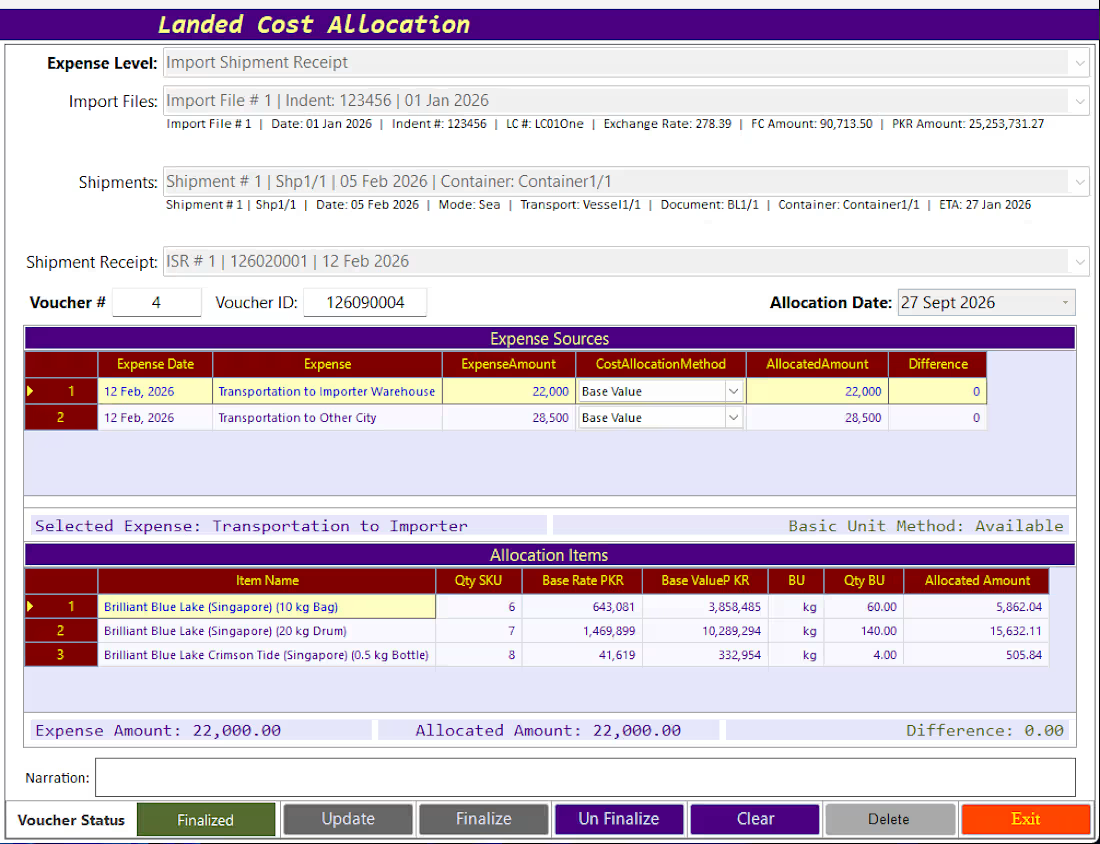
An imported item’s purchase price is only part of its inventory cost. Transport and other related expenses also need to be allocated accurately.
This Landed Cost Allocation screen is part of the custom ERP import module I developed using VB.NET (http://VB.NET) and Microsoft SQL Server.
It allows users to select an import shipment receipt, allocate each expense across received items, and review the allocated total and remaining difference before finalizing.
In this example, a PKR 22,000 transport expense is distributed across three items in proportion to their base values, with no unallocated balance.
The module supports Base Value, Basic Unit Quantity, and Manual allocation methods, helping businesses handle different costing requirements within an integrated inventory and accounting workflow.
Need a similar import-costing module or an enhancement to your existing .NET business software? Let’s discuss your requirements.
#ERP #VBNet #SQLServer #InventoryManagement #LandedCost
1
1
111
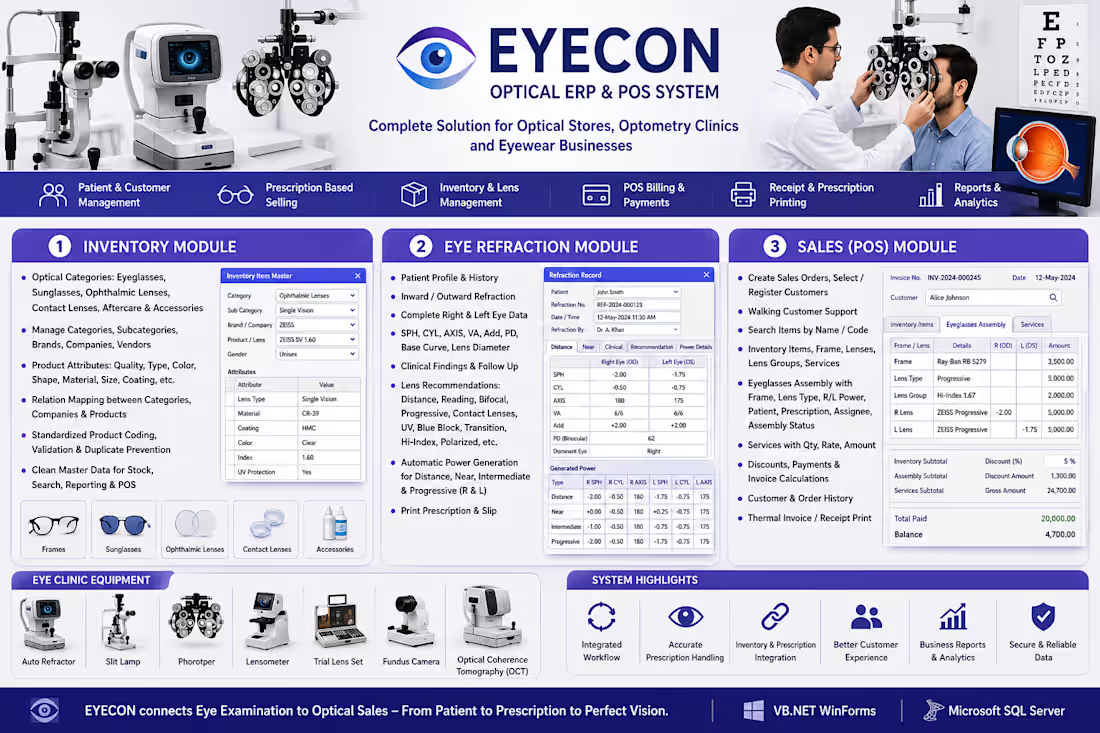
Eyecon | Optical Management System
Eyecon is an intelligent ophthalmic clinic and optical retail management
system designed specifically for optometrists, ophthalmologists, and eyewear
retail stores. The platform combines clinical eye refraction management with
optical product inventory and a fully integrated point-of-sale environment,
enabling clinics and optical shops to manage patient prescriptions, eyewear
products, and sales operations from a single centralized system.
The system maintains a
complete history of patient eye prescriptions, including refractive
measurements such as Sphere, Cylinder, Axis, and additional optical parameters
used in professional eye testing. Eyecon incorporates intelligent logic to
analyse stored prescription data and assist practitioners in determining
appropriate lens power values based on previous refraction records and standard
ophthalmic practices.
Beyond the clinical
environment, Eyecon includes a comprehensive optical retail module that manages
frames, ophthalmic lenses, contact lenses, sunglasses, and eyewear accessories.
The integrated inventory engine tracks product availability, product specifications,
and stock movement while seamlessly connecting with the POS module used for
retail sales.
The POS module allows
optical stores and clinics to sell eyewear products while automatically linking
patient prescriptions with the appropriate lenses and frames. Sales
transactions update stock levels in real time while maintaining accounting
integration for financial tracking.
Built as a cloud-connected
Windows desktop application, Eyecon allows multiple branches or clinics to
operate with a centralized database hosted on a remote server. This
architecture ensures secure data storage, synchronized operations, and
accessibility across different clinic locations.
Key capabilities
include:
• Patient eye
refraction record management
• Intelligent prescription analysis and lens power assistance
• Optical product inventory management
• Integrated optical retail POS system
• Prescription-to-product workflow automation
• Stock tracking for frames, lenses, and accessories
• Accounting and financial integration
• Cloud-connected multi-clinic architecture
Eyecon bridges the gap
between clinical ophthalmic practice and optical retail operations,
providing a unified platform that improves efficiency for eye clinics and
optical businesses
0
39
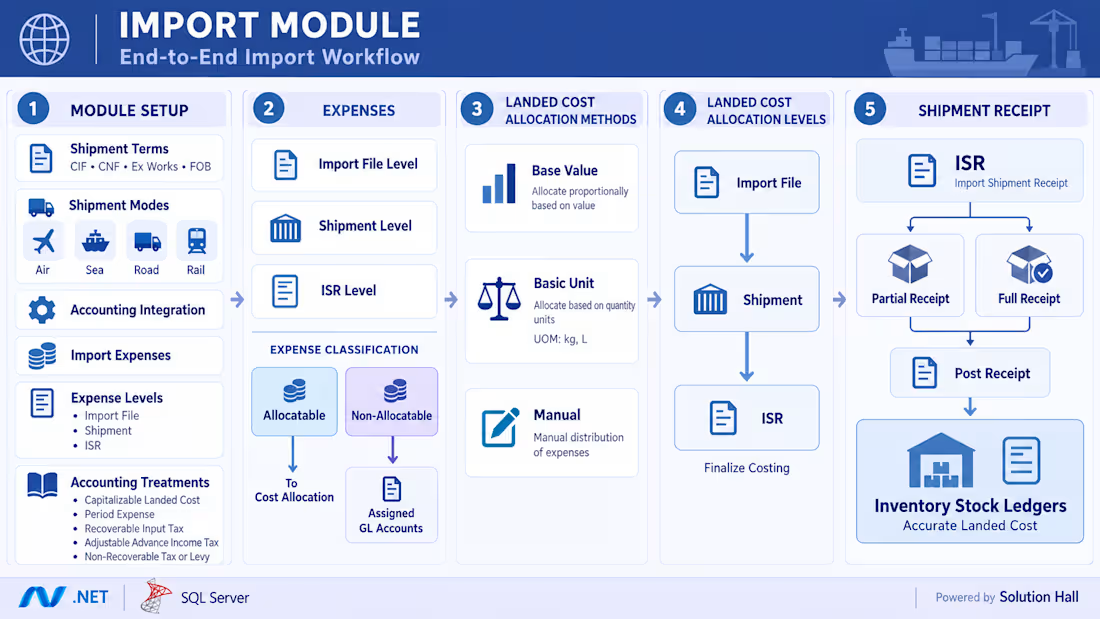
The Import
Module integrates import documentation, shipment management, expense accounting
and goods receipts into a controlled workflow that supports accurate landed
costing and inventory valuation.
Project Brief overview
Developed by
Solution Hall, the Import Module manages the import process from initial setup
and import files through shipments, expense recording and partial or full goods
receipts. It distinguishes capitalizable costs from period expenses and
tax-related amounts, with flexible methods for allocating eligible costs to
imported goods. By linking these activities with accounting and stock records,
the module strengthens financial control, improves cost visibility and provides
reliable information for business decisions.
0
39
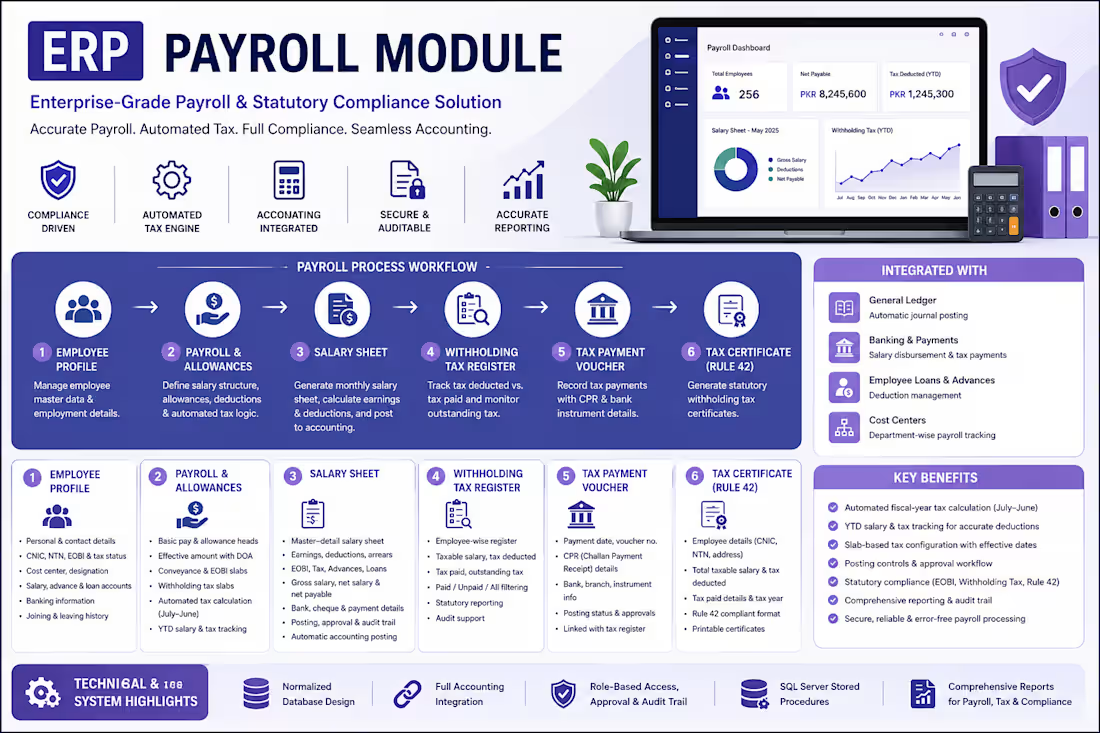
Enterprise-Grade ERP Payroll System with Automated Tax
Engine, Compliance Reporting & Full Accounting Integration.
This Payroll Module is a fully integrated
ERP-based payroll and statutory compliance system designed for medium to large
organizations. It covers complete employee master management, configurable
salary structures, allowance and deduction policies, automated withholding tax
calculation using fiscal-year annualization (July–June), and dynamic slab-based
tax configuration.
The system generates structured monthly
salary sheets using a master–detail architecture with posting controls,
approval workflow, and automatic accounting integration. It intelligently
tracks YTD salary and tax deductions to ensure accurate mid-year adjustments
and regulatory compliance.
In addition to payroll processing, the
module includes a comprehensive Withholding Tax Register (paid/unpaid
tracking), Tax Payment Voucher system with CPR and bank instrument management,
and automated generation of statutory withholding tax certificates (Rule 42
compliant).
The entire module is built with strong
database normalization, audit trail control, and finance integration, making it
suitable for manufacturing, trading, and corporate environments requiring
accuracy, transparency, and compliance-driven payroll automation.
Withholding Tax Register:
This module produces the Payroll
Withholding Tax Register, showing employee-wise taxable salary, tax deducted,
tax paid, and outstanding tax payable with flexible paid/unpaid filtering.
The Withholding Tax Register module is
designed for statutory reporting and tax compliance by maintaining a clear,
auditable trail of payroll income tax deductions and payments. It generates an
employee-wise register that includes key identity fields (Employee Name, CNIC,
NTN), transaction references (date, type, voucher no., serial no.), and
complete tax impact (Taxable Amount, Tax Deducted, Tax Paid, and Tax Payable).
The register supports practical operational
controls such as filtering by employee and cost center, and it
provides separate views for Paid vs Unpaid tax. For paid entries,
it applies a date range to produce period-based compliance reports, while for
unpaid entries it intelligently lists all outstanding liabilities regardless of
date to help finance teams track pending tax payments.
By linking tax entries with tax sections
and enforcing consistent section mapping, this module ensures accurate
classification, improved reconciliation, and readiness for government filings
and internal audits.
0
62