RBIB Building Iconic Brands
agência de branding icônico de alto padrão.
New to Contra
RBIB is ready for their next project!

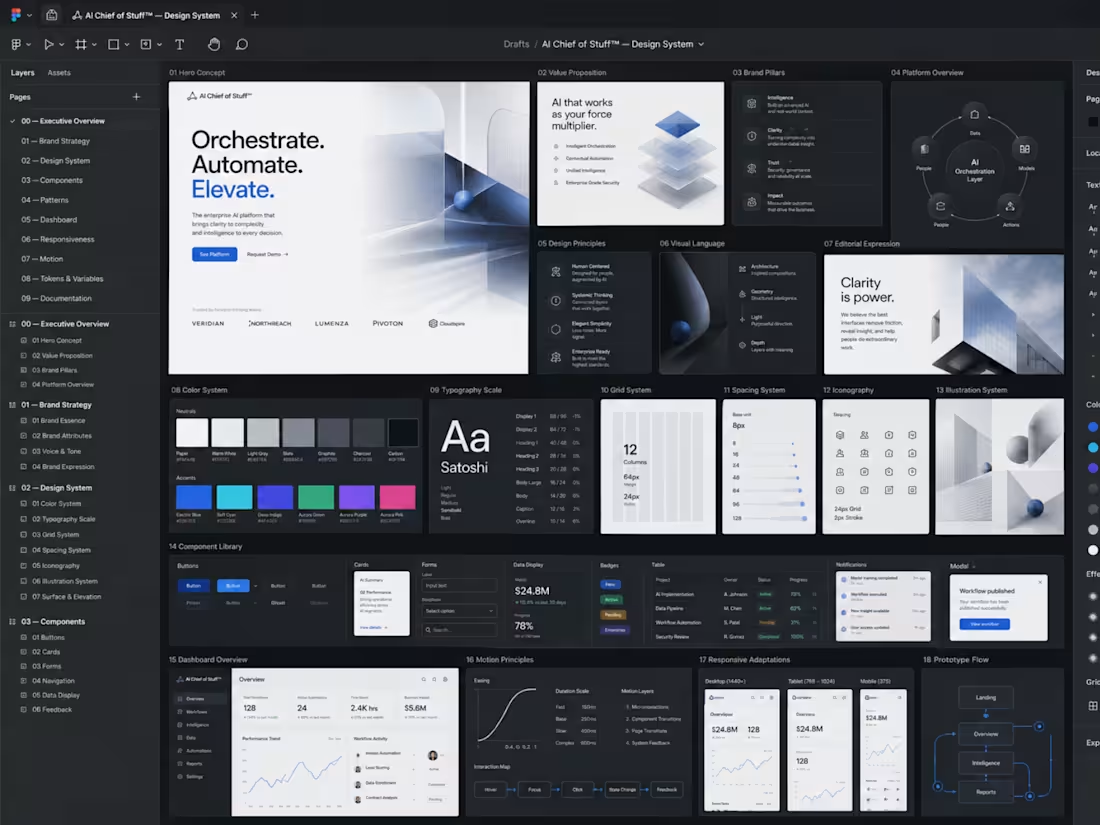
01 — Flagship Landing Page
The Brand's First Impression
The first concept focuses on the flagship landing page—the single most important touchpoint of the entire digital ecosystem. Rather than functioning as a conventional SaaS homepage, this experience is conceived as the visual embodiment of the brand itself. Every decision, from typography to spacing, hierarchy, composition, imagery, and interface behavior, is orchestrated to communicate confidence, clarity, and premium positioning before the visitor begins reading the content.
The creative direction prioritizes editorial discipline over decorative aesthetics. Large-scale typography, rigorous grid systems, generous negative space, restrained color application, and carefully calibrated visual hierarchy establish an experience that feels timeless rather than trend-driven. Artificial intelligence is expressed through intelligent information architecture and refined abstraction instead of familiar technological clichés.
From a technical perspective, the interface is conceived as a production-ready design inside Figma, employing Auto Layout, reusable components, design tokens, responsive logic, scalable spacing systems, and enterprise-grade component libraries. Every visual module is intentionally designed for seamless implementation in modern development environments while preserving pixel-level consistency across desktop, tablet, and mobile experiences.
The objective is to demonstrate how strategic branding, editorial art direction, interface architecture, and product storytelling converge into a single digital experience capable of elevating the perceived value of an enterprise AI platform.
02 — Complete Digital Brand Experience
Translating Brand Strategy into a Digital Ecosystem
The second presentation expands beyond the homepage to explore how an entire digital ecosystem expresses the brand consistently across every customer interaction. Rather than emphasizing individual interface screens, this concept illustrates how strategic positioning evolves into a cohesive system of visual language, interaction principles, product architecture, and user experience.
Here, the emphasis shifts toward Brand Expression—the process through which abstract strategic concepts become tangible digital assets. Typography, iconography, illustrations, imagery, interface modules, motion principles, and color systems are treated as interconnected components of a unified identity rather than isolated design elements.
From a systems perspective, the project demonstrates mature Design System thinking through scalable UI libraries, standardized component behaviors, consistent spacing methodologies, reusable interaction patterns, and enterprise-oriented information architecture. Every design decision is made with implementation, accessibility, responsiveness, and long-term product evolution in mind.
The result is a comprehensive demonstration of how a premium SaaS organization maintains coherence across marketing experiences, product interfaces, customer education, onboarding flows, and enterprise communication through a single visual operating system.
03 — Executive Design Review Board
The Operational Blueprint Behind the Product
The third concept presents the internal design review environment itself. Instead of showcasing only the finished interface, this presentation reveals the complete operational framework behind the product, exposing the thinking, methodology, and documentation that support every design decision.
Structured as an executive Figma workspace, the board brings together grid systems, design tokens, typography specifications, component libraries, interaction documentation, responsive layouts, iconography, visual assets, spacing scales, motion principles, accessibility considerations, prototype connections, and implementation guidelines within a single organized environment.
This approach reflects how mature product organizations operate internally. Design is not treated as isolated artwork but as a scalable engineering discipline supported by governance, documentation, consistency, and collaboration between design and development teams.
Technically, the presentation emphasizes production readiness through modular architecture, reusable components, Auto Layout, variable systems, responsive behavior, developer handoff preparation, and interface scalability. Every frame communicates operational maturity, reducing ambiguity between creative direction and software implementation.
Rather than celebrating aesthetics alone, this concept highlights the infrastructure required to sustain exceptional digital products over time.
04 — Creative Director Master Presentation
From Business Strategy to Product Execution
The fourth and most comprehensive concept synthesizes the entire creative methodology into a single executive presentation. Rather than concentrating on interfaces or design systems independently, it illustrates how strategy, branding, creative direction, digital product design, motion systems, implementation frameworks, and technical execution integrate into one coherent methodology.
This presentation represents the perspective of a Creative Director overseeing every discipline involved in the creation of a world-class digital product. Brand Strategy defines positioning; Brand Expression establishes identity; Creative Direction shapes perception; Editorial Design structures communication; Interface Architecture organizes information; Motion Design enhances usability; Design Systems guarantee consistency; and Implementation Frameworks ensure scalability and production quality.
The visual organization mirrors the workflow of leading digital consultancies, where strategic thinking precedes visual execution and every creative decision is supported by measurable design principles. Each section functions as a chapter within a broader narrative, demonstrating how branding extends beyond aesthetics into governance, operational design, product experience, and long-term business value.
From a technical standpoint, the presentation integrates enterprise-level methodologies including design tokens, responsive systems, accessibility standards, interaction models, documentation frameworks, implementation guidelines, scalable component ecosystems, and motion specifications. The result is not merely a visual presentation but a comprehensive blueprint for building, maintaining, and evolving a digital product at scale.
Unified Creative Philosophy
One Brand. Four Perspectives.
Although each presentation explores a different aspect of the project, all four share a common strategic foundation. Together they demonstrate that premium digital branding is not defined by isolated visual assets but by the creation of a coherent system capable of expressing the same identity consistently across every layer of the digital experience.
The first presentation establishes perception through the flagship landing page.
The second expands that perception into a complete digital brand ecosystem.
The third reveals the operational structure supporting the design process.
The fourth consolidates strategy, creativity, systems thinking, product design, and implementation into a unified executive framework.
Viewed collectively, these four presentations illustrate a comprehensive methodology for contemporary digital branding—one that integrates strategic thinking, creative direction, enterprise product design, scalable design systems, motion language, and implementation readiness. This holistic approach reflects how mature organizations build enduring digital brands: not through isolated interfaces, but through carefully orchestrated systems that align business objectives, user experience, visual identity, and technical execution into a single, cohesive expression of the brand.
0
2

KAGEYAMA INTERACTIVE™ — SYSTEM ARCHITECTURE
Collectively, the portfolio forms a unified entertainment ecosystem in which each franchise contributes a distinct experiential vector while remaining bound by a consistent brand architecture.
Tokyo Velocity™ → Urban kinetic identity and cultural motion systems
Shadow Circuit™ → Digital intelligence and cybernetic control structures
Ronin Protocol™ → Philosophical autonomy and narrative consequence systems
Project Horizon Zero™ → Predictive engineering and computational performance systems
Akira Division™ → Tactical execution and operational discipline systems
This structure enables KAGEYAMA INTERACTIVE™ to function as a scalable global entertainment platform, capable of expanding across games, digital media, hardware systems, and transmedia storytelling environments.
As a subsidiary creative division of RENONK™, the brand extends the parent company’s positioning into the interactive entertainment sector, establishing a coherent multi-industry architecture spanning mobility systems, digital infrastructure, and immersive media experiences.
In this context, KAGEYAMA INTERACTIVE™ is not positioned as a collection of products, but as a designed brand universe, engineered for long-term franchise scalability, global recognition, and sustained intellectual property development.
PROJECT HORIZON ZERO™
Futuristic Motorsport Intelligence System
Project Horizon Zero™ expands the racing genre into a computationally enhanced future where performance is no longer defined solely by mechanical capability, but by predictive intelligence systems and AI-assisted decision frameworks.
The franchise is structured around global competitive circuits, where human-machine collaboration defines the limits of performance optimization.
Gameplay systems incorporate real-time predictive modeling, adaptive AI co-drivers, and data-driven environmental simulation, creating a racing ecosystem that evolves dynamically based on computational learning.
The visual identity is defined by aerodynamic minimalism, glass-material interfaces, and computational grid overlays, reinforcing the concept of motorsport as an engineered intelligence system.
Project Horizon Zero™ represents the innovation and systems engineering pillar of the brand, emphasizing optimization, precision, and technological evolution.
AKIRA DIVISION™
Elite Tactical Operations Shooter System
Akira Division™ is positioned as the premium tactical operations franchise within the KAGEYAMA ecosystem, focusing on elite intervention units operating within high-density urban megastructures and global crisis environments.
The experience is structured around squad-based tactical execution, vertical combat environments, and real-time command decision systems that simulate high-pressure operational scenarios.
The design language emphasizes architectural realism, controlled visual hierarchy, and high-contrast emergency signaling systems, ensuring clarity under extreme gameplay conditions.
Narratively, Akira Division™ explores themes of discipline, leadership, and operational precision within globally interconnected security frameworks.
It represents the discipline and execution layer of the ecosystem, where structure, control, and tactical intelligence define the user experience.
0
6

KAGEYAMA INTERACTIVE™
A RENONK™ Company
Global Interactive Entertainment & Gaming Portfolio
KAGEYAMA INTERACTIVE™ is the dedicated interactive entertainment division of RENONK™, conceived as a next-generation global gaming and digital experience company focused on the creation of high-fidelity, system-driven entertainment ecosystems.
Positioned at the intersection of interactive storytelling, advanced simulation technologies, and cinematic worldbuilding, the brand operates as a structured portfolio of original intellectual properties designed to define new standards in AAA game development, immersive design systems, and transmedia franchise architecture.
Rather than functioning as a traditional game studio, KAGEYAMA INTERACTIVE™ is engineered as a brand ecosystem platform, where each franchise operates as a modular expression of a unified design philosophy rooted in precision engineering, Japanese-inspired minimalism, and globally scalable entertainment design.
Across all properties, the brand maintains a consistent strategic foundation built on five core principles: precision, system coherence, emotional immersion, technological realism, and cultural authenticity.
KZ-01 — TOKYO VELOCITY™
AAA Street Racing Experience System
Tokyo Velocity™ is the foundational expression of kinetic identity within the KAGEYAMA ecosystem. The franchise is positioned as a high-intensity, culturally embedded racing experience that redefines urban mobility as a form of identity construction and competitive expression.
Set within a hyper-real interpretation of contemporary Tokyo, the experience explores the intersection between underground racing culture, precision automotive engineering, and nocturnal urban architecture.
The narrative and gameplay systems are structured around reputation economies, adaptive driving physics, and territorially defined racing districts, creating a living urban ecosystem where status, performance, and aesthetic customization converge into a unified progression model.
The visual identity is defined by controlled neon atmospheres, wet-surface reflectivity, and architectural depth, establishing a cinematic yet grounded representation of urban speed culture.
Tokyo Velocity™ serves as the cultural anchor of the KAGEYAMA portfolio, defining the emotional language of motion, competition, and urban identity.
SHADOW CIRCUIT™
Cyber Tactical Action System
Shadow Circuit™ operates as the systemic intelligence layer of the KAGEYAMA ecosystem, positioned within a near-future environment defined by digital sovereignty conflicts, networked warfare, and algorithmic control structures.
The franchise explores tactical engagement through the lens of information warfare, where physical and digital environments merge into a single operational battlefield.
Gameplay systems emphasize adaptive artificial intelligence, environmental hacking mechanics, and multi-layer mission structures built around infiltration, disruption, and systemic control.
The aesthetic direction is defined by architectural brutalism, fragmented data visualization, and controlled monochromatic palettes enhanced by signal-based color intrusion.
Shadow Circuit™ establishes the technological and cognitive dimension of the brand universe, positioning intelligence, surveillance, and digital control as central narrative forces.
RONIN PROTOCOL™
Open World Action RPG System
Ronin Protocol™ represents the philosophical core of the KAGEYAMA INTERACTIVE™ portfolio, centered on autonomy, moral ambiguity, and systemic consequence design.
Set within a fragmented contemporary Japan influenced by speculative technological evolution, the experience explores identity formation outside institutional structures, where the concept of the “ronin” becomes a metaphor for existential independence in a destabilized world system.
The open-world structure is designed around dynamic faction systems, evolving environmental states, and branching narrative architectures that respond persistently to player ideology and behavioral patterns.
The visual language integrates traditional Japanese architectural principles with speculative design elements, creating a spatial identity defined by balance, restraint, and narrative silence.
Ronin Protocol™ functions as the emotional and philosophical foundation of the ecosystem, emphasizing meaning, consequence, and narrative depth.
1
16
SISTEMA ESTRATÉGICO DE BRANDING ICÔNICO (MULTI-SETORIAL)
Futebol — Narrativa global FIFA 2026 Estrutura de marca construída como “energia de competição global”, inspirada em grandes eventos esportivos. A linguagem visual deve operar como um sistema dinâmico: Movimento, velocidade e impacto visual contínuo Identidade emocional ligada à audiência global Construção de ícones simbólicos que funcionam em transmissões, arenas e plataformas digitais Sistema adaptável para campanhas, clubes, ligas e ativações digitais Resultado: uma marca que não “representa futebol”, mas “opera dentro do ecossistema do futebol global”.
Automotivo — Veículos elétricos Arquitetura de marca baseada em engenharia de precisão e transição energética. Direção estratégica: Estética futurista com foco em eficiência e silêncio tecnológico Linguagem visual minimalista com acentos de performance Sistema modular para diferentes categorias (urbano, SUV, premium, utilitário) Narrativa centrada em autonomia, inteligência embarcada e sustentabilidade aplicada Resultado: posicionamento de tecnologia avançada com percepção premium e confiabilidade industrial.
Eletrodomésticos com Inteligência Artificial Marca estruturada como “inteligência doméstica integrada”. Direção estratégica: Identidade visual híbrida entre tecnologia e conforto doméstico Sistema de cores por categoria funcional (cozinha, limpeza, climatização, lavanderia) Interfaces e produtos com linguagem de IA aplicada ao cotidiano Posicionamento de ecossistema conectado, não de produtos isolados Resultado: casa como sistema inteligente contínuo, não coleção de aparelhos.
Eletrônicos e Smartphones — Marca global Sistema de marca baseado em performance digital e ecossistema conectado. Direção estratégica: Design minimalista com alto contraste tecnológico Linguagem visual centrada em velocidade de processamento e conectividade Arquitetura de sub-marcas para dispositivos (mobile, áudio, wearables, smart devices) Experiência centrada em fluidez entre hardware e software Resultado: ecossistema digital unificado com percepção de marca global de tecnologia de ponta.
0
25