
Shyam Ranasara
ML & AI Engineer | Computer Vision | LLM Fine-Tuning & RAG
- 1
- Followers


📌 Project Title
Used Car Price Valuation AI — Machine Learning Resale Estimator
💡 Overview
The secondhand automotive market faces significant price opacity, making accurate valuation challenging for individual sellers, buyers, and dealership networks.
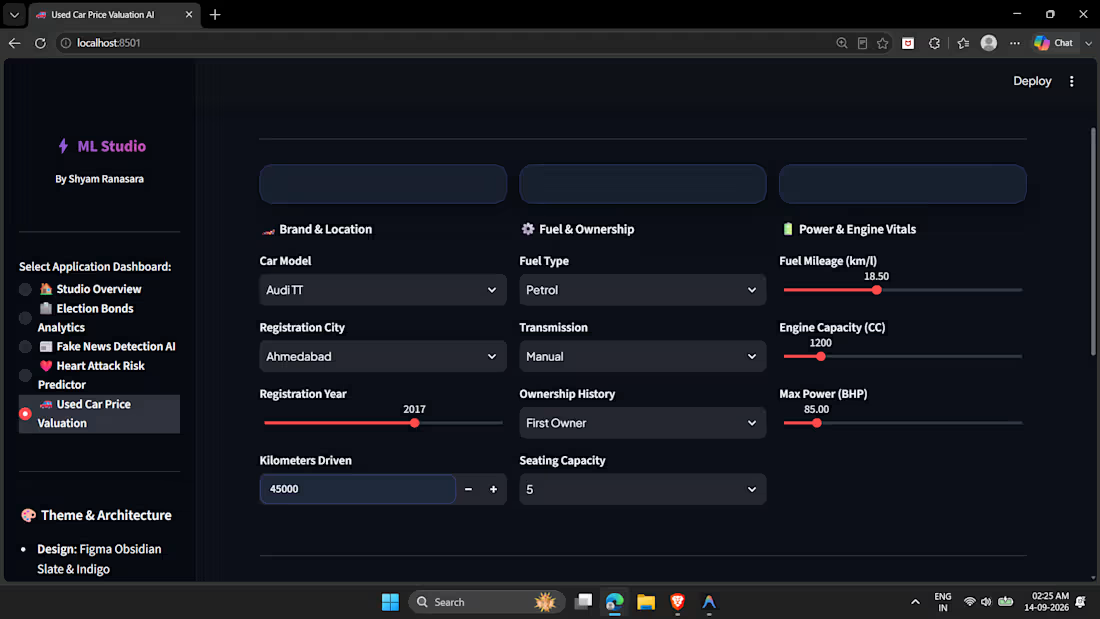
To solve this problem, I built an end-to-end Machine Learning web application that automates vehicle market price discovery. The application ingests 11 core vehicle specifications — including brand model variant, city location, registration year, driven distance, fuel type, transmission type, owner history, fuel efficiency, engine displacement (CC), and horsepower (BHP) — to deliver instant, reliable market price predictions in Lakhs INR alongside an estimated fair-market value range.
⚡ Key Features & Deliverables
High-Accuracy ML Regression Engine: Powered by Scikit-Learn HistGradientBoostingRegressor trained on thousands of vehicle transactions with custom label encodings for 200+ car models across 11 metropolitan markets.
Real-Time Interactive Valuation Dashboard: Built with Streamlit featuring live input sliders, numerical controls, and instant price calculations.
Interactive Resale Value Range & Gauge Visualization: Integrated dynamic Plotly gauge charts providing a visual market valuation indicator and a condition-based fair market range (+/- 8% variance band).
Figma-Grade Human Design Theme: Designed a custom CSS UI system (Obsidian Slate & Indigo Emerald theme: #0B0F19 background, #6366F1 indigo accents) with Plus Jakarta Sans typography and translucent glassmorphic cards.
🛠️ Tech Stack
Python 3.14 • Scikit-Learn • Streamlit • Plotly • Pandas • NumPy • Joblib • CSS3 Glassmorphism
0
34
This research-based computer vision system automates the digital transcription of analogue gauge readings from video input. By pairing deep learning keypoint detection with geometric perspective correction, the system accurately reads dial values in real time and streams logged metrics directly to cloud-based monitoring tools.
Key Technical Contributions & Features
1. YOLOv8 Keypoint Detection Pipeline: Trained a YOLOv8-pose/keypoint model to precisely identify four critical reference coordinates on the gauge dial—the scale minimum point, scale maximum point, pointer center, and pointer tip. Achieved 93% mAP across a hybrid dataset of 10,000 synthetic gauge images and 2,700 annotated real-world video frames.
2. Parallax & Geometric Distortion Correction: Designed a custom geometric mapping algorithm to overcome 3D parallax errors—where non-coplanar pointers and scale faces skew readings from off-center camera angles. The algorithm computes angular sweeps and normalizes scale orientation for precise angular-to-value conversion.
3. Real-Time Video Analytics Backend: Built an automated video processing pipeline using OpenCV and NumPy to capture live feeds, track pointer displacement continuously, and transcribe visual metrics into structured digital numbers.
4. Automated Cloud Logging: Integrated real-time data exporters to continuously push transcribed gauge values to cloud spreadsheets (Google Sheets / Excel) for continuous tracking and telemetry monitoring.
Tech Stack
Languages & Core: Python, NumPy
Computer Vision & Image Processing: OpenCV
Deep Learning & Machine Learning: YOLOv8 (Keypoint Detection), Convolutional Neural Networks (CNN), Scikit-Learn
Data Integration: Google Sheets API
0
69
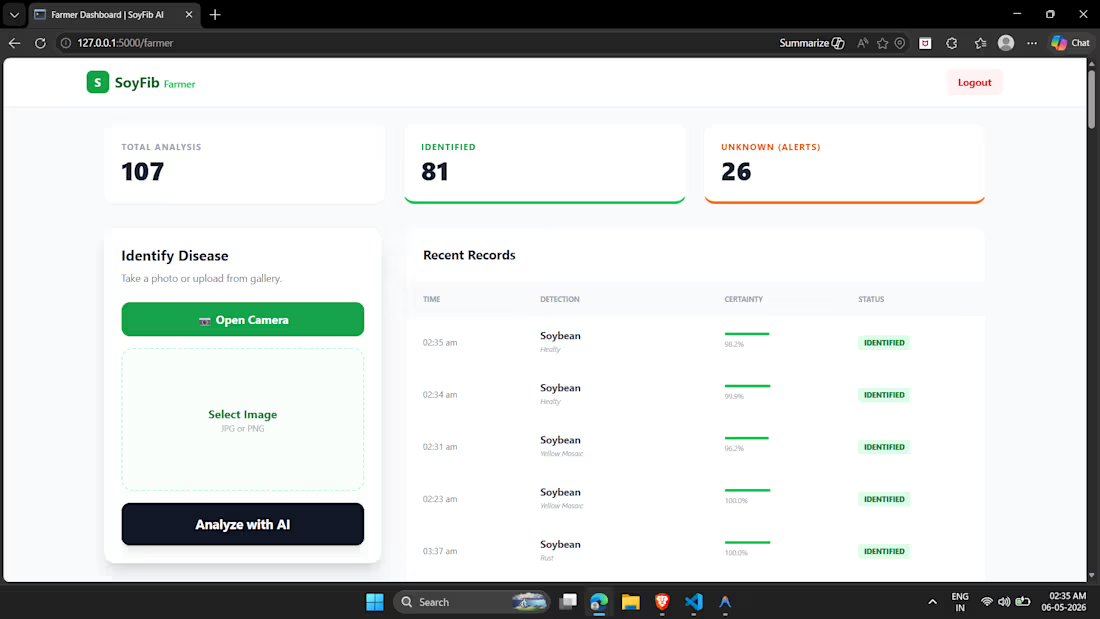
SOYFIB is a computer vision platform engineered to automate the detection and classification of soybean leaf diseases. Using a novel, hybrid deep learning architecture, the platform extracts high-dimensional visual signatures from crop imagery to perform zero-shot disease identification and provides interactive tools for researchers to dynamically expand the diagnosis database.
Key Highlights & Engineering Contributions
Hybrid Feature Extraction Pipeline: Built a deep learning vision pipeline combining a custom CNN with a Swin Transformer architecture to extract 512-dimensional visual disease fingerprints from soybean leaf images.
Dynamic Zero-Shot Detection Backend: Implemented a zero-shot diagnosis system by indexing extracted feature embeddings into a FAISS vector database, enabling ultra-fast vector matching and similarity retrieval.
Custom Dataset Preprocessing: Built an end-to-end data pipeline to handle inputs of 225 X 225 X 3 dimensions and parse YOLO-formatted annotations (.txt), optimizing feature extraction accuracy.
Web Platform & Researcher Portal: Developed a Flask web application allowing users to upload geolocated crop images and view real-time diagnostics, paired with an admin portal for researchers to register new disease vectors dynamically.
0
79
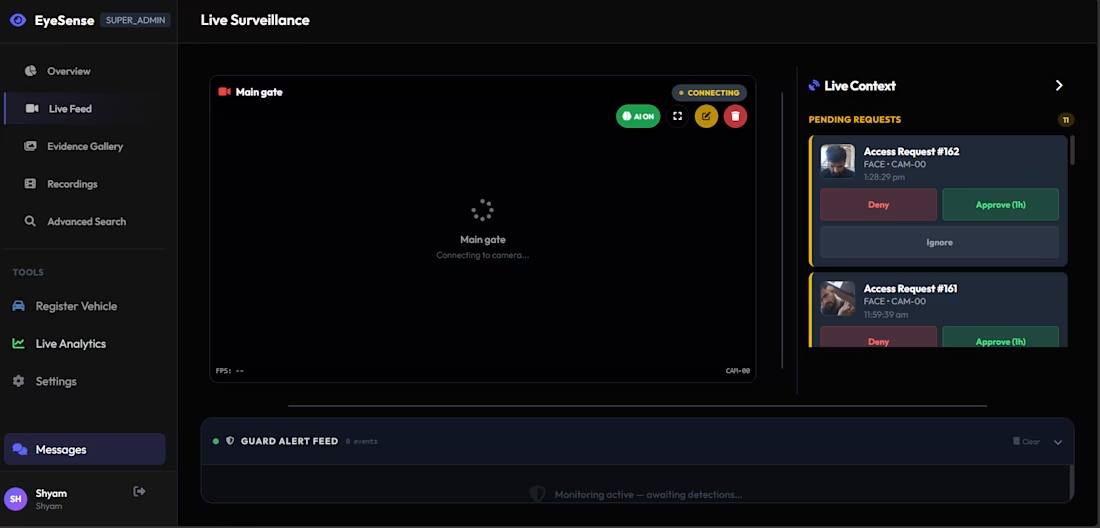
EyeSense is an enterprise-grade, real-time AI surveillance system designed for automated visitor monitoring and security tracking. The system replaces manual check-in processes by utilizing computer vision techniques to detect, track, and recognize individuals across multiple concurrent video streams, reducing manual security workloads by approximately 60%.
Key Features & Technical Architecture
Multi-Stream Processing: Engineered a low-latency video pipeline using OpenCV operating at 25 FPS, capable of processing 4 active CCTV feeds concurrently without frame drops or memory leaks.
Face Recognition & Indexing: Implemented identity matching by extracting high-dimensional embeddings using HuggingFace FaceNet models and indexing them into a FAISS vector database. Achieved sub-100ms vector matching across a database of 500+ identity profiles.
Automated Alerting Engine: Designed a real-time event engine that flags unrecognized or unauthorized individuals within 3 seconds, automatically triggering instant security alerts via SMS and email.
Management Dashboard & Containerization: Developed a Flask-based web platform for system administration, access logging, real-time visitor approval, and monitoring. Containerized the entire application stack using Docker for standardized deployment across hardware environments.
0
58