
Shivani Bhandari
AI Engineer building LLMs, AI agents, RAG systems, and effic
New to Contra
Shivani is building their profile!


Designed and developed a production website for YSMN Complete Care and Support Services, a Perth-based business offering cleaning and care services.
The website provides a complete digital presence for the business, including service discovery, company information, reviews, galleries, careers, contact forms, booking flows, and quote-request functionality.
The site covers multiple service categories including domestic cleaning, commercial cleaning, deep cleaning, garden maintenance, pool cleaning, post-event cleaning, household assistance, companionship, elderly care, community access, and rehabilitation care.
The project demonstrates end-to-end web development focused on creating a professional, service-oriented website that converts visitors into enquiries through clear navigation, service pages, quote forms, and booking workflows.
It is a strong example of applying software engineering to a real business requirement rather than building only a demo application.
0
5
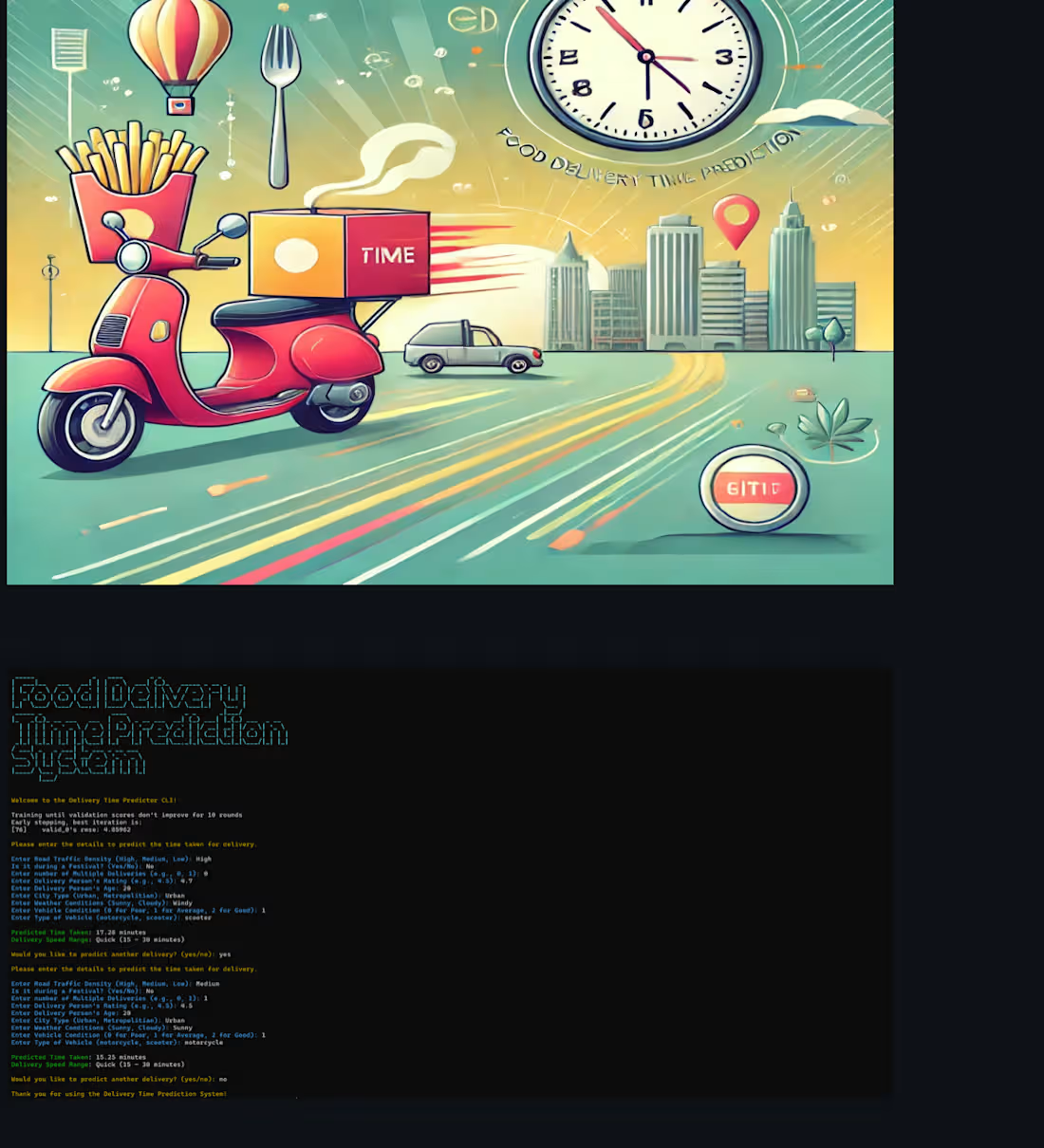
Smart Delivery Time Predictor is a machine learning system for estimating food delivery times using historical delivery information and contextual factors such as traffic and weather.
I built the data-processing and modelling workflow including exploratory data analysis, preprocessing, datetime feature extraction, categorical encoding, feature selection using SelectKBest, and hyperparameter optimization with GridSearchCV.
I evaluated multiple regression approaches including Linear Regression, Decision Tree, Bagging, Random Forest, Elastic Net, LightGBM, and XGBoost. LightGBM achieved the strongest reported performance in the project with an R² score of 0.80.
The project also includes a command-line prediction interface that allows users to provide delivery parameters and receive an estimated delivery-time category.
This demonstrates practical experience taking a machine-learning problem from raw data and feature engineering through model comparison, optimization, evaluation, and usable prediction.
0
9
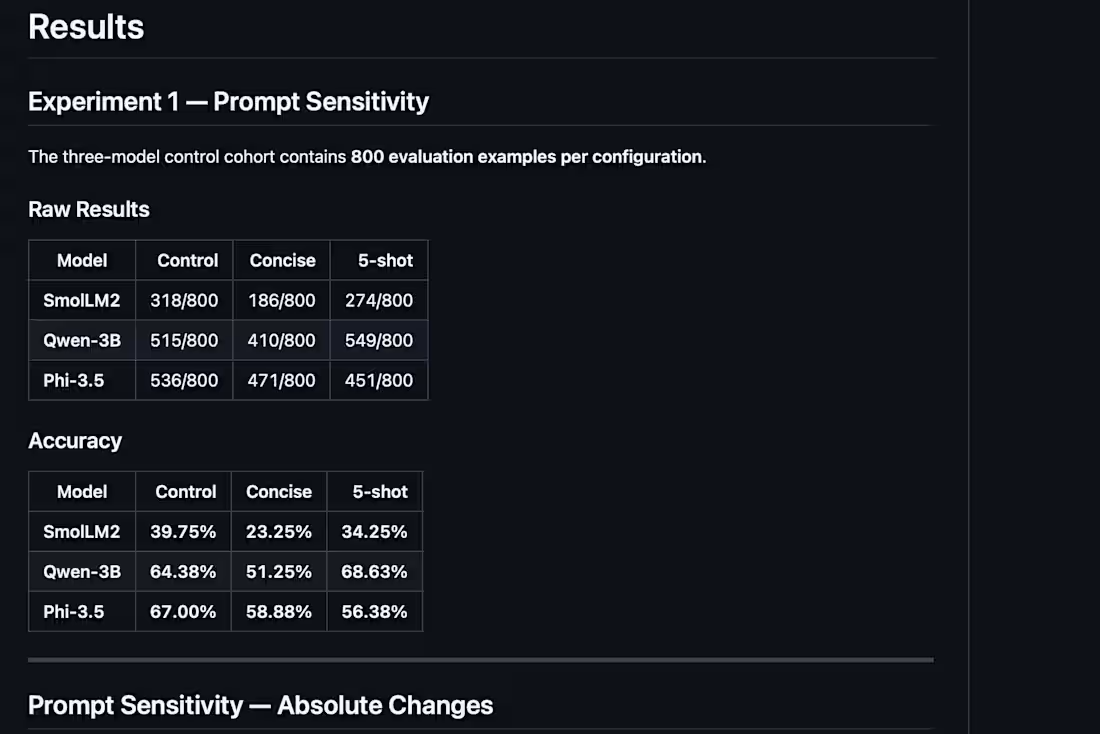
Apertus Eval Prep is a reproducible framework for studying how evaluation configurations affect LLM benchmark results and model-ranking stability.
The project systematically evaluates factors such as prompt formulation, chat templates, inference backends, quantization, decoding settings, hardware, safety, hallucination, robustness, and evaluation cost. It uses controlled one-factor-at-a-time experiments to isolate the effect of individual configuration changes.
The framework includes experiment configuration, result registries, reproducible artifacts, statistical analysis, automated validation, and research-report generation. It also incorporates confidence intervals, paired statistical testing, Kendall's tau for ranking stability, and cost-aware analysis.
The current repository contains 23/34 completed experimental cells and 58 passing automated tests.
This project demonstrates my ability to build reliable AI evaluation infrastructure rather than relying only on subjective model comparisons.
0
11
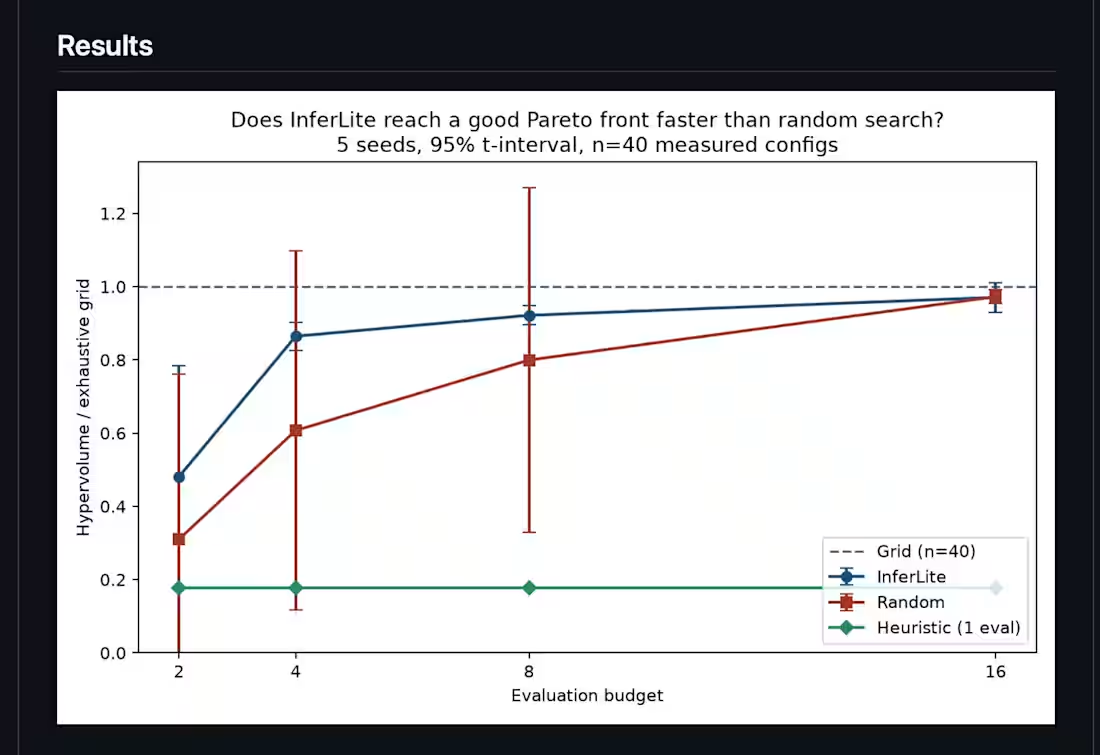
InferLite is a research-oriented LLM inference and optimization platform focused on making large language models faster, more memory-efficient, and more practical to deploy on constrained infrastructure.
I designed the project to benchmark different inference and quantization strategies across model sizes and deployment environments. It explores techniques including FP16, INT8, GPTQ, AWQ, and GGUF, with an emphasis on understanding the trade-offs between model quality, latency, throughput, memory consumption, and deployment cost.
The platform uses PyTorch and ONNX Runtime for model execution and optimization, with FastAPI providing the inference layer. Benchmarking workflows measure metrics such as time-to-first-token (TTFT), end-to-end latency, tokens/second, memory utilization, and resource efficiency. Docker-based deployment and observability components make the system easier to reproduce and monitor.
The project demonstrates practical experience in:
LLM inference optimization
Model quantization and compression
ONNX Runtime optimization
CPU/GPU inference benchmarking
Performance profiling
Memory and latency optimization
Production-oriented API design
Reproducible AI deployment
The goal is not simply to run an LLM, but to systematically understand how model and runtime optimizations affect real-world inference performance and deployment economics.
0
13