
Educational Email Courses for Mental Health & Wellness AppsAntonio Matta

I create automated educational email courses for digital health companies, mental health apps, and wellness platforms that build trust on autopilot. Through strategic interviews, course architecture design, and lesson-by-lesson writing in your voice, I handle everything from platform setup to post-course nurture sequences—while you spend just 6-8 hours total over the 6-month engagement. Your expertise, your brand, your credibility—delivered as a self-running system that educates, engages, and converts.
What's included
Course Strategy & Transformation Mapping
I conduct 1-2 asynchronous interviews with your clinical and product leads to identify one high-value insight or framework worth teaching. We'll map the journey from confusion to capability—what do users, clinicians, or enterprise buyers need to understand to trust your platform? This strategic foundation ensures your course teaches what actually moves people from skepticism to engagement, not just generic mental health education.
Course Architecture & Learning Design
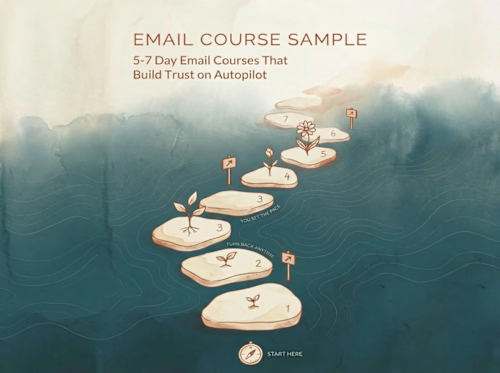
I design a 5-7 email sequence with clear learning progression. Each email builds on the previous one, moving learners from foundational understanding to practical application. Typical structure: Email 1 establishes the problem and why it matters, Emails 2-5 teach core concepts (one insight per email), Email 6 shows how to apply what they've learned, Email 7 provides next steps and clear CTA. Each lesson is digestible (5-10 minute read) and actionable.
Lesson Writing & Content Development
I write every email in your brand voice with your clinical expertise. Each lesson includes: Hook (opening that makes them feel seen), Teaching (one main concept explained clearly with examples), Action (one small task they can complete in 5-10 minutes), Transition (bridge to the next lesson), and P.S. (invitation to reply with questions). Content is substantial enough to provide real value but not so dense that people abandon mid-course.
Platform Setup & Email Automation
I handle the technical setup in your email service provider (ConvertKit, Mailchimp, ActiveCampaign, HubSpot, or your preferred ESP). This includes: building the automated sequence, setting delivery cadence and timing, creating tags for segmentation and tracking, testing the complete user flow, and ensuring mobile-responsive formatting. Once live, the course runs on autopilot—new subscribers progress through lessons daily while you focus on product development.
Lead Magnet & Landing Page Copy
our course needs a compelling entry point. I create: Lead magnet copy (the preview/promise that gets people to sign up), Landing page that explains what they'll learn and why it matters, Sign-up form copy and confirmation messaging, and Social proof elements if you have testimonials or completion data. The goal: make enrollment feel like a no-brainer for your target audience.
Engagement Mechanisms & Completion Design
Email courses fail when people stop opening. I build in psychological hooks to keep learners engaged: Progress indicators ("You're on Day 3 of 5"), Curiosity gaps (each lesson previews what's coming next), Quick wins (small completable tasks build momentum), and Social proof (case examples, user stories). We'll also create a completion certificate or badge for those who finish—gamification that drives follow-through.
Analytics Setup & Performance Tracking
I set up tracking to measure what matters: Open rates per lesson (which emails lose people?), Click-through rates on CTAs, Completion rates (how many finish vs. drop off?), and Conversion tracking (how many course grads become users, book demos, or upgrade?). You receive monthly performance reports during the 6-month engagement, with insights on what's working and recommendations for optimization.
Post-Course Nurture Sequence
Course completion isn't the end—it's a transition point. I create a 3-5 email follow-up sequence for graduates: Celebrate completion, Reinforce key lessons, Provide next-step resources, and Include strategic CTA (book demo, upgrade account, explore premium features, refer a colleague). This sequence turns educated leads into activated users while maintaining the trust you've built.
Professional Compliance & Ethical Review
Digital health companies must navigate clinical, legal, and ethical boundaries. Every lesson includes appropriate disclaimers ("This course is educational, not clinical advice"), crisis resources where relevant (988, Crisis Text Line), and language that maintains professional boundaries while building trust. I ensure your content educates without diagnosing, supports without creating therapeutic relationships, and informs without crossing lines that could harm your reputation or regulatory standing.
FAQs


Starting at$800 /mo
Tags
Canva

Gmail

MailChimp

Slack

Content Writer
Copywriter
Email Marketer
Service provided by
Antonio Matta proNew York, USA
- 13
- Followers
Educational Email Courses for Mental Health & Wellness AppsAntonio Matta
Starting at$800 /mo
Tags
Canva
Gmail
MailChimp
Slack
Content Writer
Copywriter
Email Marketer
I create automated educational email courses for digital health companies, mental health apps, and wellness platforms that build trust on autopilot. Through strategic interviews, course architecture design, and lesson-by-lesson writing in your voice, I handle everything from platform setup to post-course nurture sequences—while you spend just 6-8 hours total over the 6-month engagement. Your expertise, your brand, your credibility—delivered as a self-running system that educates, engages, and converts.
What's included
Course Strategy & Transformation Mapping
I conduct 1-2 asynchronous interviews with your clinical and product leads to identify one high-value insight or framework worth teaching. We'll map the journey from confusion to capability—what do users, clinicians, or enterprise buyers need to understand to trust your platform? This strategic foundation ensures your course teaches what actually moves people from skepticism to engagement, not just generic mental health education.
Course Architecture & Learning Design
I design a 5-7 email sequence with clear learning progression. Each email builds on the previous one, moving learners from foundational understanding to practical application. Typical structure: Email 1 establishes the problem and why it matters, Emails 2-5 teach core concepts (one insight per email), Email 6 shows how to apply what they've learned, Email 7 provides next steps and clear CTA. Each lesson is digestible (5-10 minute read) and actionable.
Lesson Writing & Content Development
I write every email in your brand voice with your clinical expertise. Each lesson includes: Hook (opening that makes them feel seen), Teaching (one main concept explained clearly with examples), Action (one small task they can complete in 5-10 minutes), Transition (bridge to the next lesson), and P.S. (invitation to reply with questions). Content is substantial enough to provide real value but not so dense that people abandon mid-course.
Platform Setup & Email Automation
I handle the technical setup in your email service provider (ConvertKit, Mailchimp, ActiveCampaign, HubSpot, or your preferred ESP). This includes: building the automated sequence, setting delivery cadence and timing, creating tags for segmentation and tracking, testing the complete user flow, and ensuring mobile-responsive formatting. Once live, the course runs on autopilot—new subscribers progress through lessons daily while you focus on product development.
Lead Magnet & Landing Page Copy
our course needs a compelling entry point. I create: Lead magnet copy (the preview/promise that gets people to sign up), Landing page that explains what they'll learn and why it matters, Sign-up form copy and confirmation messaging, and Social proof elements if you have testimonials or completion data. The goal: make enrollment feel like a no-brainer for your target audience.
Engagement Mechanisms & Completion Design
Email courses fail when people stop opening. I build in psychological hooks to keep learners engaged: Progress indicators ("You're on Day 3 of 5"), Curiosity gaps (each lesson previews what's coming next), Quick wins (small completable tasks build momentum), and Social proof (case examples, user stories). We'll also create a completion certificate or badge for those who finish—gamification that drives follow-through.
Analytics Setup & Performance Tracking
I set up tracking to measure what matters: Open rates per lesson (which emails lose people?), Click-through rates on CTAs, Completion rates (how many finish vs. drop off?), and Conversion tracking (how many course grads become users, book demos, or upgrade?). You receive monthly performance reports during the 6-month engagement, with insights on what's working and recommendations for optimization.
Post-Course Nurture Sequence
Course completion isn't the end—it's a transition point. I create a 3-5 email follow-up sequence for graduates: Celebrate completion, Reinforce key lessons, Provide next-step resources, and Include strategic CTA (book demo, upgrade account, explore premium features, refer a colleague). This sequence turns educated leads into activated users while maintaining the trust you've built.
Professional Compliance & Ethical Review
Digital health companies must navigate clinical, legal, and ethical boundaries. Every lesson includes appropriate disclaimers ("This course is educational, not clinical advice"), crisis resources where relevant (988, Crisis Text Line), and language that maintains professional boundaries while building trust. I ensure your content educates without diagnosing, supports without creating therapeutic relationships, and informs without crossing lines that could harm your reputation or regulatory standing.
FAQs
$800 /mo