
Domain Model Fine-Tuning & Evaluation SprintUgo Chukwu
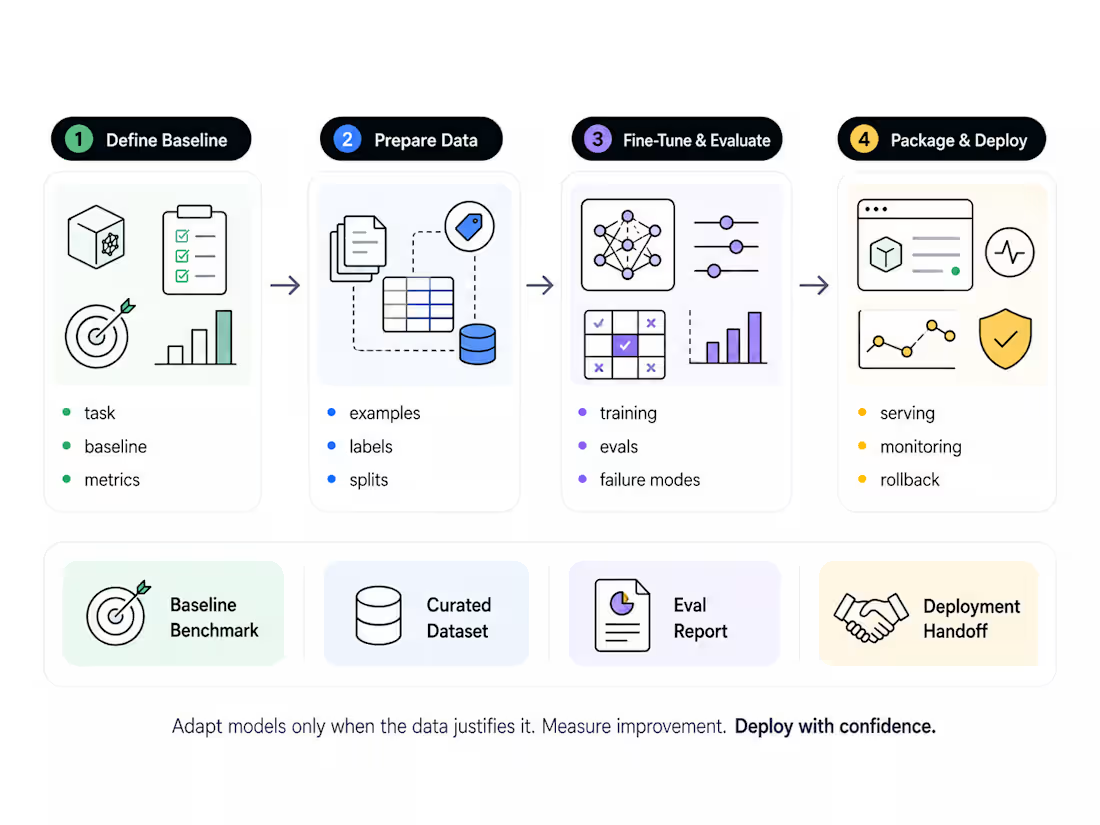
Improve a model for a specific domain task—and prove that the improvement is real.
I work with teams that have repeated, measurable AI tasks where generic prompting or retrieval is no longer producing sufficient accuracy, consistency, latency or cost performance.
The engagement starts by determining whether fine-tuning is actually the right solution.
We establish a baseline, build a representative evaluation set and compare alternatives such as:
Prompt/system improvements
Retrieval/RAG
Tool use
Structured deterministic logic
Model fine-tuning or task-specific training
If model adaptation is justified, I build and evaluate the training pipeline.
The sprint can include
Use-case and target-metric definition
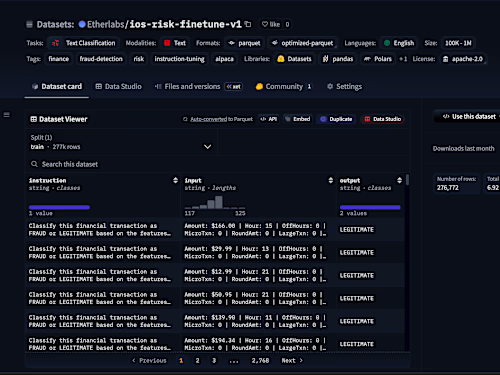
Dataset review and cleaning
Data preparation and train/validation/test splits
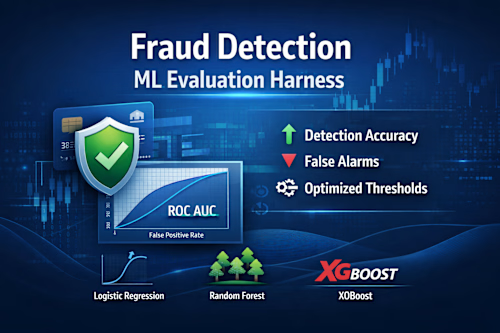
Baseline model evaluation
Supervised fine-tuning
LoRA/QLoRA/PEFT where appropriate
Embedding or reranker tuning
Experiment tracking
Held-out evaluations
Failure-mode analysis
Accuracy/cost/latency comparison
Model card and documentation
Deployment packaging
Monitoring and rollback plan
Best-fit use cases
Finance/risk classification
Domain-specific extraction
Structured decision support
Ranking and retrieval
Customer-specific terminology
Repetitive high-volume language tasks with labelled examples
Not a good fit
Very small/noisy datasets, frequently changing requirements, or problems where current facts should simply live in retrieval.
FAQs
Example work
Contact for pricing
Duration1 week
Tags
Python

AI Developer
Data Scientist
LLM
Machine Learning
Natural Language Processing
Artificial Intelligence
AI Evaluation
Model Fine-Tuning
Service provided by
Ugo Chukwu proDubai - United Arab Emirates
- $10k+
- Earned
- 6
- Paid projects
- 4.95
- Rating
- 51
- Followers
Domain Model Fine-Tuning & Evaluation SprintUgo Chukwu
Contact for pricing
Duration1 week
Tags
Python
AI Developer
Data Scientist
LLM
Machine Learning
Natural Language Processing
Artificial Intelligence
AI Evaluation
Model Fine-Tuning
Improve a model for a specific domain task—and prove that the improvement is real.
I work with teams that have repeated, measurable AI tasks where generic prompting or retrieval is no longer producing sufficient accuracy, consistency, latency or cost performance.
The engagement starts by determining whether fine-tuning is actually the right solution.
We establish a baseline, build a representative evaluation set and compare alternatives such as:
Prompt/system improvements
Retrieval/RAG
Tool use
Structured deterministic logic
Model fine-tuning or task-specific training
If model adaptation is justified, I build and evaluate the training pipeline.
The sprint can include
Use-case and target-metric definition
Dataset review and cleaning
Data preparation and train/validation/test splits
Baseline model evaluation
Supervised fine-tuning
LoRA/QLoRA/PEFT where appropriate
Embedding or reranker tuning
Experiment tracking
Held-out evaluations
Failure-mode analysis
Accuracy/cost/latency comparison
Model card and documentation
Deployment packaging
Monitoring and rollback plan
Best-fit use cases
Finance/risk classification
Domain-specific extraction
Structured decision support
Ranking and retrieval
Customer-specific terminology
Repetitive high-volume language tasks with labelled examples
Not a good fit
Very small/noisy datasets, frequently changing requirements, or problems where current facts should simply live in retrieval.
FAQs
Example work
Contact for pricing