Redowan Trafder - Database Administrator | ContraWork by Redowan Trafder
Redowan Trafder

Redowan Trafder

I design and build automation,web & software products

New to Contra

Redowan is ready for their next project!

Followed by Hamza G and Nithish R
Cover image for I developed a complete, scalable POS platform for a growing ...
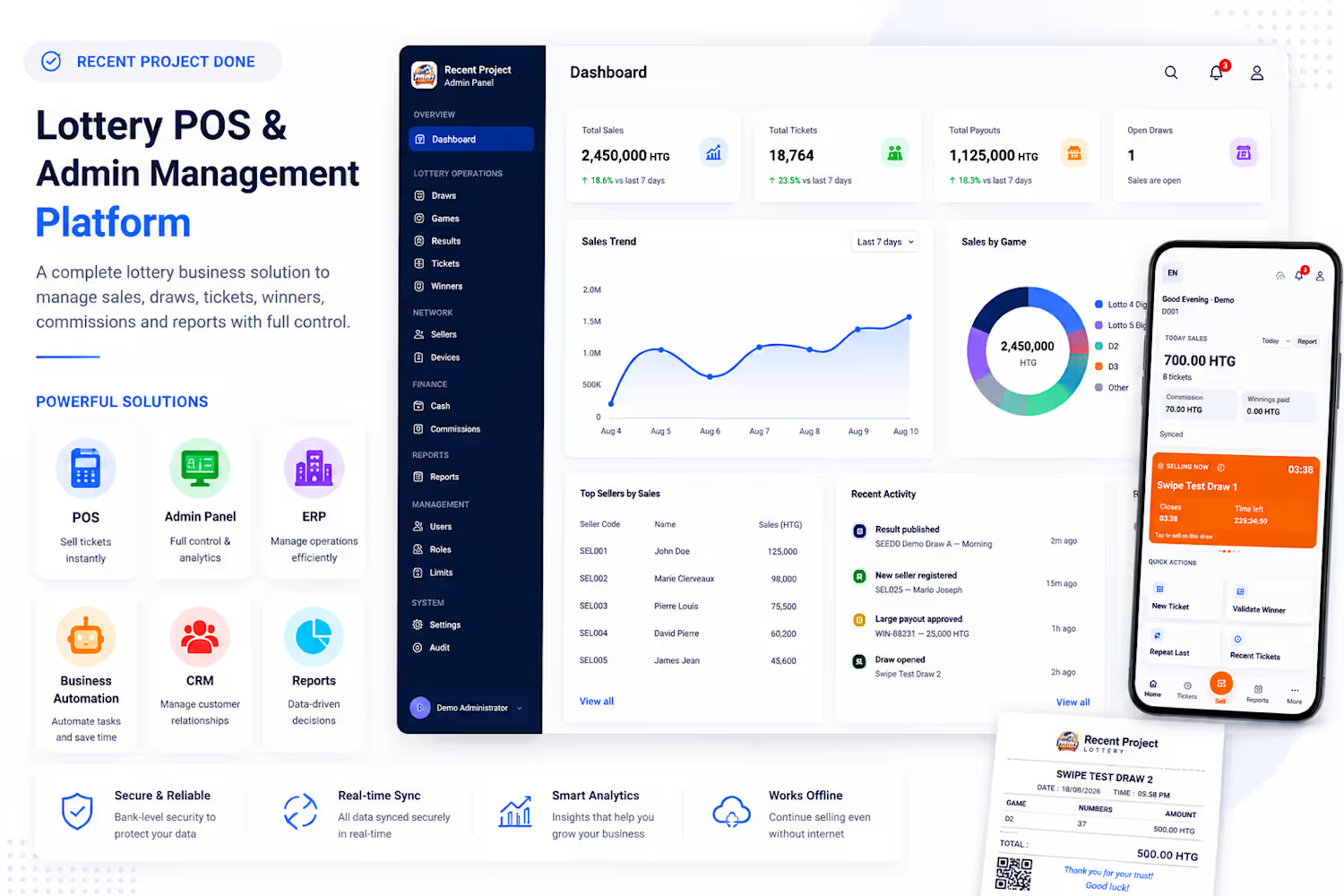
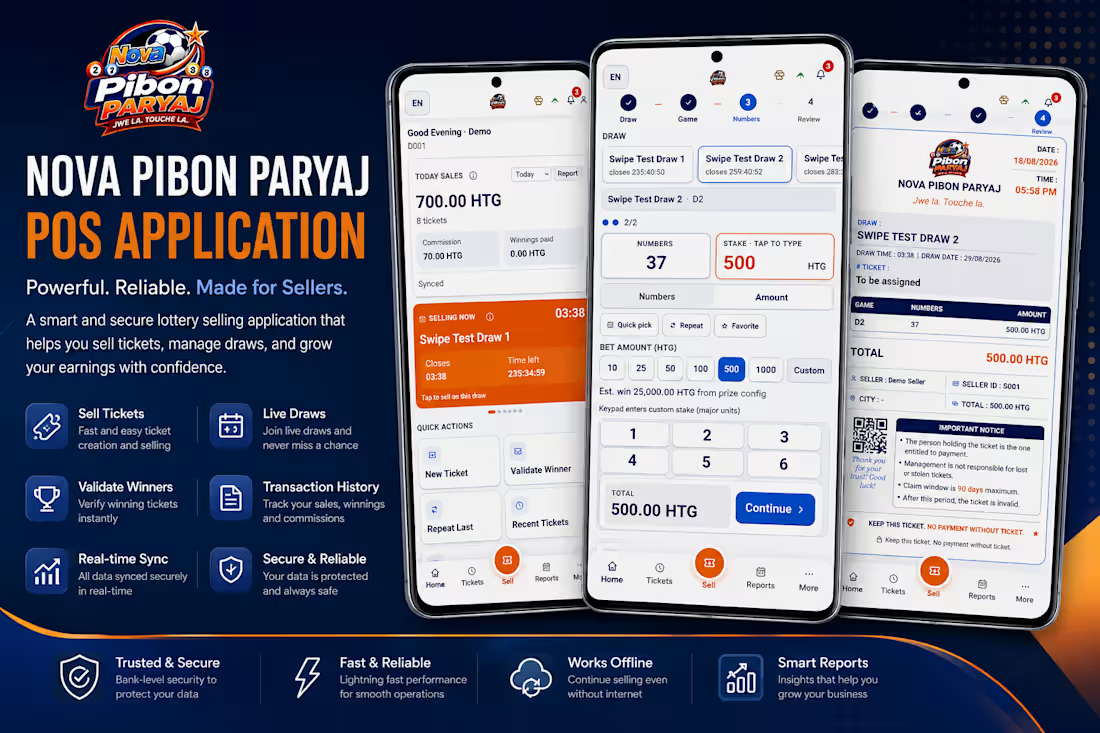
I developed a complete, scalable POS platform for a growing business, with a strong focus on reliability, security, hardware readiness, and long-term scalability. The project was valued at $7,000+ and involved building the core POS experience, administrative management system, backend architecture, authentication, transaction workflows, reporting, device management, and a foundation designed to support up to 5,000 POS devices. The most important part of the project was understanding the business requirements first and then translating them into a practical software system. The development also included dedicated support and a structured issue-reporting portal, allowing the client to report problems directly and receive ongoing development support. The initial development timeline was around 6 weeks, but the core system was delivered significantly earlier, in approximately 4 weeks, while maintaining a strong focus on functionality and stability. This project involved much more than simply building screens. It required designing the underlying architecture so the platform could grow with the business, while keeping the system maintainable and ready for future hardware and operational integrations.
1
77
Cover image for SmoothSe
Development Journey and Product Case
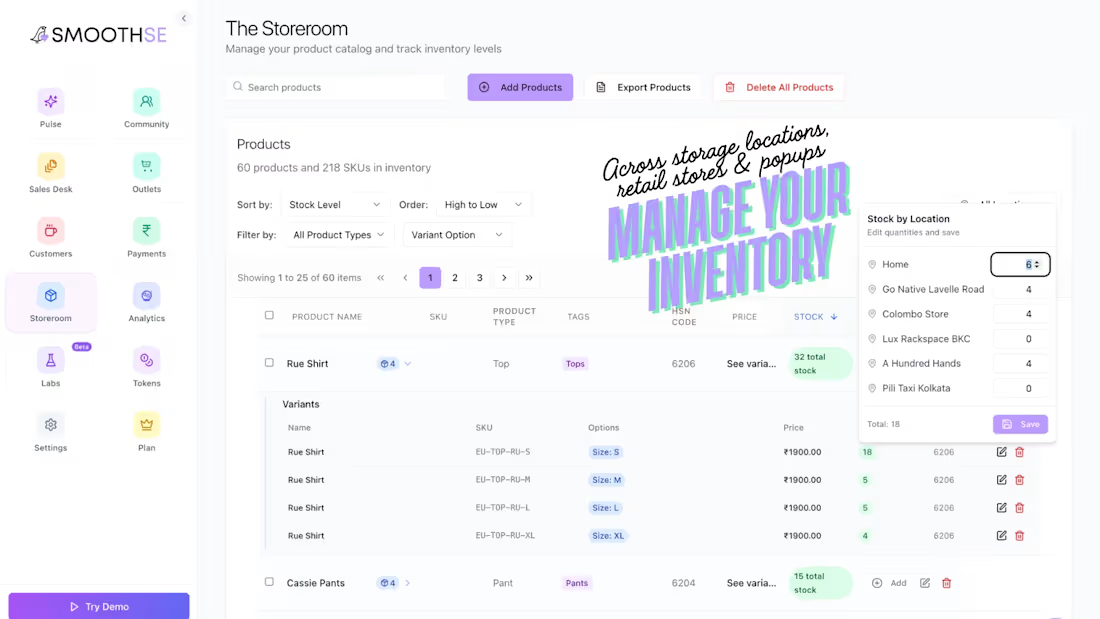
SmoothSe Development Journey and Product Case Study Project Overview SmoothSe is a business management platform designed for small D2C brands that operate across multiple sales channels. Instead of managing Shopify orders, marketplace orders, retail sales, popup-event transactions, inventory, customer information, invoices, and business analytics separately, SmoothSe brings these operational workflows into one system. (Shopify App Store (https://apps.shopify.com/smoothse)) The product focuses on five major operational areas: The goal is to give D2C founders a single operational view instead of forcing them to switch between multiple systems. 1. The Business Problem A growing D2C brand rarely operates through Shopify alone. A merchant may receive orders from: At the same time, inventory may exist across multiple physical and online locations. This creates a fragmented workflow: The merchant has to reconcile information across different systems. SmoothSe addresses this by creating a central operational layer. 2. Product Objective The product was designed around a straightforward operational objective: Give small D2C brands one place to manage their business operations. Instead of treating each sales channel independently, SmoothSe connects them to a shared operational system. 3. Core Product Modules The application combines several operational modules. The Shopify listing specifically highlights multi-location inventory, cross-channel order management, GST-compliant invoices, customer segmentation, popup and retail selling, digital receipts, data insights, and AI-driven business insights. (Shopify App Store (https://apps.shopify.com/smoothse)) 4. Development Journey Phase 1: Operational Workflow Discovery The first challenge was understanding that the problem was not simply "Shopify management." The target customer operates across several environments. The application therefore needed to work as an operational hub rather than another isolated Shopify utility. 5. Phase 2: Multi-Channel Order Management One of the central problems is order fragmentation. Instead of checking individual platforms: the system brings the operational data into one place. This gives the merchant a unified view of sales activity. The Shopify listing specifically describes synchronization and management of orders from Shopify and other sales channels. (Shopify App Store (https://apps.shopify.com/smoothse)) 6. Phase 3: Inventory Architecture Multi-channel selling creates a difficult inventory problem. If the same product is sold through Shopify, a popup event, and a retail location, inventory must remain synchronized. A simplified flow is: The application supports multi-location inventory management and real-time inventory synchronization. The Shopify listing also identifies forecasting, optimization, reports, and inventory value overview as supported capabilities. (Shopify App Store (https://apps.shopify.com/smoothse)) 7. Phase 4: Order and Inventory Relationship Order management and inventory cannot operate independently. When an order is created: When inventory changes at a physical location: This relationship is one of the core operational challenges of a multi-channel commerce platform. 8. Phase 5: GST Invoice Automation For businesses operating in India, invoicing introduces additional requirements. Instead of manually preparing invoices for every order, SmoothSe provides automated GST-compliant invoicing and reporting. (Shopify App Store (https://apps.shopify.com/smoothse)) The workflow becomes: The product listing specifically highlights one-click GST invoice generation and automated GST-compliant invoices and reports. (Shopify App Store (https://apps.shopify.com/smoothse)) 9. Phase 6: Popup and Retail Operations D2C brands often sell outside their online store. Examples include: These transactions still need to become part of the merchant's overall business records. SmoothSe supports popup and retail selling, including payment collection, customer capture, and digital receipts. (Shopify App Store (https://apps.shopify.com/smoothse)) A simplified workflow: 10. Phase 7: Rapid Popup Order Entry Popup environments create a different UX requirement. A salesperson may need to record an order while interacting directly with a customer. The process needs to be faster than a traditional back-office workflow. SmoothSe's listing specifically highlights rapid order recording by voice for popup events. (Shopify App Store (https://apps.shopify.com/smoothse)) Conceptually: This is particularly relevant for temporary retail environments where speed directly affects the number of customers a salesperson can process. 11. Phase 8: Customer Management Customer information is generated across multiple channels. Instead of maintaining separate customer records: the platform can centralize customer information. The application also supports customer segmentation and messaging across channels. (Shopify App Store (https://apps.shopify.com/smoothse)) 12. Phase 9: Business Analytics Once orders, inventory, customers, and financial information exist in one system, the platform can provide a broader business view. Instead of looking at individual operational records: the system can combine them into business-level insights. This moves the product beyond basic order management. 13. Phase 10: AI Business Assistant One of the more advanced components is the built-in AI assistant. Instead of requiring the merchant to manually inspect dashboards, the system can answer questions using live business data and surface potential growth opportunities. (Shopify App Store (https://apps.shopify.com/smoothse)) The conceptual architecture is: Example questions could include: The purpose is to turn operational data into actionable information. 14. Phase 11: Unified Business Dashboard The platform's value depends on how quickly a merchant can understand the state of the business. A useful dashboard structure is: This creates a single operational entry point for the merchant. 15. Technical Architecture A simplified architecture for the platform can be represented as: Supporting services would include: 16. Data Architecture A simplified domain model can be represented as: The important relationship is: This provides the foundation for unified reporting. 17. Synchronization Challenges A multi-channel commerce platform has a synchronization problem that a standard single-store application does not. For example: A sale at a popup event changes the available inventory. The system therefore needs reliable synchronization between operational locations and sales channels. Potential failure cases include: These require validation, retry logic, event handling, and clear source-of-truth rules. 18. Security and Data Access The platform handles sensitive business and customer information. The Shopify App Store listing indicates access to customer information, products, inventory, orders, locations, and store-owner information. (Shopify App Store (https://apps.shopify.com/smoothse)) The architecture therefore needs strong controls around: For a multi-store SaaS application: Data belonging to one merchant must never become accessible to another merchant. 19. User Experience Strategy The product serves users who are not necessarily technical. The interface therefore needs to prioritize: The complexity should remain in the backend. For example, a merchant should see: rather than needing to understand how synchronization between multiple channels works. 20. Current Product Validation SmoothSe launched on the Shopify App Store on July 22, 2026. At the time of this review, the listing shows a 5.0 rating from 2 reviews. (Shopify App Store (https://apps.shopify.com/smoothse)) The two published reviews specifically mention: Fast Shopify integration Easy setup Centralized business management Popup and online order management GST invoice generation Responsive customer support (Shopify App Store (https://apps.shopify.com/smoothse)) Because the product is still very early in its App Store lifecycle, the current review count should be considered early user validation rather than evidence of mature product-market fit. 21. What Makes SmoothSe Technically Interesting The interesting part of the product is not any individual feature. It is the connection between multiple operational systems. The platform is essentially an operational data layer connecting sales, inventory, customers, finance, and business intelligence. 22. Key Engineering Decisions Unified Operational Layer Instead of building isolated tools for each channel, the product connects them through one operational system. Centralized Inventory Inventory is treated as a shared business resource rather than separate channel-specific numbers. Shopify Integration Shopify remains an important commerce channel while SmoothSe provides broader operational management. Event-Based Synchronization Changes in orders and inventory need to propagate between connected systems. AI on Business Data The AI assistant operates on business information instead of functioning as a generic chatbot. Modular Architecture Orders, inventory, customers, invoices, analytics, and AI can evolve independently while sharing common business data. 23. Future Development Opportunities The current architecture creates several natural expansion opportunities. Advanced Forecasting Automated Reordering Advanced Customer Intelligence AI Business Operations The AI layer could evolve from answering questions into actively recommending actions. Examples: 24. Development Lessons 1. Solve the Operational Problem, Not Just the Shopify Problem The merchant's problem extends beyond Shopify. 2. Centralized Data Creates More Value Than Isolated Features Orders become more useful when they connect to customers, inventory, invoices, and analytics. 3. Multi-Channel Systems Need Strong Synchronization Data consistency becomes a core engineering problem as soon as multiple sales channels are involved. 4. Offline Commerce Should Still Become Digital Business Data Popup and retail transactions should eventually become part of the same reporting system as online sales. 5. AI Becomes More Useful When Connected to Real Business Data A business assistant becomes significantly more valuable when it can reason about actual orders, inventory, customers, and revenue. 25. Final Product Summary Product: SmoothSe Platform: Shopify + Multi-Channel Commerce Category: ERP / Business Management Target Users: Core Modules: Core Product Flow: 26. Final Case Study Statement SmoothSe was built around a specific operational problem faced by growing D2C brands: business data becomes fragmented as the brand expands beyond a single Shopify storefront. The product addresses this by connecting online orders, marketplace activity, retail sales, popup transactions, inventory, customers, invoices, and business analytics into a unified operational platform. The resulting architecture can be summarized as: The core engineering challenge is maintaining a consistent view of the business while data continuously enters the system from different channels and physical locations. That makes SmoothSe more than a Shopify management application. It is designed as an operational control layer for multi-channel D2C businesses.
1
51
Cover image for Quoffer
Development Journey and Product Case
Quoffer Development Journey and Product Case Study Project Overview Quoffer is a Shopify application for merchants who need to sell products through negotiated pricing instead of relying only on fixed-price checkout. The product supports two primary workflows: Request a Quote Make an Offer The system connects these workflows to merchant review, negotiation, automated pricing rules, draft orders, invoices, notifications, and Shopify order creation. The core product flow is: The key product objective was to keep the negotiation process inside the Shopify ecosystem instead of forcing merchants to manage it through email, spreadsheets, phone calls, or external messaging platforms. 1. Problem Definition Shopify works extremely well when the merchant has a fixed product price. The standard flow is: This becomes inefficient for businesses where price depends on the customer or transaction. Examples include: Wholesale purchasing Bulk orders High-value products Custom products Made-to-order products Art and collectibles B2B purchasing Negotiated discounts A wholesale customer purchasing 500 units may expect a different price from someone purchasing five units. A merchant selling a $5,000 product may also be willing to accept a $4,200 offer. Without a dedicated workflow, the merchant might handle the process manually: This creates unnecessary work and increases the possibility of pricing and order-entry errors. Quoffer was designed to remove this gap. 2. Product Objective The product was designed around a simple objective: Allow merchants to manage negotiated sales without leaving Shopify. Instead of treating an offer or quote as an isolated form submission, the application treats it as the beginning of a transaction. The intended lifecycle is: This distinction is important. A form that collects an offer is only a feature. A system that takes the offer through negotiation and eventually creates a real Shopify transaction is a complete commerce workflow. 3. Product Scope The product was structured around two different purchasing scenarios. 3.1 Request a Quote The quote workflow is primarily useful for B2B and wholesale purchasing. A customer can submit products, quantities, contact information, and additional requirements. Example: This approach is more appropriate than showing a single retail price when the final price depends on order volume or customer requirements. 3.2 Make an Offer The second workflow allows customers to propose their own price. Example: A counter-offer creates a negotiation rather than forcing the merchant to accept or reject the customer's first proposal. 4. Development Journey Phase 1: Product Discovery The first challenge was deciding what the product should actually solve. The Shopify App Store already contains applications focused on: Make an Offer Request a Quote Wholesale Pricing Discounts B2B purchasing Building another application that only added a "Make an Offer" button would provide limited differentiation. The product direction was therefore expanded. Instead of: the product became: This decision influenced the application architecture, database design, merchant dashboard, and Shopify integration. 5. Phase 2: Negotiation State Design An offer cannot be treated as a single database record containing only a price. A real negotiation can contain multiple actions. Example: The application therefore needs to preserve the history of the negotiation. A simplified state model is: This makes the negotiation traceable and prevents the system from losing previous pricing decisions. 6. Phase 3: Offer Engine The offer engine handles the basic commercial decisions. The three fundamental actions are: The engine also needs to understand the original product price, proposed price, currency, customer, product, merchant decision, and current negotiation state. For example: The merchant can then decide whether to accept, reject, or counter the offer. 7. Phase 4: Automated Offer Rules Manual evaluation becomes inefficient when a store receives a large number of offers. The system therefore supports rule-based decisions. Example: Another rule: Another: The important architectural decision is that these rules should exist independently from the storefront interface. The storefront submits the offer. The rule engine evaluates it. The decision engine performs the appropriate action. This makes the system easier to extend later. 8. Phase 5: B2B Quote Management B2B quoting introduces additional complexity because a quote can contain multiple products and quantities. Example: The merchant may then provide custom pricing for the complete request. The system therefore needs to maintain relationships between: This structure allows the application to handle a real quotation instead of treating the request as a simple contact form. 9. Phase 6: Quantity-Based Pricing Wholesale pricing often depends on volume. A merchant may define: This creates two complementary mechanisms: The merchant can automate predictable pricing while retaining control over unusual or high-value deals. 10. Phase 7: Merchant Dashboard As offer volume grows, managing everything through email becomes impractical. The merchant dashboard therefore becomes the operational center of the application. A simplified dashboard structure is: The objective is to give merchants one place to review and manage active negotiations. 11. Phase 8: Negotiation History Every negotiation needs an understandable timeline. Example: This history provides both operational visibility and commercial accountability. It also helps merchants understand how a final selling price was reached. 12. Phase 9: Shopify Draft Order Integration A major architectural decision was to use Shopify's existing order infrastructure instead of creating an independent order system. After an offer is accepted: This allows the merchant to continue using Shopify for: Orders Customers Products Payments Fulfillment Store administration Quoffer effectively becomes the negotiation layer on top of Shopify. 13. Phase 10: Payment and Invoice Workflow For B2B sales, payment does not always happen through a normal storefront checkout. The merchant may first need to issue an invoice or payment request. The workflow therefore becomes: This keeps the commercial agreement and the Shopify transaction connected. 14. Phase 11: Notification System Negotiation is time-sensitive. A merchant may lose a sale if an offer remains unanswered for too long. The application therefore needs notification events around important actions. Examples: The application also supports configurable communication capabilities such as email notifications and external alerts. The purpose is not simply to send more notifications. The objective is to reduce the response time between a customer's offer and the merchant's decision. 15. Phase 12: Custom Forms Different businesses require different information. For example: Another merchant may need: A fixed form would limit the application. A configurable form system allows the merchant to define the information required for their own sales workflow. 16. Phase 13: Storefront Integration The storefront interface was intentionally kept simple. The customer should not need to understand the complexity of the backend system. Example: Clicking the relevant action opens the appropriate workflow. The complexity remains inside the application. 17. Phase 14: Pricing Visibility Some merchants want to display a price. Others prefer to hide the price and request a quote. The application therefore needs to support different storefront strategies. Example 1: Example 2: Example 3: This allows the same application to support different sales models. 18. Phase 15: Internationalization The application is intended for Shopify merchants operating across different markets. Important considerations include: Multiple currencies Translated customer-facing content Localized forms Localized notifications Merchant-defined text The architecture should keep UI content separate from application logic so that language changes do not require changes to the underlying business rules. 19. Technical Architecture A simplified architecture looks like this: Supporting services handle: 20. Data Architecture A simplified data model can be represented as: The store relationship is critical. Every quote, offer, customer-related record, rule, and negotiation must remain associated with the correct Shopify store. This is essential for multi-tenant SaaS security. 21. Reliability Considerations Negotiated commerce introduces several cases that need explicit handling. Duplicate Offer A customer accidentally submits the same offer twice. The system should prevent duplicate processing. Concurrent Offers Multiple customers may negotiate for the same product. Inventory and offer validity must therefore be considered. Product Price Changes The product price may change while an offer is still pending. The application needs a clear policy for whether the existing offer remains valid. Inventory Changes A product could become unavailable after a negotiation begins. The system must prevent an accepted offer from creating an invalid transaction. Expired Offers Merchants may want offers to expire after a specific period. Payment Failure A customer can accept an offer without successfully completing payment. The negotiation and order states must therefore remain separate. Shopify API Failure External API failures should not leave the application in an inconsistent state. These cases require idempotency, validation, retry handling, and explicit transaction states. 22. Security Architecture The application works with customer and commerce information, making security a core architectural requirement. Important areas include: Other important controls include: Webhook verification API authorization Input validation Secure credentials Tenant isolation Rate-limit handling Audit logging Controlled data access The fundamental rule is: No merchant should ever be able to access another merchant's data. 23. Product Feedback and Iteration The early product feedback highlighted an important shift. Once the main functionality was available, the focus moved from: "Does the feature work?" to: "Can merchants operate the feature efficiently?" Feedback areas included: Dashboard navigation Configuration workflow Notification settings Feature interaction UI refinement This is an important stage in SaaS development. The next improvement is not always another feature. Sometimes the highest-value improvement is reducing the number of steps required to complete an existing task. 24. Product Validation Quoffer launched on the Shopify App Store in January 2026. At the time of analysis, the Shopify listing showed a 4.7/5 rating from 6 reviews. The early reviews highlighted areas including: UI Customization Ease of use Customer support Offer functionality The review count is still small, so this should be treated as early validation rather than conclusive product-market fit. The more important signal at this stage is whether merchants continue using the application after initial installation and whether they successfully complete real negotiated transactions. 25. Competitive Position Quoffer operates across several Shopify categories: The product's positioning comes from connecting these workflows. Instead of providing only: the broader workflow becomes: That is the more meaningful product differentiation. 26. Business Value The primary business value is the ability to recover transactions that may otherwise be lost because the customer cannot accept the standard price. Traditional flow: Negotiated flow: For B2B merchants, the same system reduces the manual work involved in preparing and managing quotations. 27. What Makes the Product Technically Interesting The visible feature is simple: Make an Offer The underlying system is considerably more complex. It needs to connect: The engineering challenge is therefore not the button. It is maintaining a consistent transaction lifecycle across multiple systems. 28. Key Engineering Decisions Shopify as the Commerce Backbone Products, customers, orders, and payments remain connected to Shopify. State-Based Negotiation Every offer has a defined lifecycle. Separate Rule Engine Pricing and negotiation rules are separated from UI components. Negotiation History Previous offers and counter-offers remain traceable. Multi-Tenant Architecture Each Shopify store is isolated from every other store. Event-Driven Processing Important Shopify and application events can trigger automated actions. 29. Future Development Opportunities The current architecture creates several potential expansion paths. Pricing Intelligence The system could recommend counter-offers based on: Historical acceptance rates Product margin Inventory Customer value Previous negotiations Sales Analytics Merchants could track: CRM Integration Negotiation information could be synchronized with CRM platforms. AI-Assisted Negotiation The system could recommend: Agency Management Agencies could manage multiple Shopify stores from one administrative environment. 30. Development Lessons Lesson 1: Define the Transaction Before Building the Interface The negotiation lifecycle determines the database, API, UI, and integration architecture. Lesson 2: Preserve Business History A final price without the negotiation history loses important commercial information. Lesson 3: Keep Shopify as the Source of Commerce Truth There is little value in rebuilding Shopify's order infrastructure. Lesson 4: Separate Automation From Presentation The storefront should remain simple while the backend handles complex rules. Lesson 5: Design for Failure From the Beginning API failures, duplicate events, payment failures, and inventory changes are normal operational conditions. Lesson 6: Optimize Existing Workflows Before Adding Features A faster and clearer workflow can create more value than another feature. 31. Final Product Summary Product: Quoffer Platform: Shopify Category: B2B and B2C negotiated commerce Primary users: Wholesale merchants B2B businesses High-value product sellers Custom-product businesses Merchants using negotiated pricing Core workflows: Core technical components: Core business objective: Convert negotiated customer intent into completed Shopify transactions while reducing manual merchant work. 32. Final Case Study Statement Quoffer was developed to solve a specific limitation in conventional Shopify commerce: the assumption that every product must be purchased at a predefined price. The product introduces a structured negotiation layer between the customer and Shopify checkout. The result is a Shopify-native workflow that allows merchants to handle wholesale quotes, negotiated prices, counter-offers, and high-value transactions without moving the sales process into disconnected external tools. The most important engineering challenge was not creating an offer form. It was building a reliable system that could take a non-standard customer request through pricing logic, negotiation, merchant approval, and finally into a real Shopify transaction. That workflow is the foundation of Quoffer.
2
58
Cover image for Case Study: Simple Tagger -
Case Study: Simple Tagger - Shopify Store Automation App 1. Executive Summary Simple Tagger – Automate Tag is a Shopify automation application designed to help merchants automatically organize and classify their store data using configurable tagging rules. Instead of manually tagging customers, products, and orders, merchants can define conditions that trigger automated tagging actions. This transforms repetitive administrative work into an automated workflow. The product follows a straightforward automation model: Event/Data → Conditions → Rule Evaluation → Automatic Tag → Activity Tracking The app is positioned as an affordable Shopify micro-SaaS product, with subscription plans beginning at approximately $4/month. 2. Business Problem Shopify merchants frequently need to categorize their customers, orders, and products. For example, a merchant may want to identify: High-value customers Large orders Customers from specific countries Specific product categories Repeat customers Special customer segments Orders requiring manual attention Without automation, merchants have to repeatedly inspect Shopify data and manually assign tags. This creates several problems: Time consumption Manual tagging becomes increasingly difficult as order volume grows. Human error Merchants may forget to tag an order or apply the wrong tag. Inconsistent store organization Different staff members may use different tagging conventions. Poor scalability Manual workflows become impractical for high-volume Shopify stores. Limited operational visibility Merchants need to know whether automation rules are actually executing successfully. Simple Tagger addresses these problems by turning tagging into an automated rules-based process. 3. Product Solution The central concept of Simple Tagger is a configurable automation engine. A merchant creates a rule containing: Trigger / Data Condition → Logical Conditions → Tagging Action For example: Example 1: High-Value Order Condition: Order value > $1,000 Action: Add tag: VIP-ORDER Example 2: Geographic Customer Segmentation Condition: Customer location = Canada Action: Add tag: CANADA Example 3: Product-Based Classification Condition: Product type = Shoes Action: Add tag: SHOES Example 4: Multiple Conditions Conditions: Product type = Shoes AND Order value > $200 Action: Add tag: HIGH-VALUE-SHOE-ORDER This allows merchants to create more sophisticated store-management workflows without writing code. 4. Core Product Features 4.1 Automated Tagging The primary feature automatically applies tags to Shopify objects according to predefined rules. Supported objects include: Orders Customers Products This eliminates repetitive manual classification. 4.2 Multi-Condition Rules The application supports rules involving multiple conditions. Instead of creating a separate automation for every possible scenario, merchants can combine conditions to create more precise workflows. For example: Customer location = United States AND Order value > $500 → Apply: US-HIGH-VALUE This increases the flexibility of the automation engine. 4.3 Real-Time Processing The application is designed around real-time automation. When relevant Shopify events occur, the system evaluates the applicable rules and executes the corresponding tagging action. This means merchants do not necessarily need to manually initiate a synchronization process. 4.4 Activity Monitoring Automation systems require visibility. Simple Tagger includes activity/logging functionality that allows merchants to monitor automation activity and understand whether rules are executing successfully. This provides operational transparency and helps identify problems with automation rules. 4.5 Rule Templates The application includes predefined templates intended to help merchants create common automation workflows more quickly. This reduces the learning curve for users who may not understand automation logic immediately. 4.6 Bulk Reprocessing Higher-tier functionality provides bulk reprocessing capabilities. This is particularly useful when a merchant creates a new rule and wants it applied to existing Shopify data rather than only future events. For example: A merchant creates: Order > $500 → VIP They may then need the rule applied to historical orders. Bulk processing makes that possible at scale. 4.7 Workflow Builder The higher-tier product offering includes a workflow-building capability. This indicates a progression from simple single-condition tagging toward more sophisticated automation workflows. The product therefore has the potential to evolve from a tagging utility into a broader Shopify workflow automation platform. 5. User Workflow A typical merchant workflow can be represented as follows: This workflow keeps the merchant interaction simple while moving the complexity into the automation engine. 6. Target Customers The product is primarily relevant to Shopify merchants who have enough operational volume to benefit from automation. Primary Customers Growing Shopify stores High-order-volume merchants Multi-product stores Stores with customer segmentation requirements Stores with complex order-management workflows Shopify agencies managing multiple stores Secondary Customers Shopify consultants E-commerce operations teams Marketing teams Customer-support teams Merchants performing CRM segmentation 7. Pricing Strategy The product uses a tiered SaaS subscription model. Plan Approx. Monthly Price Intended Customer Basic $4/month Small stores Growth $20/month Growing stores Pro $59/month Advanced merchants Business $199/month High-volume businesses Annual billing is also offered at discounted rates. The pricing strategy follows a common SaaS progression: Low entry price → Increased usage limits → Advanced functionality → Enterprise-scale usage This allows merchants to start with a low financial commitment and upgrade as their automation requirements grow. 8. Monetization Model The product uses recurring subscription revenue rather than a one-time purchase. The primary monetization variables are: Number of automation rules Number of automation executions/runs Advanced workflow functionality Bulk processing Higher operational limits This is a strong model for a Shopify application because the merchant's usage tends to increase together with store growth. A simplified revenue model is: MRR = Paying Stores × Average Revenue Per Store For example: If an application reaches: 1,000 paying stores with an average revenue of: $20/month then: MRR = $20,000 and: ARR = $240,000 This demonstrates why relatively small Shopify utilities can become attractive SaaS businesses when distribution is strong. 9. Technical Product Architecture A likely high-level architecture for this type of application would be: A scalable implementation would typically separate: Shopify Integration Layer Responsible for: OAuth API communication Webhooks Store authentication Shopify data synchronization Rule Engine Responsible for: Condition evaluation AND/OR logic Rule prioritization Rule activation/deactivation Execution Engine Responsible for: Applying actions Handling retries Preventing duplicate execution Recording execution results Data Layer Stores: Merchant/store information Rules Conditions Actions Execution history Usage statistics Application configuration Monitoring Layer Tracks: Successful executions Failed executions Processing time API errors Rule activity Usage limits 10. Security and Permissions Because the application interacts with Shopify customer, product, and order data, permission management is an important part of the product architecture. The application requires access to relevant Shopify resources to perform its automation functionality. Potential security considerations include: OAuth-based store authentication Shopify access-token protection Least-privilege API scopes Secure webhook validation Encryption of sensitive credentials Tenant isolation Audit logging Rate-limit handling Secure API communication Data-retention policies For a production Shopify SaaS, multi-tenant isolation is particularly important because one application's backend may serve many independent Shopify stores. 11. UX Strategy The product benefits from having a relatively simple user experience despite the complexity of the underlying automation system. The ideal UX can be structured around five steps: Step 1 — Select Object Choose: Order Customer Product Step 2 — Define Condition Example: Order Value > $500 Step 3 — Select Action Example: Add Tag → VIP Step 4 — Activate Turn the automation on. Step 5 — Monitor Review execution history and success/failure information. This reduces the cognitive load compared with traditional workflow automation systems. 12. Competitive Positioning Simple Tagger operates in a useful niche between: Manual Shopify administration and Large-scale workflow automation platforms Its competitive advantage can be summarized as: Simple automation focused specifically on Shopify tagging and store organization. Rather than attempting to solve every possible e-commerce automation problem, the product focuses on a narrow operational problem. This can be advantageous because a narrowly defined product can communicate its value more clearly. 13. Strengths 1. Clear Problem Definition The application solves a specific operational problem rather than attempting to be an overly broad platform. 2. Low Entry Price A low starting price reduces adoption friction for small Shopify merchants. 3. Recurring Revenue The subscription model creates predictable recurring revenue potential. 4. Automation Value The product saves merchants repetitive operational work. 5. Expandable Architecture Tag automation can potentially evolve into broader Shopify workflow automation. 6. Scalable Customer Model The SaaS model allows the same software infrastructure to serve many Shopify stores. 14. Potential Weaknesses The product also faces several challenges. Limited Initial Scope Tagging alone may not provide enough value for some merchants to justify higher subscription prices. Strong Competition Shopify already has a large ecosystem of automation and workflow applications. Platform Dependency The application depends heavily on Shopify APIs, policies, rate limits, and platform changes. Retention Challenge Once merchants configure their rules, the product can become a "set-and-forget" utility. This can reduce engagement unless the application continuously demonstrates operational value. Discoverability A Shopify App Store application needs strong: SEO Reviews Screenshots App Store conversion Merchant trust Onboarding to compete successfully. 15. Growth Opportunities The product could expand beyond simple tagging. Potential future capabilities include: Customer Automation Customer segmentation VIP identification Customer lifecycle tags Repeat-purchase detection Order Automation Fraud-risk classification High-value order detection Fulfillment categorization Geographic routing Product Automation Inventory-based tags Product lifecycle tags Collection automation Supplier-based classification Marketing Automation Integration with: Email platforms SMS platforms CRM systems Advertising platforms This could turn the application into a broader: Shopify Store Automation Platform rather than simply a tagging application. 16. Strategic Analysis The most interesting aspect of Simple Tagger is not the tagging feature itself. The strategic opportunity is the automation engine underneath it. Tagging is simply the initial use case. Once the application has: Shopify event processing Condition evaluation Rule management Action execution Execution monitoring Merchant configuration Usage metering the same infrastructure can support many other actions. For example: At that point, the product moves from a tagging application toward a general-purpose Shopify automation platform. 17. Business Model Opportunity A broader version of the product could use a usage-based SaaS model. Possible pricing dimensions: Rules Number of active workflows. Executions Number of automation runs. Stores For agencies managing multiple Shopify stores. Advanced Actions Premium integrations and workflow actions. Historical Processing Premium access to bulk/historical processing. This provides multiple opportunities for expansion revenue. 18. Key Lessons The product demonstrates several important SaaS principles. Lesson 1: Solve a Small Problem First A narrowly defined operational problem can be easier to market than a large, complicated platform. Lesson 2: Automation Creates Recurring Value If the product continuously saves merchant time, subscription pricing becomes easier to justify. Lesson 3: Usage-Based Limits Create Natural Upgrade Paths Small merchants can start cheaply while larger merchants pay more because they consume more resources. Lesson 4: Infrastructure Can Become the Real Product The initial tagging functionality can serve as an entry point into a much larger automation ecosystem. Lesson 5: Shopify Provides a Large Distribution Platform Building on Shopify gives developers access to a large ecosystem of merchants, but competition and platform dependency must be considered. 19. Conclusion Simple Tagger – Automate Tag represents a focused Shopify SaaS product built around a straightforward business problem: automating repetitive store classification and tagging tasks. Its product strategy combines: Simple automation Rule-based conditions Real-time processing Activity monitoring Tiered subscriptions Usage-based limitations Advanced functionality for larger merchants The strongest long-term opportunity is not merely selling automated tags. The underlying rule engine can become the foundation for a much broader Shopify automation platform. From a business perspective, the product illustrates how a relatively narrow operational problem can be converted into a recurring-revenue SaaS product when the solution is easy to understand, inexpensive to adopt, and capable of scaling with merchant usage.
1
46