The network for creativity
Join 1.25M professional creatives like you
Connect with clients, get discovered, and run your business 100% commission-free
Creatives on Contra have earned over $150M and we are just getting started
Back to feedPost

SmoothSe
Development Journey and Product Case Study
Project Overview
SmoothSe is a business management platform designed for small D2C brands that operate across multiple sales channels.
Instead of managing Shopify orders, marketplace orders, retail sales, popup-event transactions, inventory, customer information, invoices, and business analytics separately, SmoothSe brings these operational workflows into one system. (Shopify App Store)
The product focuses on five major operational areas:
The goal is to give D2C founders a single operational view instead of forcing them to switch between multiple systems.
1. The Business Problem
A growing D2C brand rarely operates through Shopify alone.
A merchant may receive orders from:
At the same time, inventory may exist across multiple physical and online locations.
This creates a fragmented workflow:
The merchant has to reconcile information across different systems.
SmoothSe addresses this by creating a central operational layer.
2. Product Objective
The product was designed around a straightforward operational objective:
Give small D2C brands one place to manage their business operations.
Instead of treating each sales channel independently, SmoothSe connects them to a shared operational system.
3. Core Product Modules
The application combines several operational modules.
The Shopify listing specifically highlights multi-location inventory, cross-channel order management, GST-compliant invoices, customer segmentation, popup and retail selling, digital receipts, data insights, and AI-driven business insights. (Shopify App Store)
4. Development Journey
Phase 1: Operational Workflow Discovery
The first challenge was understanding that the problem was not simply "Shopify management."
The target customer operates across several environments.
The application therefore needed to work as an operational hub rather than another isolated Shopify utility.
5. Phase 2: Multi-Channel Order Management
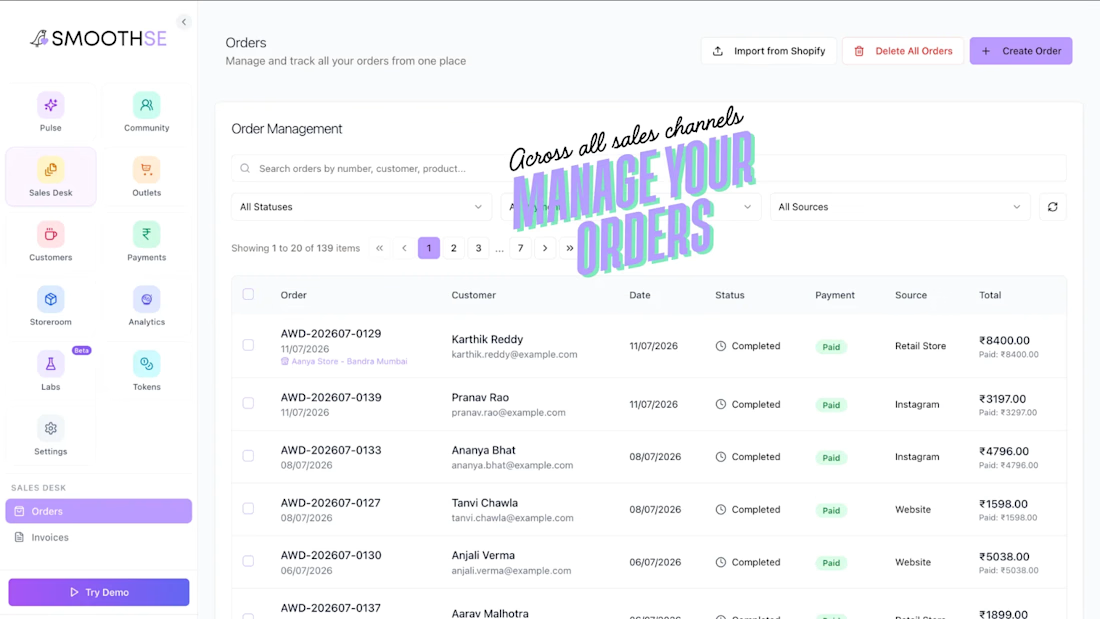
One of the central problems is order fragmentation.
Instead of checking individual platforms:
the system brings the operational data into one place.
This gives the merchant a unified view of sales activity.
The Shopify listing specifically describes synchronization and management of orders from Shopify and other sales channels. (Shopify App Store)
6. Phase 3: Inventory Architecture
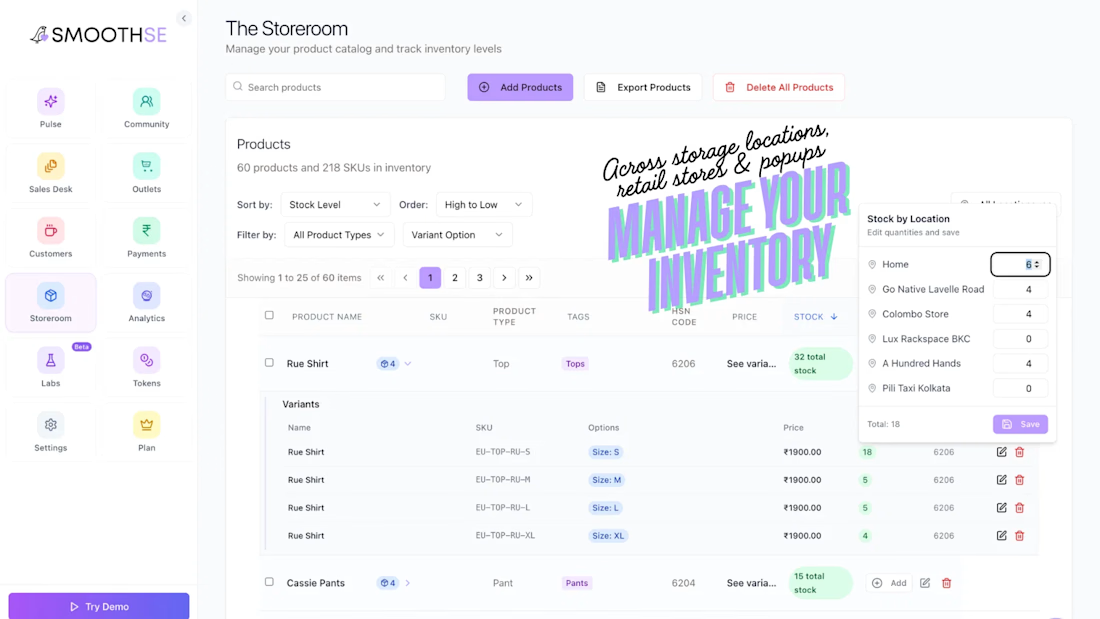
Multi-channel selling creates a difficult inventory problem.
If the same product is sold through Shopify, a popup event, and a retail location, inventory must remain synchronized.
A simplified flow is:
The application supports multi-location inventory management and real-time inventory synchronization. The Shopify listing also identifies forecasting, optimization, reports, and inventory value overview as supported capabilities. (Shopify App Store)
7. Phase 4: Order and Inventory Relationship
Order management and inventory cannot operate independently.
When an order is created:
When inventory changes at a physical location:
This relationship is one of the core operational challenges of a multi-channel commerce platform.
8. Phase 5: GST Invoice Automation
For businesses operating in India, invoicing introduces additional requirements.
Instead of manually preparing invoices for every order, SmoothSe provides automated GST-compliant invoicing and reporting. (Shopify App Store)
The workflow becomes:
The product listing specifically highlights one-click GST invoice generation and automated GST-compliant invoices and reports. (Shopify App Store)
9. Phase 6: Popup and Retail Operations
D2C brands often sell outside their online store.
Examples include:
These transactions still need to become part of the merchant's overall business records.
SmoothSe supports popup and retail selling, including payment collection, customer capture, and digital receipts. (Shopify App Store)
A simplified workflow:
10. Phase 7: Rapid Popup Order Entry
Popup environments create a different UX requirement.
A salesperson may need to record an order while interacting directly with a customer.
The process needs to be faster than a traditional back-office workflow.
SmoothSe's listing specifically highlights rapid order recording by voice for popup events. (Shopify App Store)
Conceptually:
This is particularly relevant for temporary retail environments where speed directly affects the number of customers a salesperson can process.
11. Phase 8: Customer Management
Customer information is generated across multiple channels.
Instead of maintaining separate customer records:
the platform can centralize customer information.
The application also supports customer segmentation and messaging across channels. (Shopify App Store)
12. Phase 9: Business Analytics
Once orders, inventory, customers, and financial information exist in one system, the platform can provide a broader business view.
Instead of looking at individual operational records:
the system can combine them into business-level insights.
This moves the product beyond basic order management.
13. Phase 10: AI Business Assistant
One of the more advanced components is the built-in AI assistant.
Instead of requiring the merchant to manually inspect dashboards, the system can answer questions using live business data and surface potential growth opportunities. (Shopify App Store)
The conceptual architecture is:
Example questions could include:
The purpose is to turn operational data into actionable information.
14. Phase 11: Unified Business Dashboard
The platform's value depends on how quickly a merchant can understand the state of the business.
A useful dashboard structure is:
This creates a single operational entry point for the merchant.
15. Technical Architecture
A simplified architecture for the platform can be represented as:
Supporting services would include:
16. Data Architecture
A simplified domain model can be represented as:
The important relationship is:
This provides the foundation for unified reporting.
17. Synchronization Challenges
A multi-channel commerce platform has a synchronization problem that a standard single-store application does not.
For example:
A sale at a popup event changes the available inventory.
The system therefore needs reliable synchronization between operational locations and sales channels.
Potential failure cases include:
These require validation, retry logic, event handling, and clear source-of-truth rules.
18. Security and Data Access
The platform handles sensitive business and customer information.
The Shopify App Store listing indicates access to customer information, products, inventory, orders, locations, and store-owner information. (Shopify App Store)
The architecture therefore needs strong controls around:
For a multi-store SaaS application:
Data belonging to one merchant must never become accessible to another merchant.
19. User Experience Strategy
The product serves users who are not necessarily technical.
The interface therefore needs to prioritize:
The complexity should remain in the backend.
For example, a merchant should see:
rather than needing to understand how synchronization between multiple channels works.
20. Current Product Validation
SmoothSe launched on the Shopify App Store on July 22, 2026. At the time of this review, the listing shows a 5.0 rating from 2 reviews. (Shopify App Store)
The two published reviews specifically mention:
Fast Shopify integration
Easy setup
Centralized business management
Popup and online order management
GST invoice generation
Responsive customer support (Shopify App Store)
Because the product is still very early in its App Store lifecycle, the current review count should be considered early user validation rather than evidence of mature product-market fit.
21. What Makes SmoothSe Technically Interesting
The interesting part of the product is not any individual feature.
It is the connection between multiple operational systems.
The platform is essentially an operational data layer connecting sales, inventory, customers, finance, and business intelligence.
22. Key Engineering Decisions
Unified Operational Layer
Instead of building isolated tools for each channel, the product connects them through one operational system.
Centralized Inventory
Inventory is treated as a shared business resource rather than separate channel-specific numbers.
Shopify Integration
Shopify remains an important commerce channel while SmoothSe provides broader operational management.
Event-Based Synchronization
Changes in orders and inventory need to propagate between connected systems.
AI on Business Data
The AI assistant operates on business information instead of functioning as a generic chatbot.
Modular Architecture
Orders, inventory, customers, invoices, analytics, and AI can evolve independently while sharing common business data.
23. Future Development Opportunities
The current architecture creates several natural expansion opportunities.
Advanced Forecasting
Automated Reordering
Advanced Customer Intelligence
AI Business Operations
The AI layer could evolve from answering questions into actively recommending actions.
Examples:
24. Development Lessons
1. Solve the Operational Problem, Not Just the Shopify Problem
The merchant's problem extends beyond Shopify.
2. Centralized Data Creates More Value Than Isolated Features
Orders become more useful when they connect to customers, inventory, invoices, and analytics.
3. Multi-Channel Systems Need Strong Synchronization
Data consistency becomes a core engineering problem as soon as multiple sales channels are involved.
4. Offline Commerce Should Still Become Digital Business Data
Popup and retail transactions should eventually become part of the same reporting system as online sales.
5. AI Becomes More Useful When Connected to Real Business Data
A business assistant becomes significantly more valuable when it can reason about actual orders, inventory, customers, and revenue.
25. Final Product Summary
Product: SmoothSe
Platform: Shopify + Multi-Channel Commerce
Category: ERP / Business Management
Target Users:
Core Modules:
Core Product Flow:
26. Final Case Study Statement
SmoothSe was built around a specific operational problem faced by growing D2C brands: business data becomes fragmented as the brand expands beyond a single Shopify storefront.
The product addresses this by connecting online orders, marketplace activity, retail sales, popup transactions, inventory, customers, invoices, and business analytics into a unified operational platform.
The resulting architecture can be summarized as:
The core engineering challenge is maintaining a consistent view of the business while data continuously enters the system from different channels and physical locations.
That makes SmoothSe more than a Shopify management application. It is designed as an operational control layer for multi-channel D2C businesses.


The network for creativity
Join 1.25M professional creatives like you
Connect with clients, get discovered, and run your business 100% commission-free
Creatives on Contra have earned over $150M and we are just getting started

Challenges
View all


Related posts


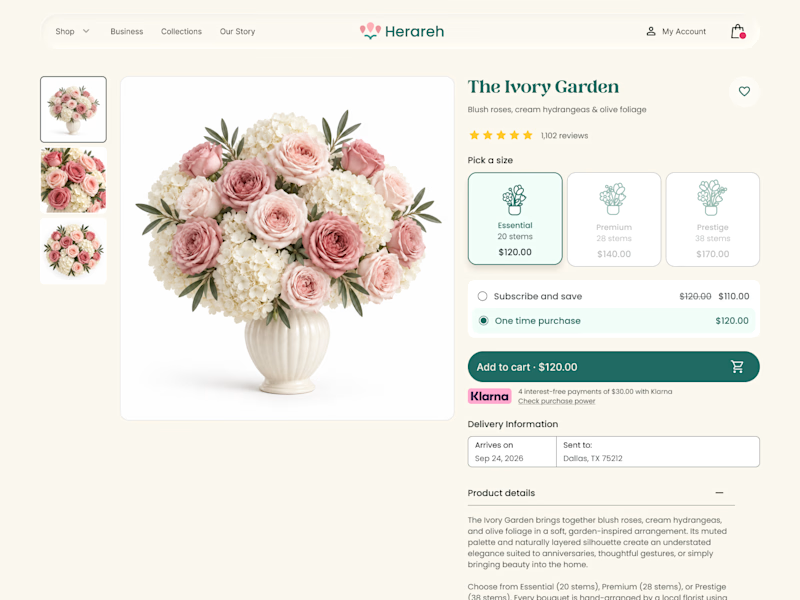
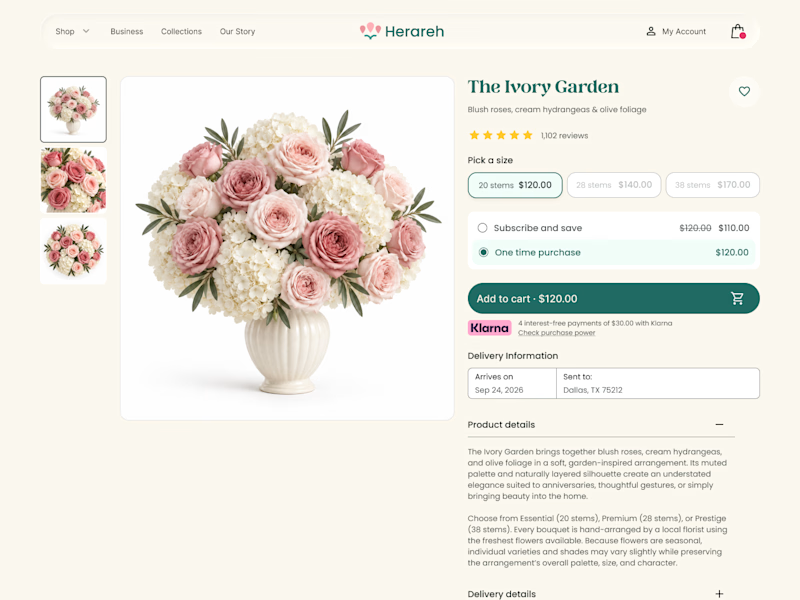

Icon cards for me, bouquets are such a visual purchase that a scannable icon beats reading "small/medium/large" every time. Did the compact chips version convert worse in testing, or are you still gathering data on that?

When your landing Page is so goated that you no longer need a launch video.


Thats what a landing page do for you hahahaah

Thank you so much for Margadarsi Infra for this opportunity🎉
Intelliflow build entire Digital platform for Margadarsi Infra #realestate business.
Where Intelliflow Built the
Public website
Lead Management system
Dedicated Channel partner portal
#websitedesign #websitedevelopment #webapplication #softwaredevelopment
#CRMdevelopment


Its a wow design!