
Isaac Cazares
Data processing with Python, and music producer



An experimental physics simulation engine currently under development. This project is designed to progressively incorporate different areas of physics and mathematical modeling into a single simulation environment.
This current version is only a brief technical demo, focused on classical mechanics, projectile motion, gravitational interactions, orbital dynamics, planetary systems, moons, and asteroid fields.
The engine is being developed incrementally, with future updates planned to incorporate additional physical models and numerical methods. The goal is to evolve it into a broader computational environment for experimenting with and visualizing physical phenomena.
0
24
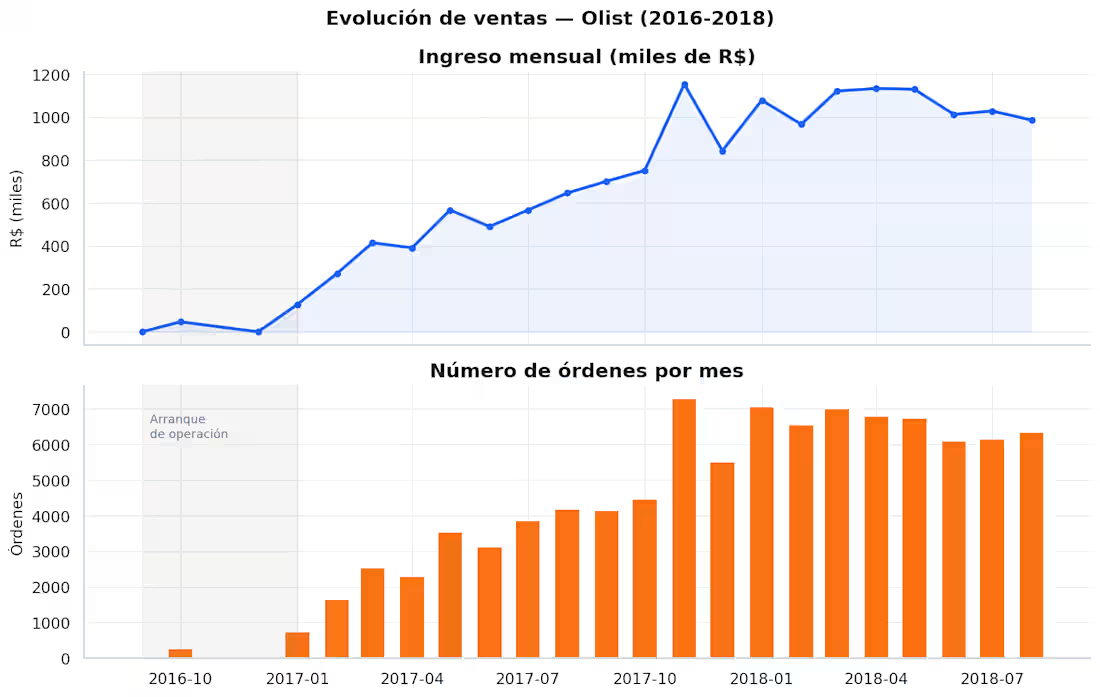
Brazilian E-Commerce Data Analysis — Customer & Sales Insights
Independent data analysis project based on the Olist Brazilian E-Commerce public dataset.
The objective was to transform raw e-commerce data from multiple related tables into actionable insights about customer behavior, sales performance, and business trends.
What I worked on
Data profiling and quality assessment
Data cleaning and type conversion
Identification and validation of primary and foreign key relationships
Relational data analysis and table joins using Pandas
Customer segmentation based on purchase frequency
Time-series analysis of orders and sales
Exploratory Data Analysis (EDA)
Data visualization and business-oriented interpretation of results
Tools
Python · Pandas · NumPy · Matplotlib · Seaborn · Jupyter Notebook
AI-assisted workflow
AI tools were used selectively as a support resource during the project, mainly for guidance on Python/Pandas concepts, debugging, analytical approaches, and visualization ideas.
The data exploration, implementation, validation of results, and analytical decisions were performed and reviewed by me. I used AI as a learning and productivity tool rather than as a replacement for the analysis itself.
Outcome
The project demonstrates my ability to work with multi-table datasets, understand relational data structures, perform data cleaning and exploratory analysis, and translate raw data into meaningful business insights.
1
38
Thin-Film Optical Coating Simulator
"Thin-Film Optical Coating Simulator — Reflectance Modeling with the Transfer Matrix Method (TMM)"
Description:
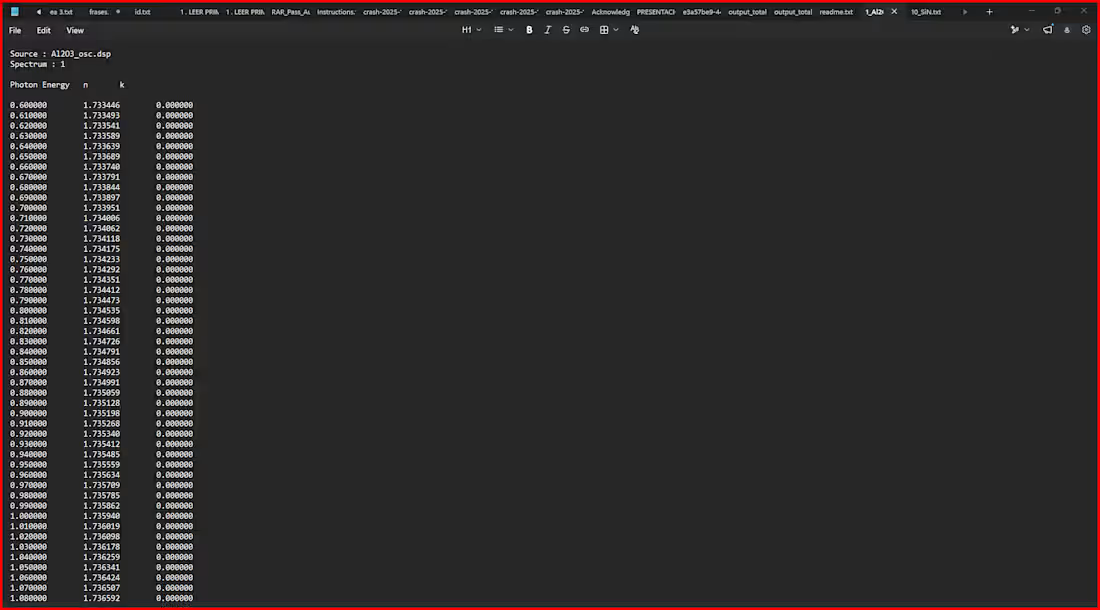
A Python tool for simulating the optical reflectance of multilayer thin-film coatings using the Transfer Matrix Method (TMM). The project models the optical behavior of an Air | Al₂O₃ | SiN structure using real refractive index data (n, k) as a function of photon energy, and generates:
Reflectance vs. wavelength curves (250–2050 nm) across multiple layer thicknesses (10–1000 nm) and angles of incidence (0°–70°).
Heatmaps summarizing reflectance as a function of thickness and angle at a fixed wavelength (e.g., 550 nm), making it easy to identify optimal design combinations.
The program is built with an object-oriented architecture, supports loading optical spectra (n, k) from experimental or database-sourced files, and automates parameter sweeps (thickness, angle, wavelength) for comparative analysis.
Applications: anti-reflective coating design, optical filters, thin-film analysis for photovoltaics, precision optics, and material characterization.
Tech stack: Python, NumPy, Matplotlib
1
45