Chronometer: Geometric Symbolic Reasoning

Toby Godden


The machine determines what is there. The symbolic system determines what kinds of meaning may attach to it. The language model makes that structure speak.
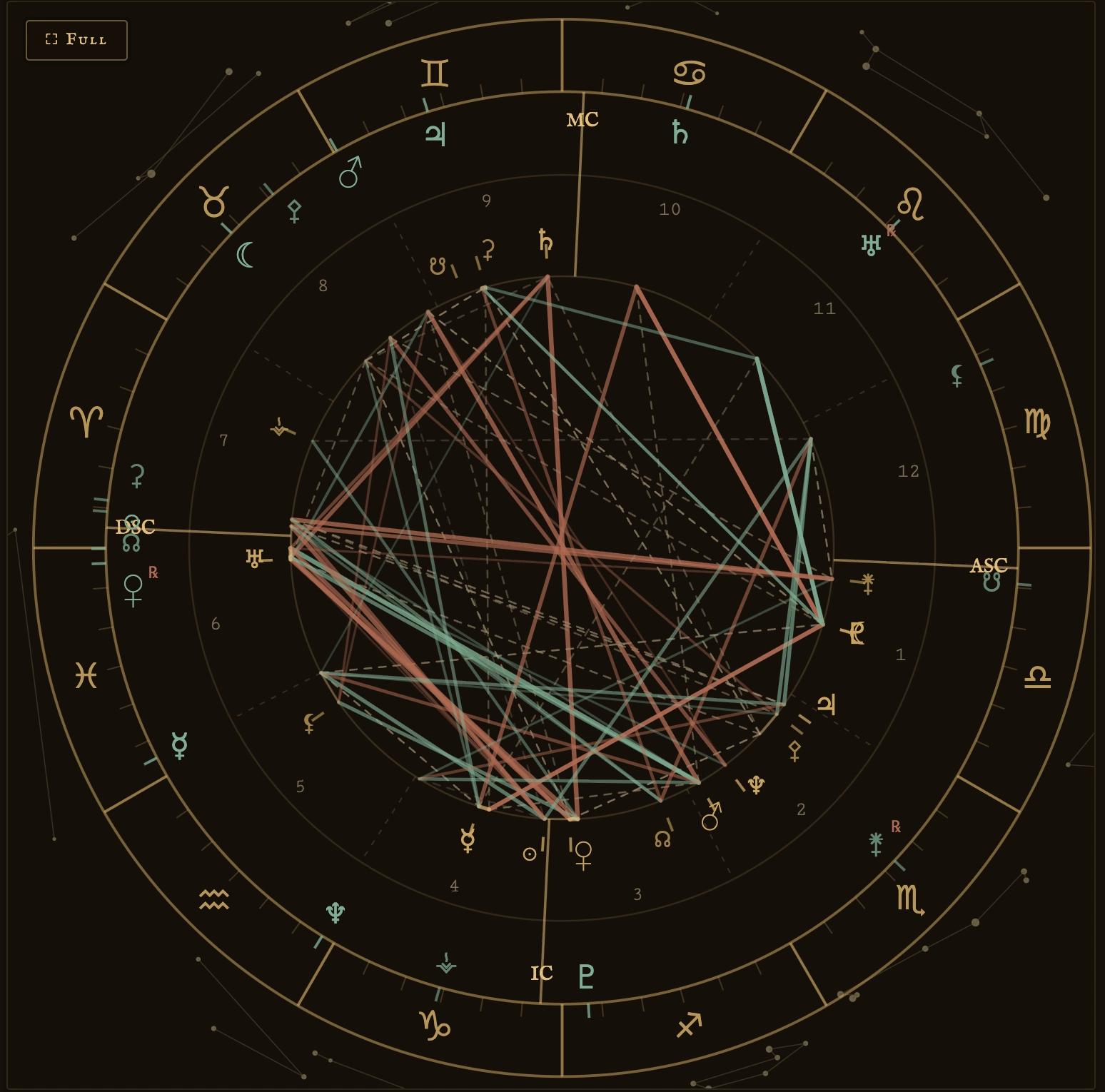
Chronometer.online is a browser-based astronomical engine, interactive chart instrument, and constrained AI interpretation system. It computes planetary positions from orbital elements, measures their geometric relationships, and passes the resulting structure to a language model that is prohibited from inventing what it has not been given.
The project produced a formal paper — Geometry Before Language: Towards Geometric Symbolic Reasoning, and a Falsifiable Test of the Astrological Hypothesis — and a 52-page experiment design for a blind self-recognition trial.
The architecture is called Geometric Symbolic Reasoning (GSR): a deterministic relational geometry is computed first, symbolic knowledge is bound to it, and language arrives last as witness, not author. Language becomes descriptive rather than constitutive. The important innovation is refusing to let language invent structure.
Origin
The project began as ffilm.org/chrono — a geocentric clock and orrery rendering astronomical time as moving geometry. Alongside it, Personal Sky (ffilm.org/astro) was a heavier PHP system combining natal charts, transits, and AI interpretation.
The conceptual turning point came through conversations with astrologer and collaborator Kelfin Oberon. His position: a chart should not begin as a list of placements and keywords. It should first be approached as a whole geometric event. The hierarchy that emerged: geometry first, then planets, then signs, then houses.
On 25 July 2026, while travelling by bus to Swansea, I built the Aspect Engine — approximately four files versus Personal Sky's fifty. It computed the sky itself in the browser, without asking an ephemeris service. Three days later, the project moved to chronometer.online.
Architecture
Nothing mystical happens in the computational layer.
The ephemeris is hand-written JavaScript implementing the Schlyter orbital element series directly: Kepler solve, heliocentric-to-geocentric conversion, topocentric Moon parallax, perturbation terms for Jupiter-Saturn-Uranus resonances, and a fitted correction for Chiron derived from JPL Horizons validation. No astronomy library is involved.
The frontend is eleven script tags loaded in dependency order into one shared global scope. About 3,000 lines of plain JavaScript. The zodiac wheel is 642 lines of hand-built SVG via createElementNS. The 3D orrery uses three.js r128, lazily injected only when opened — the flat chart never pays for it.
The backend is five PHP files totalling roughly 2,000 lines. The Anthropic API call is raw curl to api.anthropic.com — no SDK, no framework.
The language model (Claude Sonnet) enters constrained. It cannot introduce a body that was not computed. It cannot introduce an aspect that was not measured. The difference between these two prompts is the whole architecture:
"Tell me about Saturn."
versus:
"Saturn is applying to a square with the natal Moon, orb 0.6°, separating from a trine to Mercury. Interpret these two relations and nothing else."
The first invites improvisation. The second permits only description.
The formal system
GSR is defined as a pipeline: compute, bind, describe.
The relational geometry G(t) is a directed, weighted graph — entities as nodes, aspects as edges, orb and angular velocity as weights. It is the output of a deterministic function of ephemeris time: same input, same graph, on any machine, with no model in the loop.
A symbolic binding Φ annotates the graph with a traditional lexicon without adding, removing, or reweighting any edge. The language layer L maps the annotated graph to strings under an admissibility condition: every relation asserted in the output must correspond to an edge that was computed.
The critical property: fabricated relations become well-defined, mechanically decidable violations — unlike standard generation, where there is nothing to check against.
The symbolic layer is a free parameter. Substitute the lexicon and the engine is unchanged. Astrology's contribution is maturity of dataset — an unusually well-developed symbolic graph refined over millennia. Whether the sky has anything to do with it is, for the architecture, entirely optional.
The paper
Geometry Before Language separates two claims.
The architectural claim is offered with confidence: GSR is a useful way to constrain AI, applicable wherever complex relational systems exist — diagnosis, legal reasoning, ecology, education, comparative religion.
The empirical claim is offered as an open question: whether the astrological hypothesis has ever actually been tested. The paper front-loads the negative evidence (Carlson 1985, Voas's ten million marriages, Dean & Kelly's time twins), concedes it, then argues that these studies tested the crudest available formulations — sun signs, personality inventories — not the relational structure practitioners actually claim to use.
The deflationary account is stated at full strength: astrology may survive not because planets influence psychology, but because it became an extraordinarily efficient symbolic indexing system for human experience. The paper's author bets on this explanation.
The falsification condition is committed to in advance: if scrambled charts match biographies at the same rate as real charts, the empirical claim is dead. "I expect that outcome. I think it is more likely than not. I would rather know than be right."
The experiment
Which Sky Is Yours? is a blind self-recognition trial.
Each participant supplies their birth date, time, and place. The system generates one interpretation from their actual birth geometry and ten from matched controls — real, astronomically possible moments with similar year, season, latitude, time-of-day, and chart complexity. All eleven are shuffled, stripped of astrological terminology, and presented anonymously.
The participant reads, rates, and ranks all eleven, then selects the one that feels most specifically like them. Chance baseline: 1 in 11 (9.09%).
The build sequence runs from internal pilot (10-20 testers) through open exploratory study (100-300 participants) to preregistered confirmatory study with frozen protocol, power analysis, and locked pipeline. Phase 4: independent replication by sceptical researchers. The strongest result would not be one produced by the Chronometer's creator. It would be one reproduced by people who expected it to fail.
What was actually built
The cover image shows the chart of Jesus of Nazareth — the most provocative test case in the paper, and deliberately disqualified as evidence within it. The system produced a sustained symbolic reading that experienced astrologers described as unexpectedly coherent. The significance was not that it proved anything. It was that the architecture behaved as designed: the model refused to fabricate biography from geometry.
Chronometer.online is not simply an astrology app. It is an instrument for investigating how a machine might look at a structure, know what it is actually looking at, and speak without pretending that its words created the thing.
The project began as a way of looking at the sky. It became a way of asking whether language can be made accountable to structure — and whether a contested symbolic practice can be made available to experiment when its geometry is explicit, reproducible, and separable from its interpretation.
Like this project
Posted Jul 28, 2026
A browser-based astronomical engine, constrained AI interpretation system, and formal paper proposing Geometric Symbolic Reasoning — an architecture where deterministic geometry is computed first and language is never allowed to invent structure.
Likes
1
Views
13
Timeline
Jul 23, 2026 - Ongoing
Clients
Ffilm.org