Tiny Universe Lab: Interactive Astronomy Sandbox

Fareed Kilani


Tiny Universe Lab
A solar system you can touch.
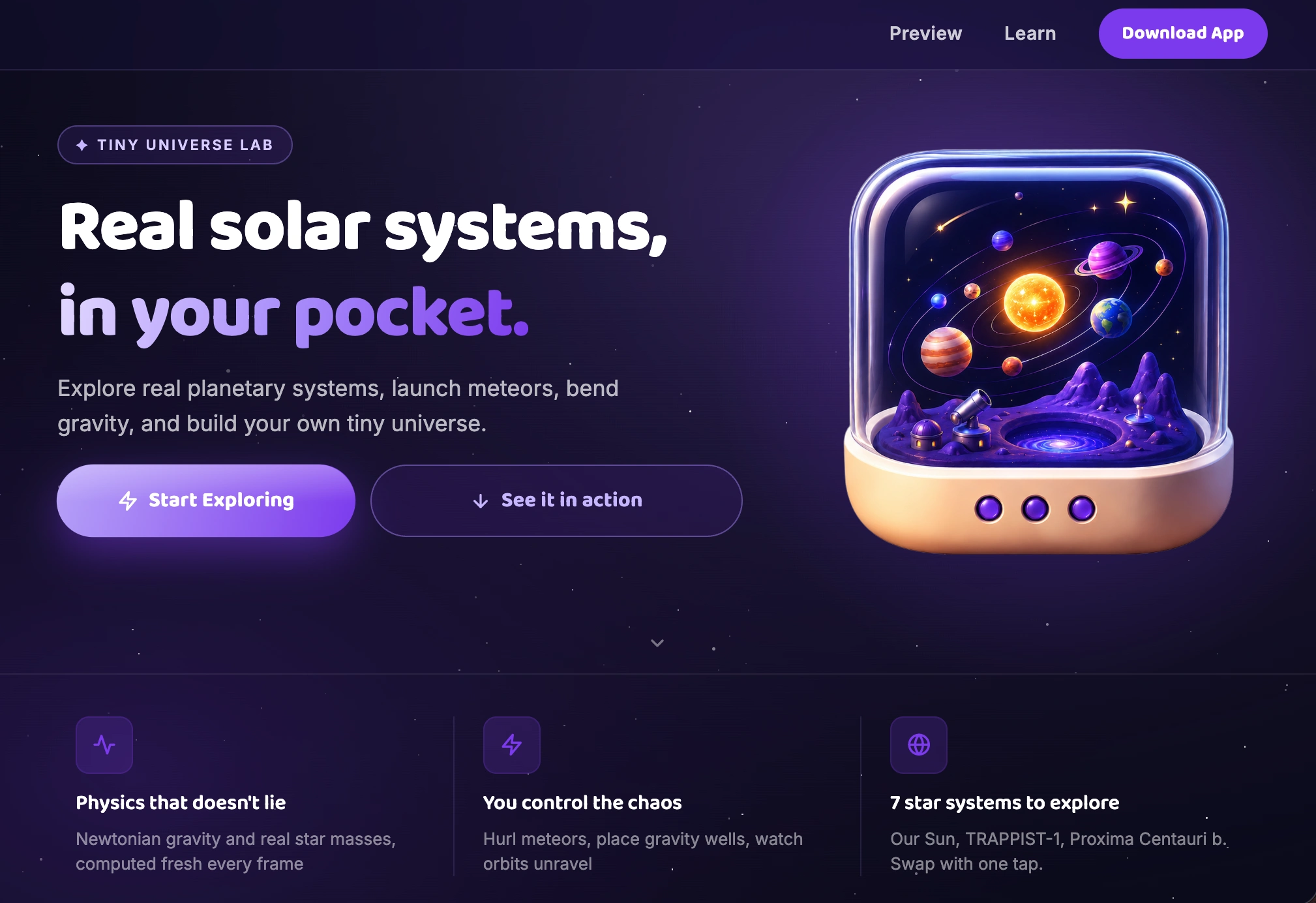
Tiny Universe Lab is a mobile-first science sandbox that turns astronomy into something people can explore through play. Users can build planetary systems, change gravity, launch meteors, inspect planets and discover what happens when the rules of a universe are changed.
Role
Product design, interaction design and development
Platform
Mobile-first web application
Initial build
24 hours
Recognition
5th place and Honourable Mention ($10k credits) in the Replit 24 hour Buildathon.
Why I built it.
Space is usually explained before it is experienced.
I wanted to teach my six-year-old niece about solar systems, but diagrams and blocks of text were never going to hold her attention.
The better question was: what if she could touch one?
That idea became Tiny Universe Lab. Instead of asking someone to memorize how a solar system works, the app lets them change it, disrupt it and immediately see the result.
The idea.
Learning through cause and effect.
Every control is designed to become a small experiment.
Users can choose a star, add planets, adjust gravity, speed up time, introduce moons or launch a meteor into the system. More extreme tools, including black holes, allow them to push the simulation beyond normal conditions and watch the universe react.
There are no lessons to complete and no wrong answers. Curiosity becomes the interface.
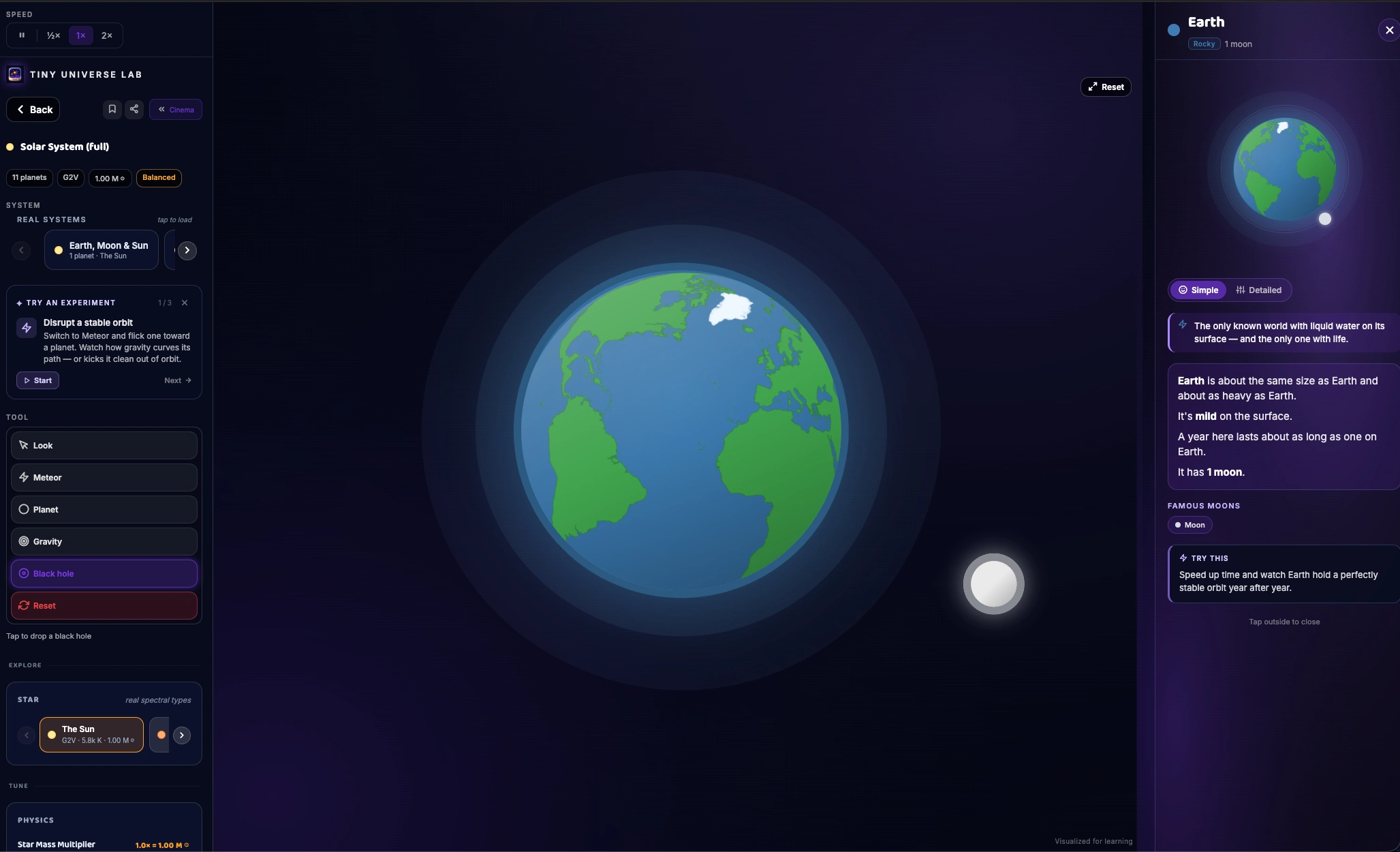
Build a system
Choose a star and create a planetary system from scratch.
Change the rules
Adjust gravity and time to see how orbital behaviour changes.
Create some chaos
Launch meteors or introduce a black hole and watch the system respond.
Designing for curiosity
Simple enough for a child. Interesting enough for anyone.
The challenge was balancing scientific ideas with an interface that never felt like schoolwork.
Complex controls were translated into direct, visual actions. Changes needed to feel immediate, motion needed to explain what was happening, and deeper information needed to be available without interrupting exploration.
The experience was shaped around three principles:
Touch first
Important actions are visual, direct and easy to understand.
Immediate feedback
Every adjustment produces a visible reaction in the universe.
Depth without clutter
Planet details, distances and scale are available when users want them, but never dominate the experience.
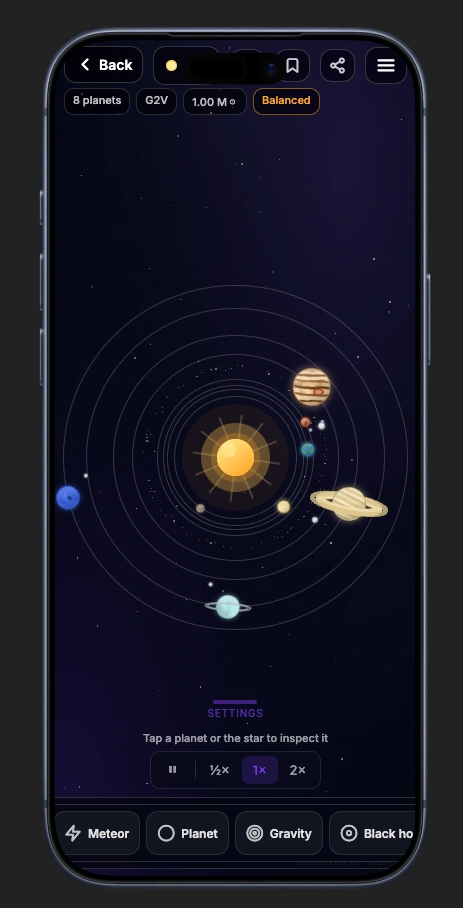
Building the universe
From an idea to a working product in 24 hours
Tiny Universe Lab began during a Replit Buildathon with only 24 hours to turn the concept into something playable.
That constraint forced every decision to serve the central experience. The priority was not adding as many features as possible. It was making the first interaction feel magical: open the app, create a system and immediately understand that this universe belongs to you.
By the end of the build, the project had grown into a responsive, mobile-first experience with interactive orbits, multiple star types, editable planetary systems, moons, meteors, black holes, inspection tools and cinematic ways to explore each creation.
The result
5th place
Honourable Mention
$10,000 in Replit credits
Tiny Universe Lab placed fifth in the Replit Buildathon and received an Honourable Mention.
The recognition was meaningful, but the stronger result was proving that an educational product did not need to begin with instruction. It could begin with wonder.
What started as one universe became a larger idea
Tiny Universe Lab became the first step toward Tiny Labs, a collection of playful tools that make science feel tangible, visual and inviting.
The project reinforced something I now carry into other products: people understand complex ideas more naturally when they are given the freedom to explore them.
Real solar systems, in your pocket.
Like this project
Posted Jul 31, 2026
Developed Tiny Universe Lab, a web and mobile app for exploring planetary systems, earning an award in a Replit buildathon.
Likes
1
Views
5