Understanding Facebook Algorithm Changes for Content Creators

Roseline Oyedeji


Facebook Algorithm Changes: The Brutal Truth No One Tells Content Creators
I know.
You’ve wondered for years why Facebook suddenly deletes your posts.
Why your posts have little or no reach? Why your feed look messy with no valuable information? And why Facebook suspend your account?
Finally, I have an answer:
It’s you plus the Facebook algorithm.
That’s probably not the answer you’re looking for, but it’s the truth.
Aside from the fact that Facebook is undergoing some changes right now. The simple explanation is that there are things you’re doing wrong, and the algorithm is backing you on that.
But not to worry, I’ve got you covered on the things you need to know about Facebook, its algorithm, and what you must do right now.
What Is the Facebook Algorithm?
The Facebook algorithm is the AI system Facebook uses to decide what to show in your feed anytime you log onto the platform.
This AI system determines the types of posts you see, how your content performs, the new accounts Facebook suggests, and even the ads in your feed.
Ideally, the algorithm assesses your content and activity on the platform and uses that to show posts that may interest you based on the content you’ve liked, shared, and commented on.
That’s why you see posts from people you’re not connected to that Facebook thinks you’ll like, because the algorithm has watched your activities for so long to predict your likes.
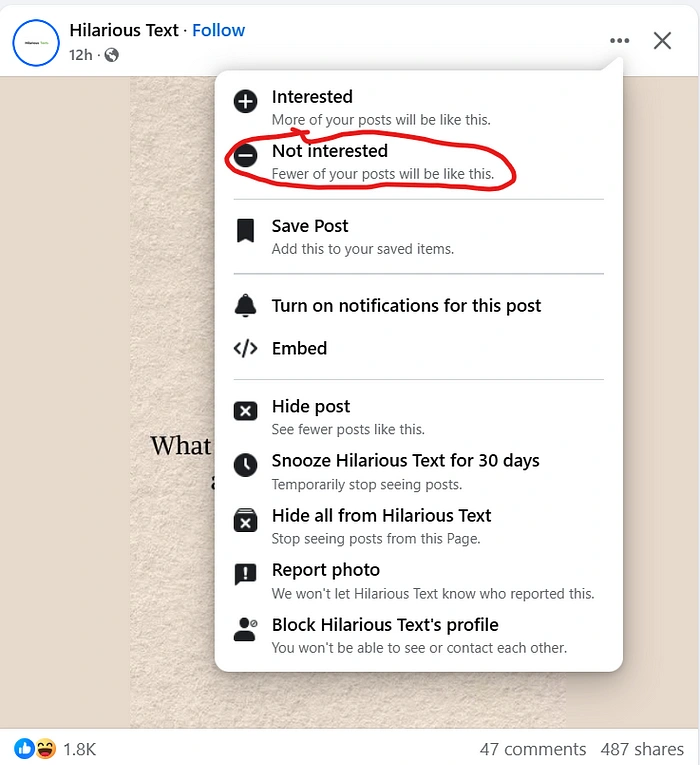
And this means that if you don’t like the content you see in your feed — you can signal the Facebook algorithm that you’re not interested in that type of post.
Why Your Facebook Posts Are Not Getting Engagements?
I’ve broken down the reasons into 5 major things. Let’s look at each one.
1. You’re Violating Your Country’s Laws
Did you know that your country’s laws can determine how your post performs on Facebook?
Sounds impossible, right?
In May 2025, a government group from Côte d’Ivoire known as “HACA” sent a request to Facebook to delete a certain post from their platform. The post allegedly violated a special law in their country.
Now, while Facebook tries to resolve cases like these with its human rights policies and global network initiative — this means that your country can influence whatever happens on your account.
But Facebook is keen on resolving issues like this optimally.
2. You’re Violating the Facebook Community Standards
You know this already.
Just like every social platform, Facebook has its dos and don’ts.
The Facebook community wants a safe space for all of its users.
So if you’re engaging in activities that violate their community standards, your posts and account might experience some hiccups, which could lead to your content being frozen in time.
3. The Facebook Algorithm
You sure know this point will make it to the list .:)
You can’t game the system.
You can only abide by Facebook rules.
The algorithm does what it does best, and that’s running its set course.
But as of the time of this writing, the Facebook algorithm is likely the reason your content is playing hide and seek — because of the recent issues like account deletion and so on.
4. Your Audience
See, your content can be fire while your audience is ice.
If people aren’t engaging with your post, it might mean that they’re not interested or are not the audience for your type of content.
What’s the point of having a gazillion followers when they don’t actively engage?
You may need to clean out your followers’ list for the algorithm to show your content to those who value it.
5. Spammy Contents
Spammy content is when you post about a bag and caption it as a dress.
It’s when you fill your post with too many irrelevant links and hashtags, and join every group you see.
When you do this, the algorithm perceives you as spam and not trustworthy.
Also, other basic reasons might include:
Inconsistency in posting
Low-quality content
Irrelevant hashtags
Lack of visuals
Lack of a strong brand voice
How the Algorithm Decides What You See on Your Feed?
If you’ve ever wondered how Facebook knows the type of content to show in your feed — it’s simple.
Facebook’s goal is to ensure that you find content you enjoy, making sure you stay on the platform.
They do this by shuffling posts from your followers, people you’re following, those you’re likely going to connect with, groups you joined, pages you liked, content they think you’ll love (recommended content), and even ads — so that you can enjoy a mix of content.
Now, let’s look at how Facebook decides what to show on your feed:
Inventory: What this means is that Facebook gathers posts from your followers, pages, groups you joined, and new posts that you see when you open the platform. Basically, they collect all your activities on the platform.
Signals: For each collected post, Facebook then uses thousands of signals to predict the post you’ll like. These signals are the information you give to them when you interact with a post and all the activities you do inside the platform.
Prediction: Recently, my mom asked me how Facebook knows she loves funny videos. You know the answer. Facebook studied her activities on the platform and guessed that she’d love more of those videos. Facebook also uses surveys to make these predictions.
Relevance score: Lastly, the Facebook algorithm rates your posts based on relevance. So posts that the algorithm predicts to be valuable will show more in your feed. This means you’ll see multiple posts from different persons, groups, and pages.
What Does This Mean for You as a Creator?
If your feed isn’t serving you well or you’re tired of the type of content you consume — you’re in control.
You can train the Facebook algorithm on your likes and dislikes.
Here’s how you can do that:
Click on the post you do not want to see on your feed
Click on the three dots at the top right corner of the post
Click “Not interested”
This signals the Facebook algorithm to stop showing likely posts.
Do it for any post that you don’t want showing on your feed.
New Facebook Changes 2025 You Must Know
Facebook is Cleaning Up Spammy Content
You called, and Facebook answered.
If you’ve been complaining about your feed not giving you value — Facebook says not anymore. Because they’re wiping out every content that looks spammy.
Here’s how they’re doing that:
Lowering the reach of spam content
Removing fake accounts and impersonators
Elevating creators who share original content
With that, Meta (the parent company) took down over twenty-three million accounts that impersonated some creators.
Facebook Introduces a “New Friend Tab”
Though this feature is not yet available worldwide, Facebook wants to bring back the “OG” experience, as they call it.
This could be a helpful feature for creators, making the platform feel more connected and personal.
Instead of looking for your friends’ posts, this feature makes it easy to see their stories, reels, birthdays, and friend requests — all in one tab.
It’s only available in the United States and Canada, but we hope to see it soon in other parts of the world.
You can see the tab through the navigation bar on your home feed and access it in the Bookmarks section of the app.
If you can’t see this tab and you’re in the US or Canada, here’s how to pin it:
Click your profile picture
Click “Settings & Privacy”
Click “Settings” and then “Tab bar”
Choose to customize your bar
Then click “Friends” and pin the tab
This is useful as this can help cut down distractions from recommended content. Check out this video for visual guidance.
Facebook Increases File Sharing to 100MB
Gone are the days when you wanted to share a file up to 20MB but couldn’t.
Because now Facebook has increased the file size.
You can send files up to 100MB in videos, PDFs, Word, and Excel without paying a dime.
This can help you save space on your phone or computer and give your drive some breathing space.
Facebook will Remove Live Streams
In February 2025, Facebook announced they’re removing old livestreams after 30 days.
When you go live to connect with your friends and family — that live video will only be available for 30 days, then deleted.
But Facebook has prepared for you to download and share that video within 30 days.
With this, your friends can easily access up-to-date live information while ensuring a clean and structured look.
And you can download the videos in a single and in bulk too. If you need more time to download your live videos, check out this guide on how to go about it.
Facebook Built an AI Assistant
If you don’t already know, Facebook now has a Meta AI app that works like ChatGPT.
Though there have been lots of controversies, like the conversations you have with the app linking out, I’m not so sure of the credibility of the app.
Well, let’s hope Facebook resolves that glitch.
Also, the AI assistant on your Facebook now remembers the chats you have with it.
For instance, if you prompt it to suggest fruits that you can dice and it recommends pineapple. You can tell it that you’re allergic to pineapple and it will note that point going forward. And if you don’t want it to store your conversations, you can delete them (available also on Messenger and WhatsApp).
They’re also rolling out a few personalizations on Facebook.
Let’s say you ask Meta AI for fun weekend plan ideas. Meta AI will suggest some ideas based on your profile, like tickets to a local concert or brunch nearby.
Unfortunately, again, this feature is only available in the US and Canada.
The Facebook Monetization Program for Creators
There’s a new way for you to earn on Facebook: it’s through the content monetisation beta program.
Though it’s not available for everyone, and only Facebook can invite you to be part of the program, or by filling out this form if you’re interested.
Instead of Facebook paying you based on the ads placed in your content like they used to, Facebook’s content monetisation program rewards you for making quality public videos, stories, reels, photos, and text posts that perform well.
Here’s how they combined the program:
In-stream ads — earn from videos
Ads on Reels — earn from reels
Performance bonus — earn from posts, photos, and videos
Instead of joining each one separately, Meta has bundled them into just one program.
But once you join the new monetization program, you can’t go back to the old programs (like using just ads on reels alone).
How Do You Get Paid?
Although this program is by invitation only, the amount you earn through content monetization is based on the engagement your content receives on Facebook.
Also, your video must be a minimum of 15 seconds to qualify to earn.
But Facebook might not pay you if you post:
Contents that belong to someone else
Content that promotes a brand
Content in a language Facebook doesn’t support
Content that isn’t originally yours
Content you boosted
Content you deleted (even if it had lots of likes before)
Content that uses fake or forced engagement
And according to them, there’s more to the criteria above.
What Should You Do Now?
Always Stay Updated
Know that the algorithm changes every time. And Facebook rolls out lots of information and features, so keep your ears close to the ground to adjust to any changes when needed.
This is for a better user experience and to make the platform a feel-at-home space where you can connect with your friends.
2. Avoid Spammy Tactics
Sure, you want to go viral and reach many with your content.
But you’ve got to do it right. Facebook can shadow ban or, worse, delete your account.
Here’s what you need to stop doing as a creator:
Stop the use of clickbait terms
Stop the engagement bait
Avoid misleading or harsh language
Stop the use of irrelevant hashtags
3. Monitor Your Analytics
By now, you know Facebook has an in-built analytics system.
You can use this system to monitor how well your content performs. And if it flops, you can always go back and make some tweaks.
4. Post Original Contents
Post original quality content for the algorithm to boost your account and for people to engage with it.
Truth is, you put your account at risk when you copy content from another creator. Facebook thinks when you do this without their permission, it’s an unfair advantage, which is true.
Like I said earlier, Facebook is cracking down every spammy content, so make original and quality content for your audience and the algorithm.
The good thing?
Facebook made provisions for how you can create engaging and original content, so you know what to do.
5. Always Engage On Posts
Don’t be a robot.
Engage with your post and others’ posts to spark new conversations, grow your audience, and form a bond with your connections.
You can do this by adding a call to action on your posts, like asking people their opinions.
Is Facebook Still Worth It for Creators in 2025?
With so many creators raving about how Facebook isn’t serving them well.
Should you still use it? Is it worth it?
Well, it depends.
If your audience is on Facebook and you want to grow your business, it may be worth trying since the platform has over three billion users.
And with the recent changes we discussed, Facebook can still be a valuable traffic source for creators in 2025.
Bottom Line?
Original content and true authentic self are now a must. With all the changes and features Facebook is rolling out, you’ve got to be a detective if you want to up your game.
Facebook is watching everything — what you post, what you do on the platform, and how you engage.
So, create content that’s yours and aligns with the goals of the platform and your country’s laws, because only the real creators will survive in this new Facebook world.
What challenges are you currently facing with Facebook? And do you think Facebook is serving its users well? Let me know what you think below!
Like this project
Posted Jun 28, 2025
Explained Facebook algorithm changes affecting content creators.
Likes
0
Views
0
Timeline
Jun 22, 2025 - Jun 25, 2025