From Company Blog to Multi-Million-Dollar Inbound Engine

Sorilbran Stone



Case Study · Inbound Engine
When I joined the team, the website was solid—but the blog was basically a seasonal holiday gallery of beautiful infographics. There was no year-round search strategy, no sales enablement content, and no clear role for marketing in driving new business.
Context
New content only published around the holidays.
Blog posts built around large, beautifully illustrated infographics.
Content designed for “shares” and embeds, not for search or sales.
No consistent keyword strategy or topical structure.
Marketing credited with a small share of new business activity.
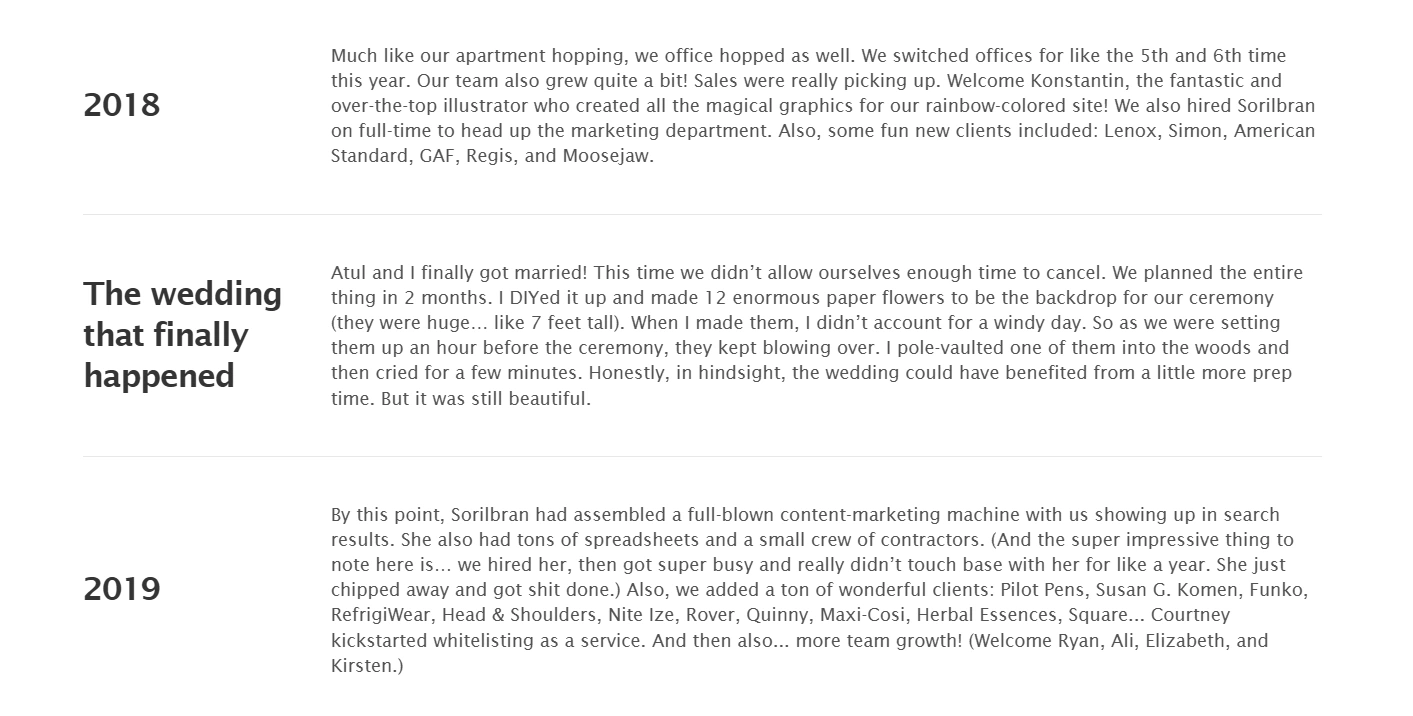
Screenshot from the About page of The Shelf website confirming what I accomplished between 2018 and 2019 in my first year as the marketing lead.
My Approach
Shift the blog from seasonal content to year-round discoverability.
Build a search architecture around real buyer intent.
Turn sales questions and objections into reusable content assets.
Move from “pretty content” to strategic, machine-readable content.
Position the blog as a trusted industry publication—not a company news feed.
Phase 1 · Search-First (Years 1–2)
In the first phase, I focused on teaching search engines what the company actually did and which problems we solved.
Mapped high-intent, revenue-aligned keywords in a new industry.
Audited existing content and retired “pretty but pointless” posts.
Built a topical structure so the blog read like a knowledge base.
Partnered with our illustrator to support strategic articles, not just holiday campaigns.
Wrote content around search behavior instead of internal assumptions.
Phase 2 · Sales-Driven (Years 2–4)
Once we were findable, I shifted the blog to work directly for the sales team.
Listened in on weekly sales meetings and captured recurring questions.
Turned objections and sticking points into deep-dive articles.
Created explainers sales could send before and after calls.
Focused content on client pain points and strategy gaps competitors weren’t addressing.
Elevated the blog from “updates” to a strategy-first industry resource.
What the inbound engine was actually made of.
This is the content mix behind the inbound engine – a balance of SEO, sales enablement, and strategic deep-dives built to educate prospects, earn trust, and drive pipeline for a growing agency.

Building the inbound engine wasn’t just about writing strong content. It required architecture, quality control, and a brand voice that functioned as both a conversion tool and a cultural signal. These are the biggest operator insights from that phase of the company’s growth.
We were extremely intentional about the voice we developed — conversational, strategic, slightly irreverent, and deeply transparent. That voice didn’t just differentiate us in search. It became a quiet recruitment engine.
Candidates said our content helped them understand our culture.
New hires felt connected before their first day.
Readers often assumed we were a magazine — not an agency.
The takeaway: Brand voice isn’t aesthetic. It’s a trust signal, a culture beacon, and a competitive advantage in a noisy market.
As the writing team grew, quality control could not rely on “everyone just writing well.” To maintain consistency across tone, structure, accuracy, and strategic intent, every piece was anchored by a detailed content brief.
Preliminary research, keyword strategy, and angles were defined upfront.
Writers received clear guidance on article type, length, and purpose.
Comparable ranking content was provided for context.
Every piece aligned with the brand voice and strategic content architecture.
The takeaway: Systems scale teams. Briefs are not bureaucracy — they are how you protect quality, voice, and authority at scale.
My time in marketing has been full of fun adventures. This is just one. Check out a few more.
Like this project
Posted Jan 12, 2026
Transformed Inbound Engine's blog into a strategic marketing tool.