E-sports Tournament Platform Development

MATHEUS NASCIMENTO


E-sports tournament platform
1.0 - CAD Matrix - Certainties, assumptions and doubts
To start the exploration phase, we needed to gather all the information we had, mixing in our assumptions and question marks along the way. This led to drawing up an intelligent matrix of what is certain, what is assumed and what is up in the air, inserting all the relevant details into each category. At this early stage in the game, solid facts are like rare treasures, so we only got four: the big reveal was our product design - a championship platform arena where people can form teams, immerse themselves in the battlefields of e-sports and, all the while, we're on a mission to get the minimum viable product to stay in the game with the big players in the league.
Then we venture into the land of assumptions - our springboard for hypothesis-driven searches and solutions. We bet on the idea that our audience craves championships not just for the glory and the loot, but for the chance to go pro. We also speculated that our warriors wouldn't want to clash in the arena on a daily basis; they need downtime to train, strategize with their squad and other things in life, which led us to come up with something extra to keep them coming back for more.
When we reached the home straight, we put all our question marks in the last column of our matrix. As we entered the unknown, the deeper we went, the more questions arose. As this market is somewhat mysterious, we drew up a list of exploratory probes to light our way through the fog. Questions such as who will run the championships, which clans are already fighting in this realm and the details of how it all works were all set to guide our expedition, as illustrated in the figure below.
1.1 - Desk research
Kicking off this Desk Research, we took a deep dive into the CSD matrix (highlighted in the figure above) to fuel our research quest. Firstly, we examined the landscape of gaming giants, the big players who are shaking up the sector. Riot Games enters the ring with its arsenal - League of Legends, Valorant, Wild Rift - but keeps a tight rein on new game providers, rankings or matchmaking adventures, opening up the arena to championships only. You can get this information on their website, under the usage policy banner.
So, entering the game is Valve, with Counter-Strike and DOTA2, playing a different game by welcoming new providers, ratings, matchmaking and, of course, championships to its domain. This open-door policy is presented on Valve's official website, painting a picture of a slightly more liberated gaming battlefield.
As we zoom in, we discover that companies are creating battlegrounds for championships. Player 1 emerges from the shadows, a digital coliseum where online tournaments meet the vibes of the gamer community. Here, players don't just compete; they create, shape their leagues and earn items such as coins for game equipment and in-game skins. Soon after comes Battlefy (hello, Figure 9), an architect of championships that allows you to build, fight and join or go it alone, rewarding your valor with experience points and coins to climb the ranks and immerse yourself in gamified glory.
Last but not least, Challonge throws itself into the ring, a platform where champions are formed and communities and events thrive, uniting competition and connection. So, as we navigate this gaming odyssey, each player, from Riot to Valve to the league's crusaders, creates a unique slice of the competitive pie, with our eyes set on dissecting their moves in our epic saga.
1.2 - Interpretation
All platforms lean towards activities that indirectly involve the championship, such as gamification, rewards, purchases, bonuses, interpersonal interactions. These activities make the use of the product, according to the book "Hooked - Engaged", increasingly resemble a habit-forming platform.
This is because, through a Persona's Habit Zone (which is to play), other functionalities can be incorporated that add up to a potential habit based on the characteristics of that persona (interact, conquer, buy).
In addition, there are some gamification principles addressed in these platforms, which are:
💡 Extrinsic motivation - People motivated by external factors (winning, receiving rewards...)💡 Intrinsic motivation - Self-motivated individuals (who are there to interact with the community, improve their skills...)2.0 - Searching for an empirical persona
According to Richard Bartle's (British games researcher) Taxonomy of Players, there are four types of players in the environment:
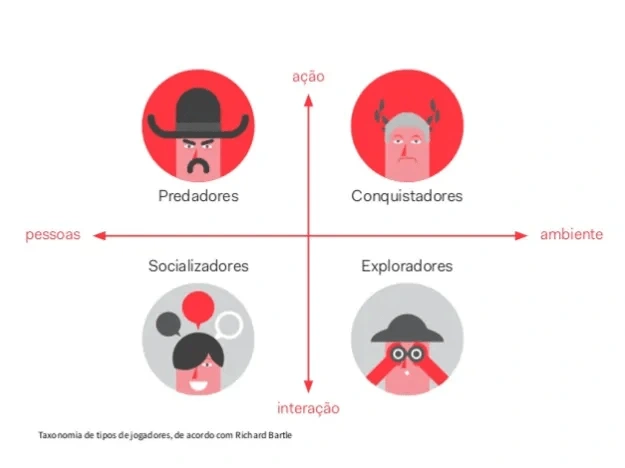
Predator: Focus on winning
Achiever: Focus on rewards
Socializers: Focus on having fun with friends and making new connections
Explorers: Focus on discovering new things⏰ According to Richard Bartle, we are never just one type of gamer, but a combination of them, in which one can dominate more than the others. 📢 In this context, Game DNA carried out a study, and their sample showed that 80% of them were predominantly socializers.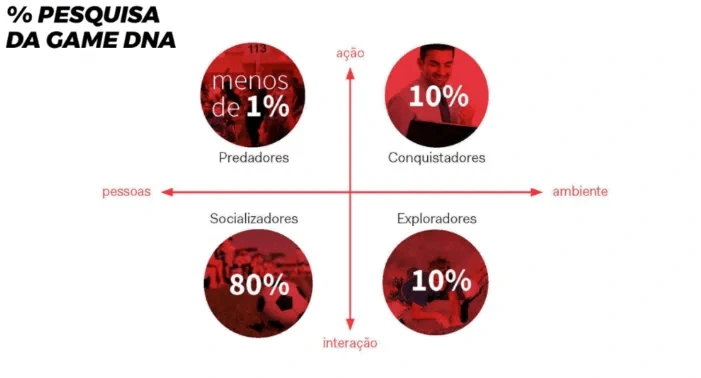
2.1 - Costumer Journey
Home → Find a tournament → Register for a tournament → Create a team
Did you arrive on the scheduled date of the tournament?
Yes: Checks in → Plays → Flow ends
No: Doesn't show up → Flow ends
With this in mind, we can create some potential ideas with the help of the How Might We
3.0 How Might We
The "How Might We" (HMW) method guided our brainstorming process, with the aim of revealing possibilities for a problem that we will define through our hypotheses. One of our hypotheses is the need to guarantee a competitive advantage among companies in the e-sports software sector. Thus, the question that "How Might We" posed to stimulate the creation of initiatives was the following How can we guarantee a competitive advantage for the e-sports tournament systems sector?
Five initiatives were then discussed to solve the problem. The first solution considered was to guarantee prizes and bonuses for potential winners as a way of encouraging recurring participation in championships. Next, creating a spectator mode for users could be a good initiative, as it differentiates itself by allowing players to socialize with each other. Next, enable a betting system so that those interested in following the games can also win money. Another initiative would be to hold a qualifying stage in this championship through group phases to increase the number of participants per championship. Now, with so many initiatives to be tackled, it's essential to prioritize them in order to define what will really set this new product apart.
3.1 - Effort and impact matrix
Now that the motivation behind each initiative has been understood, prioritization will be carried out using the effort and impact matrix, represented in the figure below.As described, it was determined that the best solution for the initiatives in HMW to use as a differentiator, initially, is a spectator mode. This feature allows participating and non-participating players in a given championship to broadcast the game in progress via screen sharing, with the aim of generating activity on the platform from users who want to watch.
This feature promotes social interaction, as players can watch other competitors play, learn from them, analyze moves and understand playing styles. In this way, it will be possible to reach the majority of player profiles according to Richard Bartle's taxonomy, i.e. socializers, who represent 80% of the total player base.
With regard to the other features that were deprioritized, the rewards system, despite generating a significant impact on the community, requires a great deal of effort due to the need to create partnerships with game owners or hardware companies, demanding a lot of negotiation initially. The group stages and match scheduling initiatives, despite offering differentials that would improve the capacity of the championships, would not have as much impact because they are only aimed at the predator and achiever player profiles, reaching a smaller percentage of players. Finally, the sports betting initiative would involve a high level of effort to deal with legal bureaucracy, as the topic could easily be interpreted as gambling.
Therefore, due to the potential for a large user reach, the spectator mode initiative was prioritized. After this, a quantitative survey was carried out with the audience of players to obtain more information about their behavior, with the aim of discovering their motivations for using the spectator mode feature.
4.0 - Quantitative Research
In order to carry out the quantitative research, it was necessary to involve individuals involved in electronic sports games. Thus, through a communication system called Discord in a gamers' room, it was possible to approach players to answer the questionnaire illustrated in the images below. It is important to note that, in order to guarantee the credibility of the survey, it was necessary to request a login, limiting to only one response per participant, and also to maintain compliance with the General Data Protection Act, no sensitive data was requested.
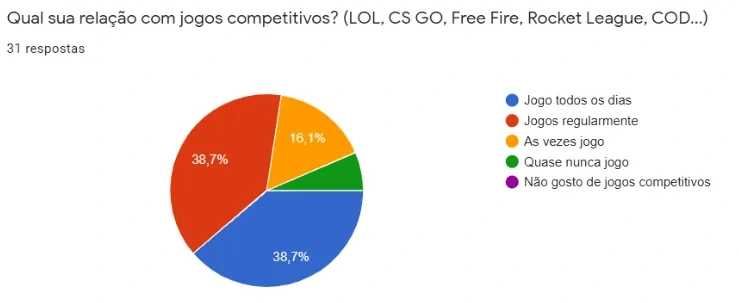
Translate:
Question: How often do you play competitive games?
Options:
Everyday (38.7%)
Regurlaly (38.7%)
Sometimes (16.1%)
Almost never play
I dont like competitive games (0%)
At this early stage of the questionnaire, it was already possible to conclude that we are targeting the right audience for this type of research, because in order to give relevance to the data, we need individuals who are actually playing these e-sports games.
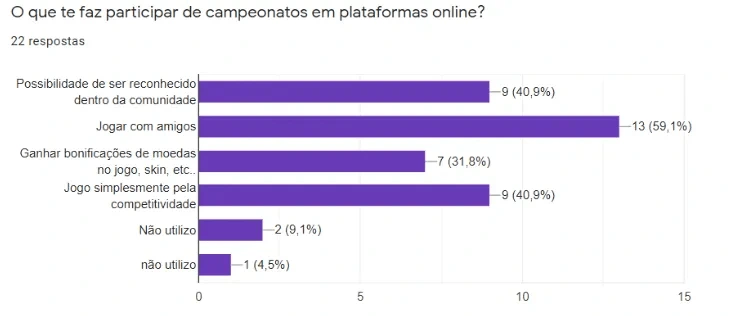
Translate:
Question: What makes you participate in e-sports tournaments?
Options:
Possibility of being recognized within the community (40.9%)
Playing with friends (59.1%)
Gain advantages in the game (31.8%)
Competitive spirit onlyAlmost never play (40.9%)
Doesn't use it (13.3%)
In addition to actually playing championships on online platforms, Richard Bartle's research is once again evident in this sample, showing that the majority of the public who play any type of game fit the socializing profile. This is clear from the data that indicates that 59.1% of the sample answered that playing with friends is the main motivation for staying active on these platforms.
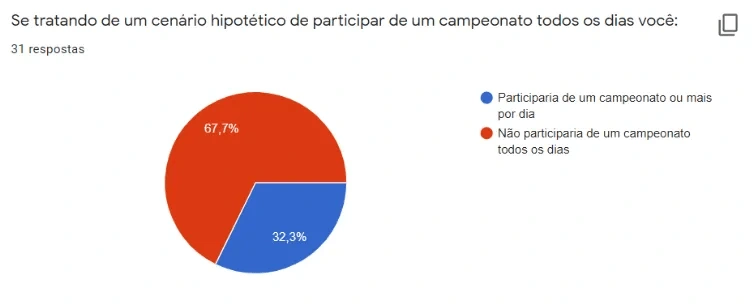
Transalte:
Question: In a hypothetical scenario of participating in a championship every day, would you:
Options:
Participate every day (32.3%)
Would not participate every day (67.7%)
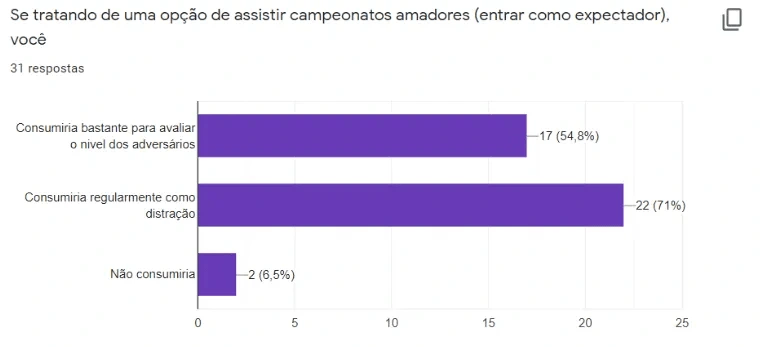
Translate:
Questions: With regard to the option of watching amateur championships, would you watch?
Options:
I would consume it to check the level of the players (54.8%)
I would watch as a distraction (71%)
Not at all (6.5%)
In the end, the initiative that will create differentiation in the championship platform market was validated. Only 6.5% of the survey participants said they would not use this type of functionality. Meanwhile, the rest of the participants had different motivations, one for analysis and the other for entertainment, thus stimulating socializing profiles.
After understanding the users' needs, it's time to make the functionality tangible through prototyping.
5.0 Prototyping
5.1 - User Journey
The journey to watch a championship is facilitated by a page where the broadcasts are available, allowing users to search, filter and finally watch. At the end of the match, it may be possible to watch more matches from the same league, if they are available, or simply move on to another league that is being broadcast. In this way, we aim to encourage continuous interactions on the platform.
As for broadcasting matches, this will be done via screen sharing, in a similar way to the video communication tools we have today, such as Zoom, Google Meet and Microsoft Teams.
5.2 - User Interface - Handoff
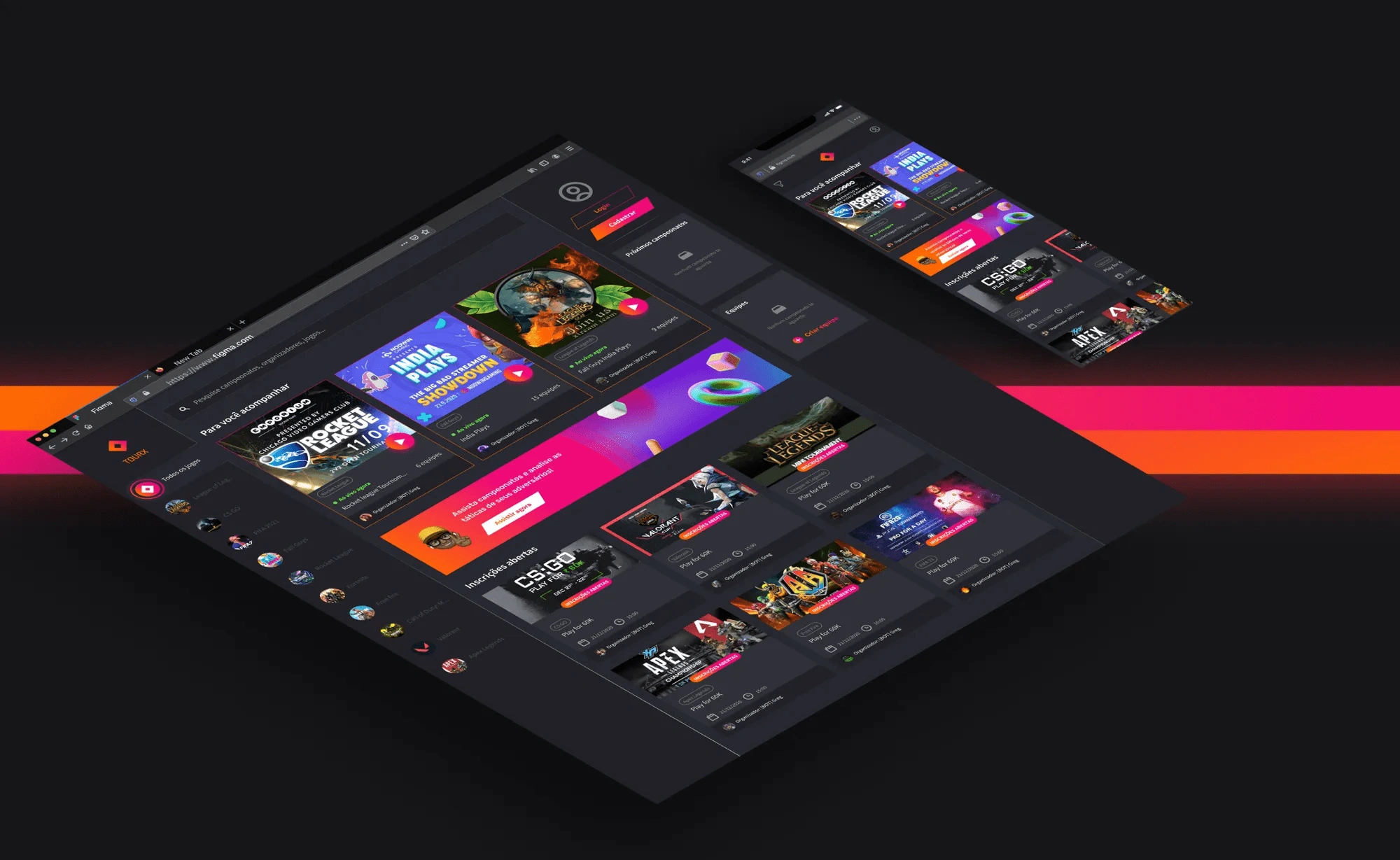
To create the user experience, different screens of the system were developed with the aim of detailing the platform's use cases, thus creating interactions through clicks to move between the screens.The first screen in the flow corresponds to the platform's home page, which displays the matches available to filter, a search bar, the championships and broadcasts available and, on the right-hand side, a sidebar containing profile information requesting authentication (registration or login), as well as options to create teams or championships.
Like this project
Posted May 5, 2025
Developed a spectator mode feature for an e-sports tournament platform.
Likes
0
Views
11