Muling Pagka-buhay Church: A Case Study

Precious Anne Mantelo


INTRODUCTION
Religion holds a significant role in Filipino's lives as it is not just as a belief system but rather as an experience, rituals, and communal practices (Li Jia, 2021). Although Roman Catholicism still continues to be the primary religion in the country, the increased number of independent religious groups highlights a more complex and diverse religious beliefs. One such religion is the Spiritual Catholic Church: Muling Pagka-buhay Inc., a lesser-known religious group that was first founded in Tamaraw Hills, Valenzuela City. Despite them having closely similar symbols and rituals, the religion operates independently from the Roman Catholic.
Additionally based on the statement of Monsignor Pricilla Soccoro Flores, one of the church leaders, they follow the statute of God and aim to spread the gospel. Despite their presence in different local communities, there are limited records of its history, beliefs, and its role among their members. This prompted the researchers of what the origin of such a small group of religion is? What is the purpose of its establishment? and who is the founder of the said group? By examining the origin of the Spiritual Catholic Church: Muling Pagka-buhay Inc. San Pedro City, Laguna, the study can provide an understanding of Filipino spirituality and how faith is expressed in different lenses of religions.
This study aims to explore the Spiritual Catholic Church: Muling Pagka-buhay Inc. We aim to trace the church beginnings, its founder, early years, the date of its establishment, the church doctrines, objectives, principles, and how it shaped the lives, character, and faith of its people through its spiritualized and localized lens. Additionally, this study explores the memories of Spiritual Catholic Church: Muling Pagka-buhay Inc. and focuses on documenting and understanding the history, beliefs, and how the religion influences the lives of its members. The study is restricted only to one local parish of the Spiritual Catholic Church: Muling Pagka-buhay Inc. San Pedro City and does not include any parishes and religious groups that are related nearby. As this is an oral-history-based study the researchers also acknowledge the limitations in memory, personal interpretation, and personal bias among the participants. Moreover, the study omits other variables, specifically practices of the church.
To uncover the origin of the Spiritual Catholic Church: Muling Pagka-buhay Inc. we began by examining the internet for any useful information about the Spiritual Catholic Church: Muling Pagka-buhay Inc. Unfortunately, we haven't seen any written documents, books, or studies tackling this specific religion but only stumbled upon social media posts and one small mention of the church in a study that proved its existence, but the mere Facebook post and brief mention of the church was not enough for us to use as a tool to know the religion's origin. Therefore, we decided to conduct an interview with the parish's active leaders and members to add voices that social media and the tiny mention alone could not provide. Using purposive sampling, we selected participants based on their involvement and familiarity with the church. A number of them are members of the church for generations and were considered reliable sources of local memory. The study uses a qualitative approach using semi-structured interviews which are delivered in a conversational manner that allows the participants to express their knowledge and experiences freely. Each interview began with open-ended questions that could encourage storytelling and with the permission from the participants we recorded each interview through audio recording. After gathering the stories, we transcribed each one of the recordings and compared the stories to identify common themes, recurring events, and shared memories. Furthermore, the final narratives are arranged based on themes and are organized chronologically to ensure the statements of the participants are aligned to one another.
THE ORIGIN OF THE CHURCH
Spiritual Catholic Church: Muling Pagka-buhay Inc. is a new and independent church where its main purpose was to preach the gospel "Humayo kayo at ipangaral ang aking mga salita, basbasan sila sa ngalan ng ama, anak, at ng espiritu santo." Because of the lack of documentation about its origin we began to interview the active leader of the parish here in San Pedro City, Laguna, Monsignor Pricilla Soccoro Flores. She started serving way back when she was young due to the fact that her father was the renewed supremo after the founder Dr. Monsignor Felix Rubio in 1980.
According to Monsignor Pricilla Soccoro Flores, Dr. Monsignor Felix Rubio started at a small hut in Valenzuela until it gained its followers over the years, building several churches in Luzon, Visayas, and Mindanao. Dr. Monsignor Felix Rubio was born on June 30, 1861 and died on June 19, 1978. Additionally, according to oral accounts Monsignor Felix Rubio was believed to have lived to an exceptionally old age; however, this statement can't be verified because of the lack of written documentation about this claim. After the death of Dr. Monsignor Felix Rubio, Monsignor Mauricio Gadula Flores, the father of Msgr. Pricilla Flores, was the next in line for the position. Other than Msgr. Pricilla Soccoro Flores, we also interviewed the active Reverend Father of the church, Reverend Father Dante Teves Tolalyan. Father Dante told us about the name changing of the church, specifically he told us how the church was firstly named Spiritual Filipino Catholic Church and was changed after Msgr. Mauricio Gadula Flores took the position of supremo. This information sparked a light of curiosity in our minds since when we are first researching about the church there are several 'Spiritual Filipino Catholic Church' studies appearing across the web; however, we push it aside since we are not focusing on Spiritual Filipino Catholic Church but on the Spiritual Catholic Church: Muling Pagka-buhay. Father Dante added 'kasi nawala na 'yung Filipino dahil that time, nagkaroon ng mga foreigner na lumalapit sa Spiritual Filipino.'
After learning about this information we stumbled upon a study of the Spiritual Filipino Catholic Church 'Kakaunting kahayagan mula sa lihim na karunungan: The history of the Spiritual Filipino Catholic Church (1952-2009)’ the study of Christian Jeo N. Talaguit stated that the Spiritual Filipino Catholic Church or SFCC was established by Supremo Bishop Monsignor Arcadio S. Centeno Sr. with the help of Dr. Felix Rubio, Herbasyo Cruz Jimenez and Arturo Del Rosario. SFCC was fragmented into schismatic sectors caused by internal conflict within the Church.
Additionally, Msgr. Pricilla Flores stated that the Spiritual Catholic Church: Muling Pagka-buhay Inc. was established on May 1st, 1980 (Philippines Statistics Authority), but the Church is way much older than that since according to Msgr. Pricilla Flores the church was facing a financial problem, since when the church was originally established the government had not yet required newly built religions to register their churches. After years, the government required the independent religions to register their churches. The Spiritual Catholic Church complies with the documents needed for its registry which also include a large amount of tax needed to be paid for the years of its run since the original development of the church. Due to the lack of funding the church decided to not include the past years because of its high tax value and registered the church under May 1st, 1980 instead of its original date of establishment.
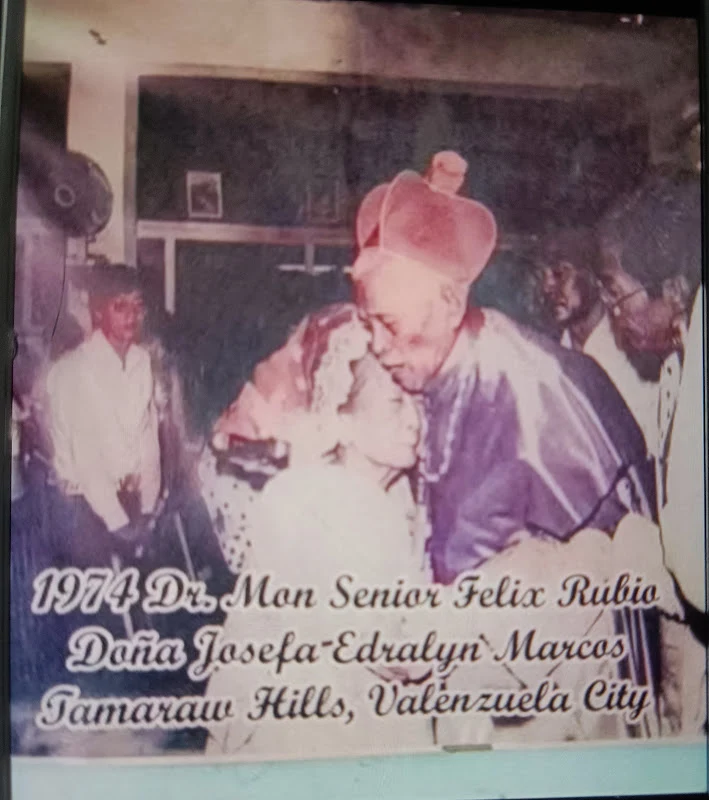
Msgr. Pricilla Flores has also shared a rather surprising piece of information suggesting that the mother of Ferdinand Marcos Sr., Doña Josefa Edralin Marcos, was the grandchild of Dr. Monsignor Felix Rubio, but this revelation was still not confirmed because we have not found any written document about Josefa's relation to Dr. Monsignor Felix Rubio. However, Msgr. Pricilla Flores provided a picture of Doña Josefa Edralin Marcos hugging the late Dr. Monsignor Felix Rubio at a church.
Figure 1: Picture of Edralin Marcos hugging Dr. Monsignor Felix Rubio.
In contrast to this statement, we gathered up some information from the study of Mr. Christian Jeo N. Talaguit titled 'Kakaunting kahayagan mula sa lihim na karunungan: The history of the Spiritual Filipino Catholic Church (1952-2009)’. In his study it states that ‘Edralin Marcos, Ferdinand’s mother, used to pray in the Church’ showing no similarities between the statement of Edralin Marcos being Dr. Monsignor Felix Rubio grandchild. Nonetheless, this can still be changed due to the fact that Dr. Monsignor Felix Rubio was the main bishop of Tamaraw Hills branch back when Spiritual Catholic Church: Muling Pagka-buhay Inc. and SFCC were still affiliated in the same group and might reveal this significant information about his life in one of his masses at his time.
Furthermore, after re-reading the testimonies of Reverend Father Dante Teves Tolalyan and Msgr. Pricilla Soccoro Flores we noticed that there is rather no mention of the founder of SFCC owing to the fact that it contributes to the story of its founder Dr. Monsignor Felix Rubio and their church, with this in mind we personally talked with Mr. Talaguit and raise this concern to him. He stated that back in the days there has been an oral acknowledgement between Dr. Monsignor Felix Rubio and the founder of SFCC about ‘walang pakialamanan’ or no interference among the two, which gives no doubt why there are no other mentions about the SFCC founder and any other heads.
SAN PEDRO BRANCH ORIGIN
According to Mnsgnr. Pricilla, the San Pedro branch came in missionary activities and fate-based healing practice out here in Laguna. She stated that in early years of the movement, prominent figures such as Mnsgnr. Mauricio and Mnsgnr. Felix Rubio traveled to Laguna after getting invited to perform a miraculous healing for an individual who was seriously sick. This event was remembered by Mnsgnr. Pricilla as an important moment that strengthened the local belief in the church's spiritual authority and contributed to the growing presence of the movement in the area. Additionally, during the time of the event, Mnsgnr. Mauricio was already a resident of San Pedro City, Laguna, which allowed for continuous religious activities and the gradual formation of the local church.
Moreover, according to Mnsgnr. Pricilla, the establishment of the San Pedro branch was supported by a local individual who donated a patch of small land to Mauricio. Because of the members' pooled contributions the church was later built and the land later became its permanent site. Additionally, Mnsgnr. Pricilla also indicates that the church name change was due separation from Spiritual Filipino Catholic Church and because of it they adopted the name Spiritual Catholic Church: Muling Pagka-buhay Inc. This suggests that the name change was a response to both separation and legal necessity, as churches are not permitted to register under identical names.
Overall, San Pedro branch origin may suggest that it comes from its lived spiritual experiences and community involvement than in formally written records. This explains why the story of its origin are concise and primary preserved through oral narratives
THE BELIEFS OF THE CHURCH
Findings from the interview analysis revealed that Spiritual Catholic Church: Muling Pagka-buhay are deeply rooted in the Gospel's order to spread God's word and emphasize faith (pananampalataya), hope (pag-asa), and love (pag-ibig) as their central spiritual principles.
According to Msgr. Pricilla, the primary mission of their church is to fulfill God's order to preach the Gospel and bless people in the name of the Father, Son, and Holy Spirit. This mission was expressed through three (3) core components of worship: the Mass, preaching, and novenas, which are believed to strengthen believers faith and their spiritual commitment. Additionally, they believe that humans were articulated through the understanding of the body, soul, and spirit, where the Holy Spirit is seen as a guiding force that gives moral discernment, discipline, and spiritual growth. Their teachings also highlight worship "in spirit and in truth," that are drawn from biblical scripture and emphasize that religious devotion must come from sincere spiritual experiences rather than rigid institutional rules.
Msgr. Pricilla also emphasized the church's belief in equality in the eyes of God, stating that both men and women are equally called to serve, that include leadership roles (priesthood and episcopacy). Furthermore, the church beliefs center on active faith, continuous prayer, moral accountability before God, total reliance on divine providence, and to express the church's motto "Diyos muna bago ang lahat.”
THE INFLUENCE OF THE CHURCH
After attending several masses of the church, the researchers witnessed how the members engaged in scripture-based testimonial sharing, in which Reverend Father Dante Teves Tolalyan assigned biblical verses for the members to discuss and relate to their personal struggles and experiences. Additionally, participants described increased confidence and emotional openness after becoming a member of the church, in the statement of one participants "oo wagas ang pag improve ko kasi imagine dati... Ano... Nag... Pag di ka nakakasimba parang mabigat sa loob mo... Na walang nilalapitan o binubulungan ng nararamdaman mo pero kapag nasa simbahan naibubulong mo sakanya yung problema mo, yung sama ng loob mo na kahit hindi mo nasasabi sa ibang tao nadudunog mo sa panginoon." and several testimonies highlights that their regular church participation and prayer provided them strengths during times of trial and helped them cope with their personal struggles.
Moreover, the influence of the church extended across generations as several participants mentioned encouraging their children to attend and taking up a role in the church, such as sacristan and church aide as to them, holding church responsibilities gave them a sense of obligation and consistency in worship that strengthened their commitment even during moments of discouragement or doubt. Overall, these testimonies highlight how the Spiritual Catholic Church: Muling Pagka-buhay influences the personal, emotional, and spiritual lives of its followers and how it plays a vital role in shaping family practices, member resilience, and reliance on prayer and faith in facing life's uncertainty.
DISCUSSION
Although the results showed the local origin of the San Pedro branch of Spiritual Catholic Church: Muling Pagka-buhay Inc. the findings still shows the complex and, at times, conflicting information surrounding the origins and development of the Spiritual Filipino Catholic Church (SFCC) and the Spiritual Catholic Church: Muling Pagkabuhay Inc. (SCC-MP). The study of Mr. Christian Jeo N. Talaguit titled ‘Kakaunting kahayagan mula sa lihim na karunungan: The history of the Spiritual Filipino Catholic Church (1952-2009)’ shows the statement of Dr. Mnsgnr. Felix Rubio about ‘walang pakialamanan' between the Spiritual Filipino Catholic Church (SFCC) and the Spiritual Catholic Church: Muling Pagka-buhay Inc. (SCC-MP) which suggests organizational independence between the two groups. This statement of Dr. Mnsgnr. Felix Rubio raises questions regarding the historical relationship between the churches, particularly in terms of their chronological development. In contrast, oral accounts from Reverend Father Dante Teves Tolalyan indicate that SCC-MP was previously named as SFCC before the leadership transitioned under the father of Mnsgnr. Pricilla Socorro Flores. This suggests that SCC-MP may previously functioned as a branch of SFCC which raises questions regarding the statement of ‘walang pakialamanan' mentioned by Dr. Mnsgnr. Felix Rubio that may indicate a more complex historical relationship between the two organizations.
Additionally, the findings suggest that the church’s practices and traditions are a combination of Roman Catholic, Aglipayan, and Born Again. This can be seen in their sharing of personal experiences with everyone, their singing of a mix of sacred church songs and worship songs, and their reading of Bible verses. In difference, the way they choose their leaders is different from the three religions mentioned, because women are allowed to hold high positions, not only as Madres or Nuns. This information was noteworthy since it is widely recognized, not all or none of the other churches apply this kind of opportunity to women to become a bishop or have a high position within a church. Moreover, the findings show that they are very consistent and committed to their faith and in proclaiming the word of God. This is because they choose to pass down their faith from grandparents to parents, and then to their children and grandchildren. This also applies to how the elders guide the children to become one of the church leaders someday.
CONCLUSION
The study highlighted the Spiritual Catholic Church: Muling Pagka-buhay Inc. history, origin, beliefs, and the influence of the church to its members regarding to their character, life, and faith. This study bring clarity to the history of the Spiritual Catholic church: Muling Pagka-buhay Inc., make us understand its unique beliefs, objectives, and ways of how they spread God’s words to its members and also enlightens the information on what its differences are to other churches or religions, and that the church help the members to build commitment and consistency in worship in the church. Overall, it covers the history, beliefs, reasons of their existence, testimonies, experiences of the members and active leaders, and their influence to their people, which bridge the gap of information due to the lack of documentation of the Spiritual Catholic Church: Muling Pagka-buhay Inc. However, this study lacks more information about the church history as we have only focused on one particular branch of SCC-MP and does not have the capabilities to interview the other leaders of the church who might give additional information about the church history and answer the remaining questions that still linger in this study.
Like this project
Posted Oct 1, 2026
Conducted oral-history research on the origins and beliefs of the Spiritual Catholic Church.
Likes
0
Views
0