iOS Mobile App Case Study

Riley Knowles


Today is an iOS mobile app designed to support young adults with ADHD complete self care tasks in their day by restricting access to addictive apps and redirecting their attention to incomplete self care tasks.
My Role
User Research - I conducted desk research on adult ADHD symptoms, collaborated on survey design and respondent recruitment strategy, then personally scripted and conducted 5 user interviews over zoom.
Problem Solving - For the feature explored in this case study, I synthesized the key problem from research insights, conducted a competitive analysis of current solutions, then iteratively developed a solution mechanism.
Design System - I was also responsible for the development of the app's design system and documentation maintenance.
Team
Myself, Designer
Madison Hatch, Designer
Jaye Sloat, Designer
Tools
Figma, FigJam, Google Suite, Zoom
Timeline
4 Weeks + 1 Week Solo Sprint
Context
During the IterateUX Design-a-thon, two other designers and I followed a design-thinking approach to research and design a multi-featured task tracking app specifically for young adults with ADHD. Following the 4 week event, I wanted to dig deeper into the user journey of a specific feature. The below case study is comprised of our team research and my individual 1 week feature exploration.
Research

Build Foundational Understanding
Our group members had personal connections to young adults with ADHD, so we each performed foundational research to check our assumptions. Our key learnings were that our user base...
Struggled with time management & prioritization
Struggled with task follow-through
Motivated by urgency
Identify Key Problems with Surveys
Informed by our foundational research, we developed a survey to quickly and easily identify users' key problems, current management strategies and their effectiveness.
75%
Struggled with Personal Hygiene
88%
Struggled with Chores
We learned users had strategies in place to manage work and school related responsibilities, but no strategies for completing personal care tasks such as showering, cooking meals, or cleaning.
Define the Persona to Build Alignment
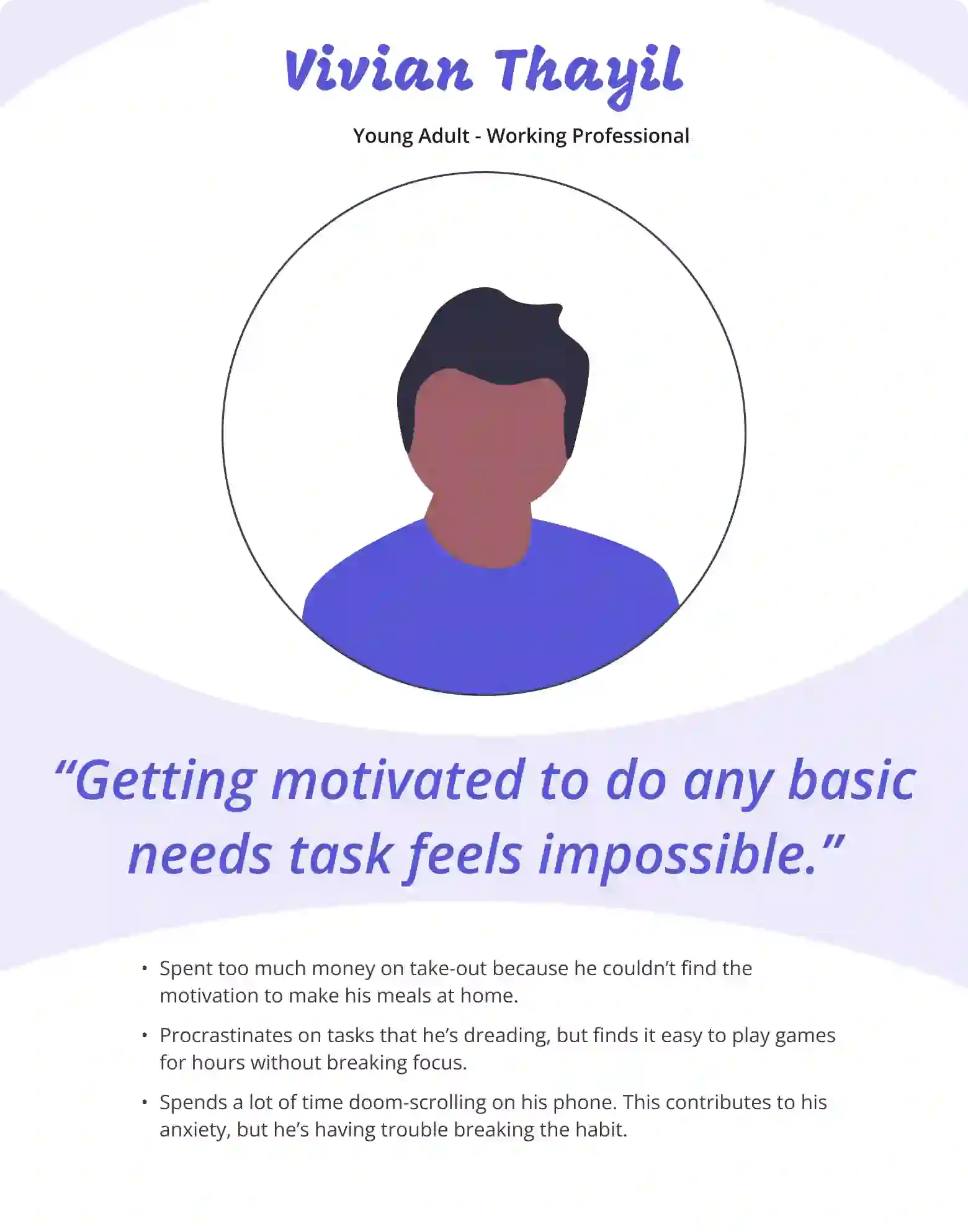
These results gave us a very clear picture of who our targeted user was, so we developed a persona to build team alignment and have a reference for later stages of the project.
Dig Deeper with Interviews
I still wanted to get a deeper understanding of the emotions and thought patterns our user base experienced around completing these self care tasks, so I conducted 5 Zoom interviews with young adults between ages 18 and 26 to ask about these habits.

During the interviews, one story was told again and again:
"I wake up and instinctually reach for my phone, get sucked into scrolling until I've run out of time to do anything except run out the door to work."
It was very clear this was a narrative all users shared and one that elicited extremely negative emotions and self talk, making it the urgent focus of my feature development.
Understanding Step by Step
I knew to effectively address this problem, I needed to understand each step the user takes and the emotions at each step in order to explore opportunities for changing this user journey outcome.
Journey Mapping of Phone Scrolling in the Morning
Define
How might we stop users from endlessly scrolling and refocus their attention on self care tasks?
Explore
Blurred competitor icons
Were there other companies trying to address this problem?
Yes. Kind of. There were many apps on the market providing features to remind users to take breaks from addictive apps and others that blocked users out from apps altogether, but none of these addressed our core problem.
1. Push notifications are easy to circumvent.
Push notifications introduce friction to the user journey, but ultimately won't change the outcome of user behavior. Young adults with ADHD are motivated by urgency and novelty, neither of which are created by push notifications.
2. Restricting access to addictive apps only solves half the problem.
This was effective (and one of our user bases' current strategies) for staying off addictive apps during the workday or completing homework, but wasn't helping anyone complete self care tasks.
The New Proposed Mechanism
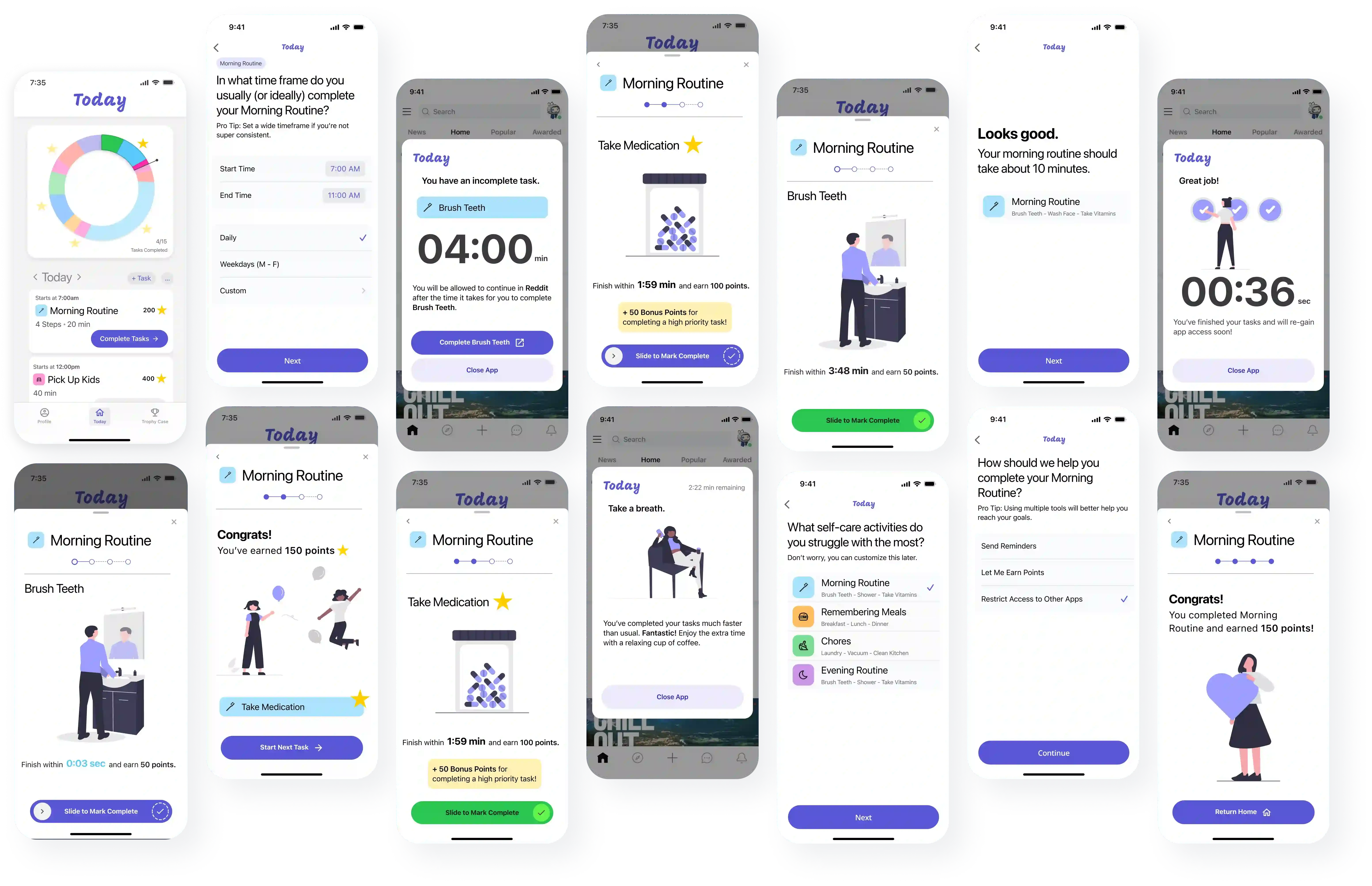
What if I bound app restriction specifically to tasks and redirected users' attention to their incomplete self care tasks, and even better, once their self care tasks are complete, they can regain access.
Diagram of new proposed mechanism
This solution leverages the app blocking mechanism promoted by competitors, but includes a novel feature designed specifically for young adults with ADHD to capture and redirect attention.
Working Out the Details with a User Flow
Before drafting screens, I wanted to flush out how the mechanism would work. This would inform what information needed to be available to the user on screen, and what design patterns would be best to implement the mechanism.
User Flow Diagram of Proposed Mechanism
Proposed Solution - Setting Up the Mechanism in Onboarding
Onboarding: Selecting Task Group
Creating Low Barrier to Entry
When users onboard, they're given pre-grouped self care tasks to reduce the effort of task creation and create a low-barrier to entry. This was important to our team because we learned from our research that when young adults with ADHD are faced with multi-step, high cognitive input tasks, they were less likely to complete them.
Onboarding: Establishing Time Frame
Helping with Time Management Too
Additionally, subtasks are pre-assigned an estimated time for completion. This is important to the block out mechanism, but also helps our user group better grasp how long tasks will take and improve time management. If our estimations for tasks are wrong, users can of course change them later in the settings.
Onboarding: Selecting Tasks
Establishing Time Frame
Nobody wants reminders to brush their teeth when they should be making dinner - that makes no sense!
Proposed Solution - Mechanism In Action
Interruption
When a user opens a restricted app within a time frame that they have incomplete self care tasks, they're blocked. This interrupts their habit and creates opportunity for establishing a different behavior.
Interruption Sequence
Redirection - Novel
Instead of just blocking the users from restricted apps (common competitors' mechanism), the user is redirected to their next incomplete task (novel!).
Specifically designed for people with ADHD to guide their attention to incomplete tasks.
Redirection Sequence
Routine Completion and Trying to Circumvent the Mechanism
Depending on how long a user takes to mark their tasks as complete, they will see one of two screens when navigating back to their restricted app.
Routine Completion Happy Path
Routine Completion Unhappy Path
Design System
Reflection
Lessons Learned the Hard Way
Building a style guide and components is not enough. Written guidelines for usage or a meeting on how the design system should be used would have helped us maintain more consistency when collaborating as a team.
Up-leveled Skills
More advanced (and delightful) prototyping
iOS Mobile Design Patterns
Next Steps
Data & Testing
In an ideal world, I'd love to assess app engagement rates, and deploy a lightweight satisfaction survey to users to establish a baseline of success, then follow with more data collection and testing from there.
Accessibility Audit
This app was designed with WCAG guidelines in mind, but it would be beneficial to do a more thorough assessment to ensure all users can have an equitable experience using the app.
Like this project
Posted Jan 16, 2024
An iOS mobile product design to help young adults with ADHD complete the tasks in their day. https://www.knowriley.com/today-mobile-app-case-study
Likes
0
Views
3