Real-Time Analytics Platform on AWS

Advancing Data Solutions


Real-Time Analytics Platform on AWS
Role: Data Engineer and Cloud Architect
Project Overview
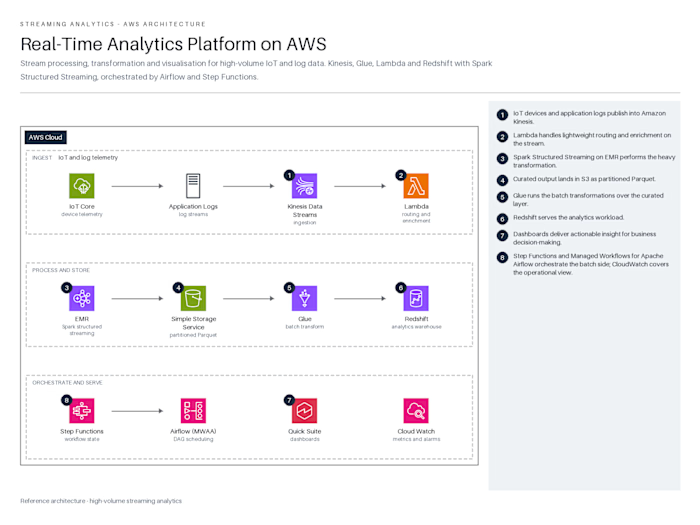
Organizations dealing with high-volume telemetry require systems that can ingest, process and visualize data with minimal latency. I designed and deployed a comprehensive real-time analytics platform on AWS to handle massive streams of data from IoT devices and application logs. This architecture bridges the gap between raw streaming ingestion and actionable business intelligence by leveraging distributed processing, serverless data warehousing and robust orchestration.
The Architecture & Data Flow
1. High-Velocity Ingestion and Enrichment
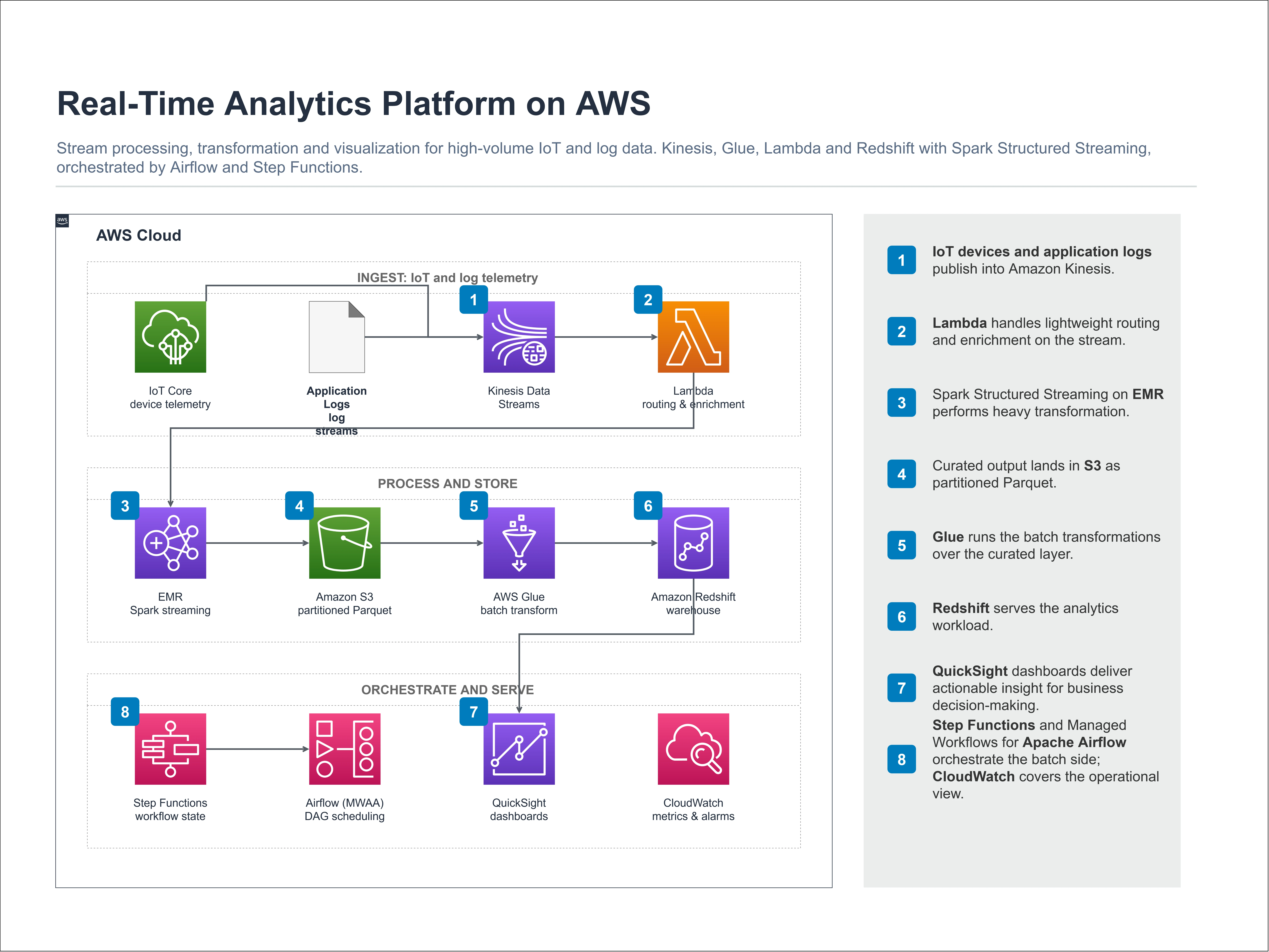
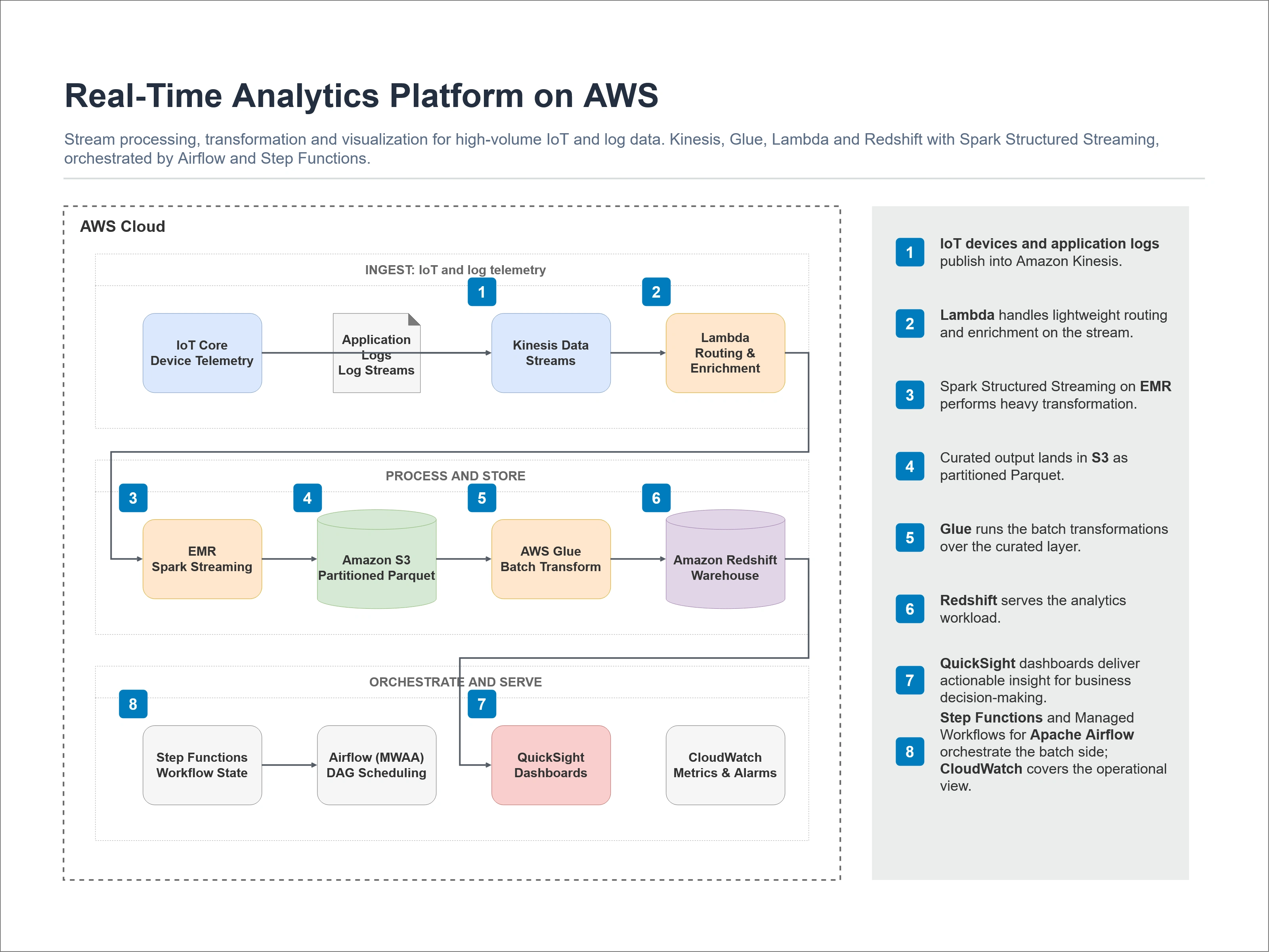
The pipeline begins with continuous device telemetry from AWS IoT Core and raw application logs being published directly to Amazon Kinesis Data Streams. To ensure downstream systems receive clean information, AWS Lambda intercepts the stream to perform lightweight routing, filtering and initial data enrichment before the data enters the core processing phase.
2. Stream Processing and Data Lake Foundation
For the heavy analytical lifting, Amazon EMR runs Spark Structured Streaming to execute complex transformations on the fly. The curated output is continuously written to Amazon S3. By storing this data as partitioned Parquet files, we established a highly optimized, cost-effective and analytics-ready data lake foundation that prevents storage bottlenecks.
3. Batch Transformation and Warehouse Loading
Once the streaming data lands in the S3 data lake, AWS Glue takes over to manage serverless batch transformations over the curated layer. The fully transformed and aggregated datasets are then loaded into Amazon Redshift to serve heavy analytical queries and support the primary data warehouse workloads.
4. Advanced Workflow Orchestration
Managing a hybrid streaming and batch architecture requires precise coordination. This platform uses a dual-orchestration approach. AWS Step Functions manages specific workflow states and execution sequences, while Amazon Managed Workflows for Apache Airflow (MWAA) handles complex DAG scheduling across the batch processing pipeline.
5. Dashboards and Operational Intelligence
To deliver immediate business value, Amazon QuickSight connects directly to Redshift to turn complex analytics data into accessible, interactive and actionable dashboards for key decision-makers. Simultaneously, Amazon CloudWatch provides comprehensive operational visibility by tracking metrics, monitoring pipeline health and triggering alarms across the entire AWS ecosystem.
Technology Stack
Streaming Ingestion: AWS IoT Core and Amazon Kinesis Data Streams
Lightweight Processing: AWS Lambda
Distributed Transformations: Amazon EMR and Spark Structured Streaming
Data Lake Storage: Amazon S3 (Partitioned Parquet)
Batch Transformations: AWS Glue
Data Warehouse: Amazon Redshift
Orchestration: AWS Step Functions and Amazon MWAA (Airflow)
Business Intelligence: Amazon QuickSight
Monitoring & Alerting: Amazon CloudWatch
Business Impact
This implementation resulted in a highly scalable, fault-tolerant and automated pipeline capable of turning raw IoT noise into structured business insights. By decoupling storage from compute and utilizing partitioned columnar storage formats, the architecture significantly reduced query latency, lowered operational storage costs and empowered stakeholders with real-time decision-making capabilities.
Like this project
Posted Sep 8, 2026
Designed an AWS real-time analytics platform that turns IoT telemetry and application logs into reliable, dashboard-ready business insights.
Likes
0
Views
5