
Business Problem
A manufacturer needs to translate its staffing plan into a reliable personnel budget. Finance and operations need to understand how monthly staffing levels, pay rates, merit timing and benefits affect direct labor, indirect labor and salaried costs.
Approach
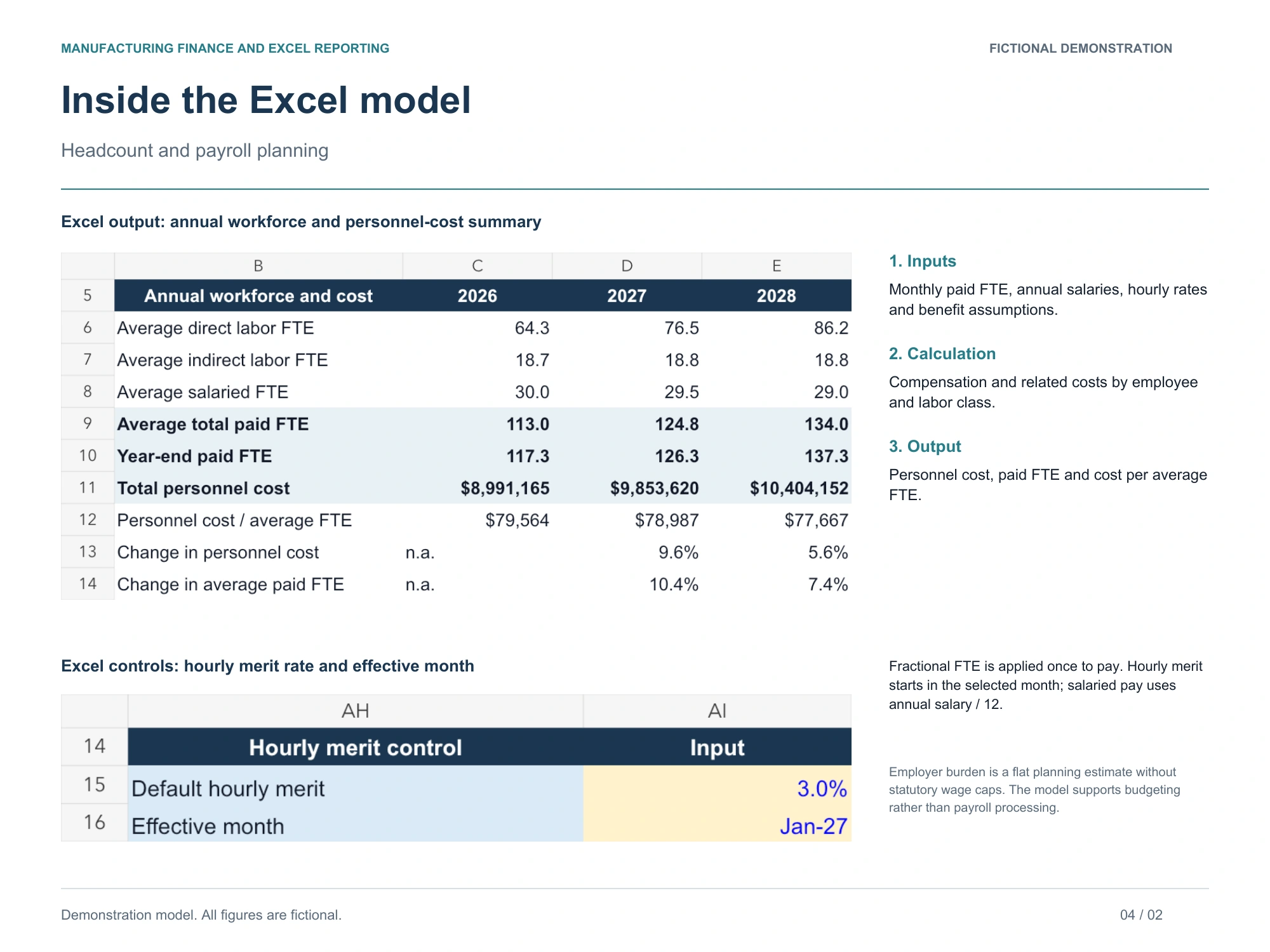
I built an Excel planning model combining employee-level pay inputs with monthly paid full-time equivalents (FTE). The model supports fractional FTE and calculates compensation and related costs by labor class, including hourly merit timing, overtime, paid leave and benefit assumptions. Detailed schedules feed monthly and annual personnel-cost reporting.
Model / Output
The model covers 2026-2028 and summarizes personnel cost, average and year-end paid FTE, and annual cost per average FTE. Reviewers can adjust staffing allocations, hourly rates, salaries and benefit assumptions, then trace the effect through employee schedules and the personnel P&L. Reconciliation checks support review of the payroll-cost build.
Result / Decision Support
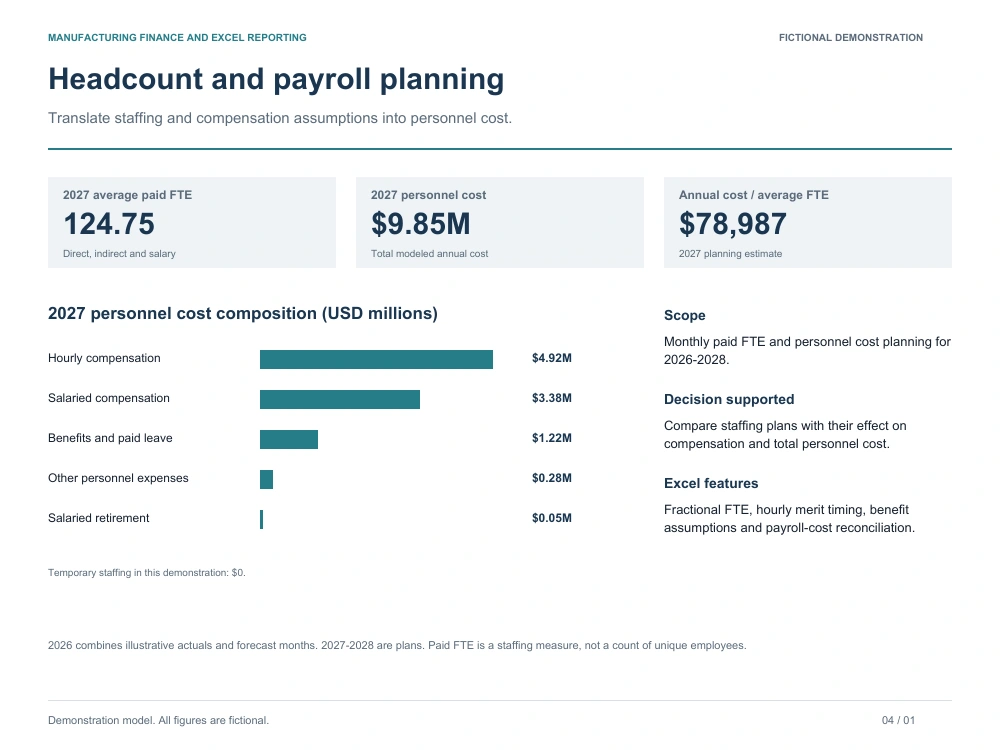
The fictional 2027 plan shows average paid FTE of 124.75, total personnel cost of $9.85 million and annual cost per average FTE of $78,987. The model supports staffing-budget reviews, comparison of direct and indirect labor costs, and assessment of compensation and benefit assumptions. These figures illustrate model behavior; they are not client outcomes or claimed savings.
Scope and Confidentiality
All staffing and compensation data is fictional. Paid FTE measures staffing allocation, not the number of unique employees. 2026 combines illustrative actuals and forecast months; 2027-2028 are plans. Employer burden uses flat planning assumptions without statutory wage caps. This is a workforce-budgeting model, not payroll processing or a statutory-tax calculator. No confidential employee or client data is shown.
0 likes · 1 view · Oct 17, 2026
Fictional Excel workforce budget linking monthly paid FTE, compensation and benefit assumptions to personnel cost and management reporting.
