Ilmversity: Unified Education Operations Platform

Waleed yaseen


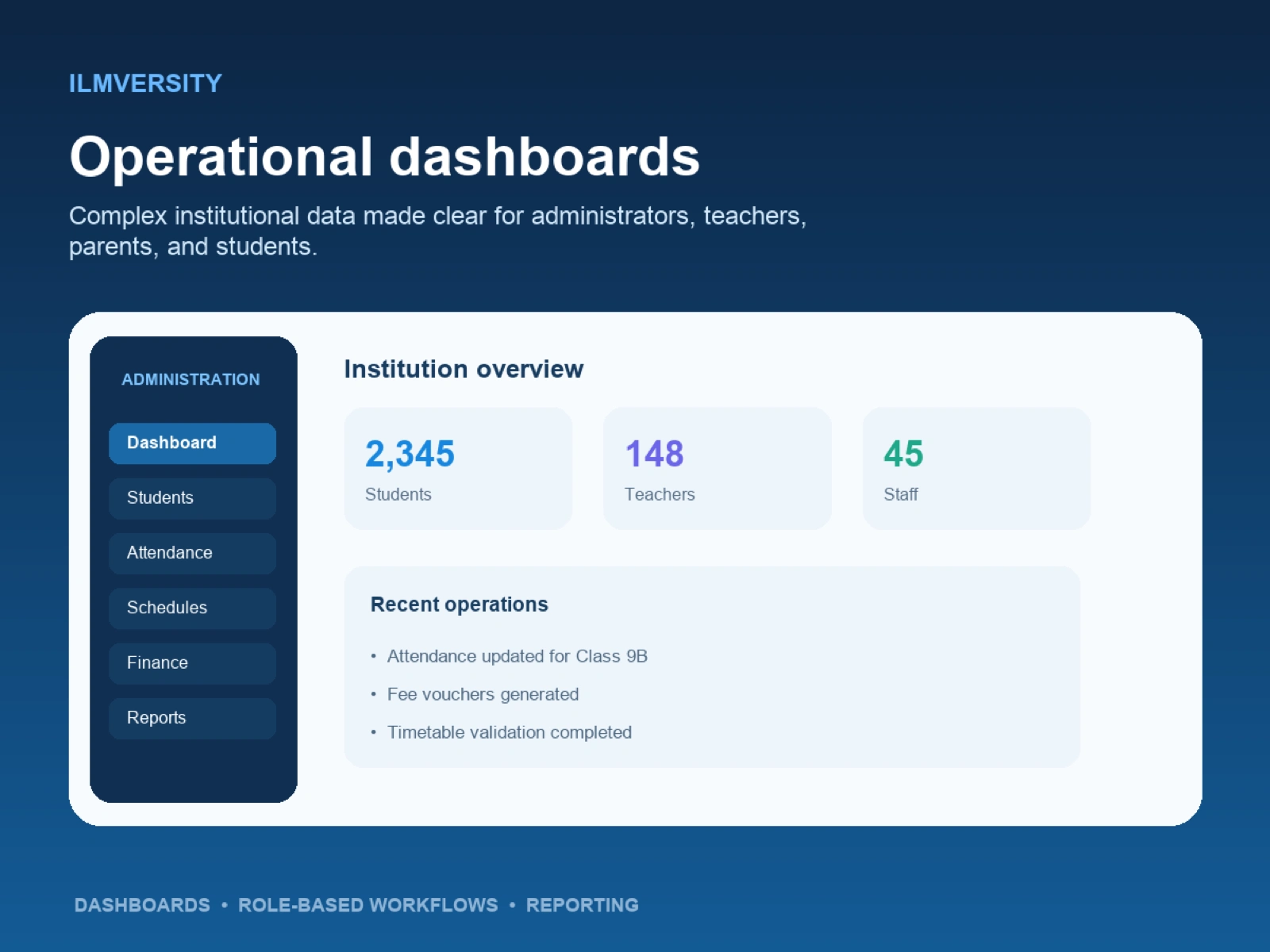
Ilmversity — Engineering a Unified Education Operations Platform
Production case study • Backend engineering, business workflows, and SaaS product development
The operational problem
Schools rarely struggle because they lack software. They struggle because attendance, admissions, fees, scheduling, academic records, communication, and reporting live in separate systems. Every handoff creates duplicate data, delayed decisions, and work that administrators must reconcile manually.
Ilmversity addresses that fragmentation with a cloud-based school management and learning platform. Its public product brings student records, attendance, scheduling, admissions, finance, reporting, and parent communication into one operational environment across web and mobile.
I contributed as an engineer within the wider Ilmversity team. My work focused on backend services, API improvements, payment-related workflows, AI-enabled product features, deployment support, and maintainable business logic. This case study describes that contribution without attributing the entire platform to me.
The product challenge
Education software has unusually connected workflows. A new admission can create or update student records, class placement, fee plans, portal access, notifications, and reporting. A timetable change can affect teachers, rooms, students, and attendance. A payment may depend on plan, currency, discount, prior usage, and expiry rules.
Treating each feature as an isolated screen would have produced inconsistent data and fragile integrations. The engineering problem was to preserve clear boundaries while allowing important events to move safely across the product.
Designing services around institutional workflows
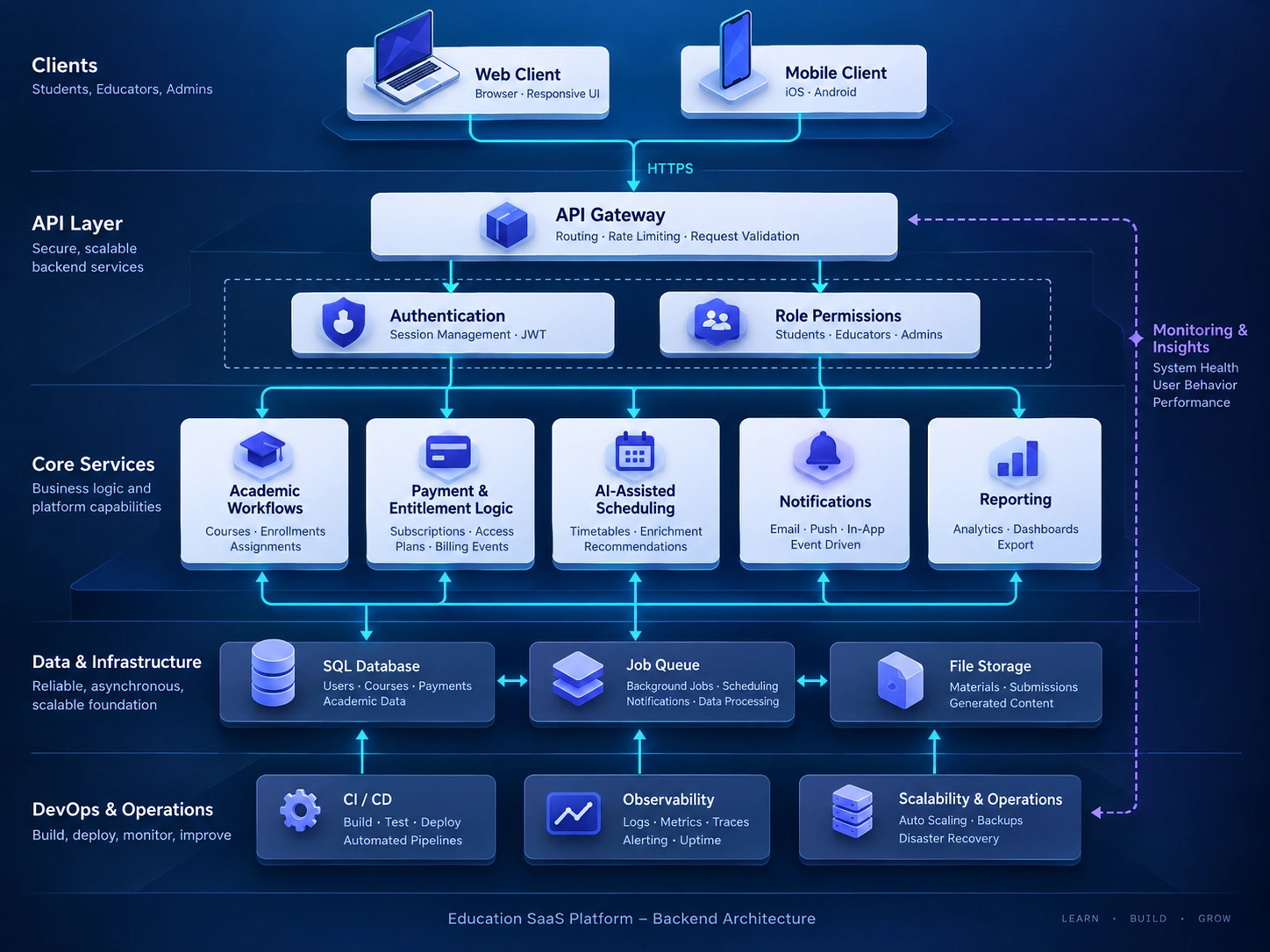
The backend work centered on Node.js and Express.js services supporting real school operations. I worked on API behavior and product workflows that needed predictable validation, consistent errors, authorization, and maintainable service boundaries.
The core design principle was to model institutional actions rather than generic database operations. APIs represented concrete actions such as enrolling a student, updating a payment state, applying a plan rule, recording usage, or advancing an administrative workflow. This made business rules visible in the service layer and reduced the chance that different clients would implement the same rule differently.
Important engineering concerns included:
• Role-aware access for administrators, staff, teachers, students, and parents
• Validation at workflow boundaries rather than only at the interface
• Transactional updates where one action affected several related records
• Idempotent handling for operations that could be retried
• Stable API contracts for web and mobile clients
• Structured logging and error responses that made production issues diagnosable
Building payment and entitlement logic that could evolve
Education billing is more than recording a successful payment. Plans can differ by institution, currency, duration, discount, included usage, and expiry. A robust design also needs to distinguish an entitlement from the payment that funded it.
My related work included payment modules and the design of subscription and credit-system structures covering plans, currencies, discounts, payments, usage, and expiry records. I separated commercial configuration, transaction history, and consumption state so the system could answer three different questions:
• What was the institution offered?
• What was paid or adjusted?
• What access or credit remains available now?
This separation supports clearer reconciliation, safer plan changes, and a better audit trail. The subscription and credit work included system design as well as implemented payment-related functionality; I do not present every proposed record or workflow as a fully deployed platform feature.
Integrating AI inside the product workflow
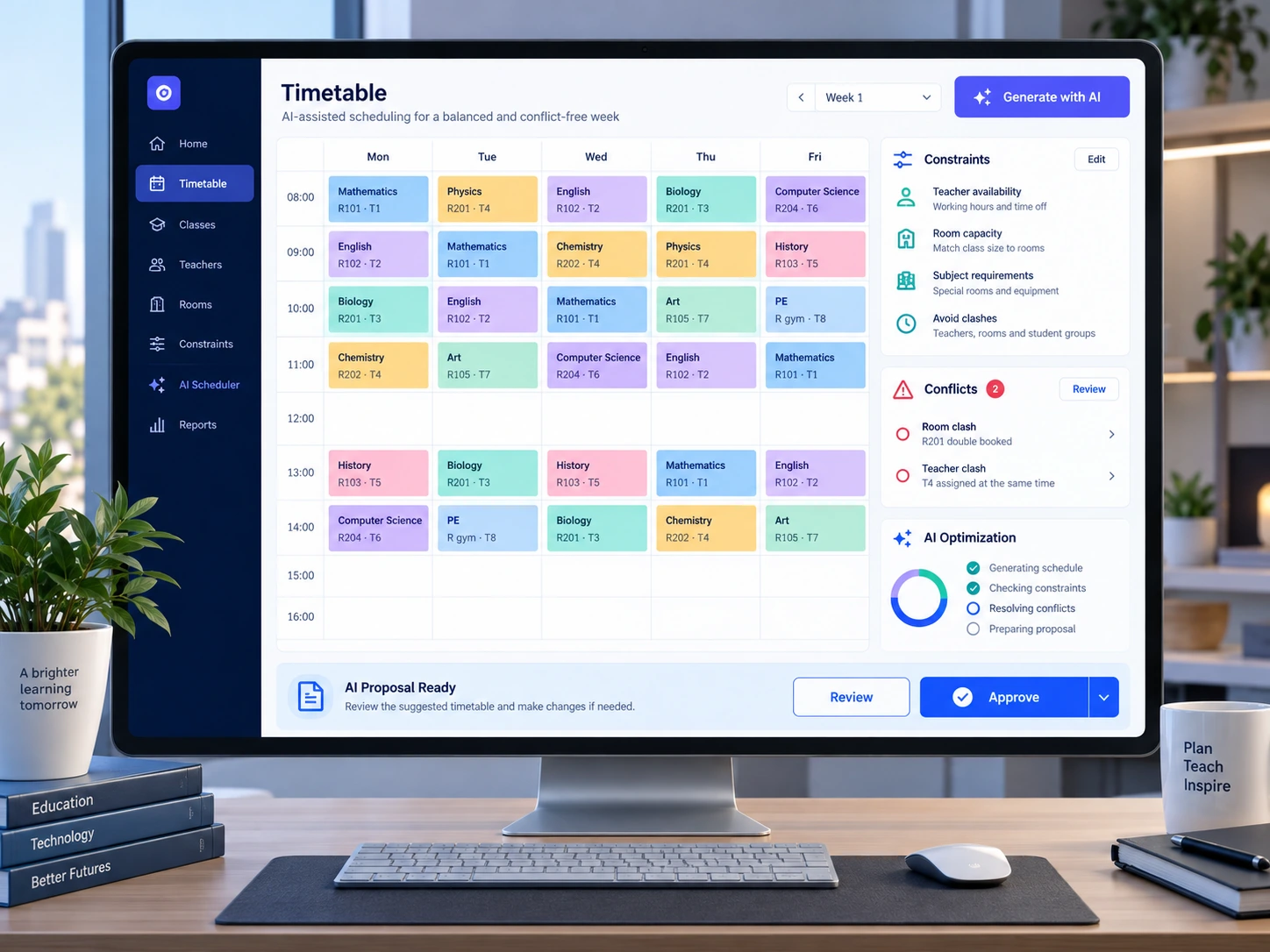
Ilmversity publicly offers AI-assisted scheduling alongside broader school-management capabilities. The useful product question is not simply whether an AI service can return an answer. It is whether that answer can enter an institutional workflow with the right constraints, review state, permissions, failure handling, and fallback behavior.
My AI-related contribution focused on connecting useful automation to the surrounding application. That meant treating model or optimization output as a proposal that the product could validate, display, and revise. The interface and backend still needed to preserve the source inputs, expose conflicts, handle incomplete data, and keep a human decision-maker in control.
The same approach applies to other education workflows: automation should reduce administrative work while leaving the institution with a clear, reviewable result.
Supporting delivery in a live product
Production SaaS work continues after a feature passes local testing. API changes must remain compatible with active clients, migrations need an explicit path, and deployment failures must be recoverable.
I supported CI/CD and production delivery for the services I worked on. The practical focus was repeatable builds, environment-aware configuration, migration discipline, and enough observability to trace a failed request across the application. This reduced the risk of treating deployment as a manual final step and made incremental product improvements easier to ship.
Product outcome
The result is a connected education-operations platform where institutions can manage academics and administration within one product instead of moving the same information through disconnected tools. Ilmversity’s public platform covers student management, AI-assisted scheduling, attendance, admissions, fees and payments, analytics, communication, learning workflows, and web/mobile access.
My contribution strengthened the service and workflow layer behind that product: clearer APIs, more maintainable business rules, payment-related functionality, structured subscription and credit design, AI-enabled workflow integration, and production delivery support.
What this case study demonstrates
• Engineering business software around real operational workflows
• Improving an existing production SaaS application safely
• Designing API behavior, validation, permissions, and failure handling together
• Modeling payments, plans, credits, usage, and expiry without conflating them
• Integrating AI as a governed product feature rather than a standalone API call
• Contributing effectively inside a wider product and engineering team
My role
Backend Engineer / Full-Stack Product Engineer within the wider Ilmversity team
Relevant technology
JavaScript • Node.js • Express.js • REST APIs • SQL data modeling • Payment integrations • AI-enabled workflows • CI/CD • Cloud deployment
References
Live product: https://ilmversity.com/
Public feature overview: https://ilmversity.com/features/
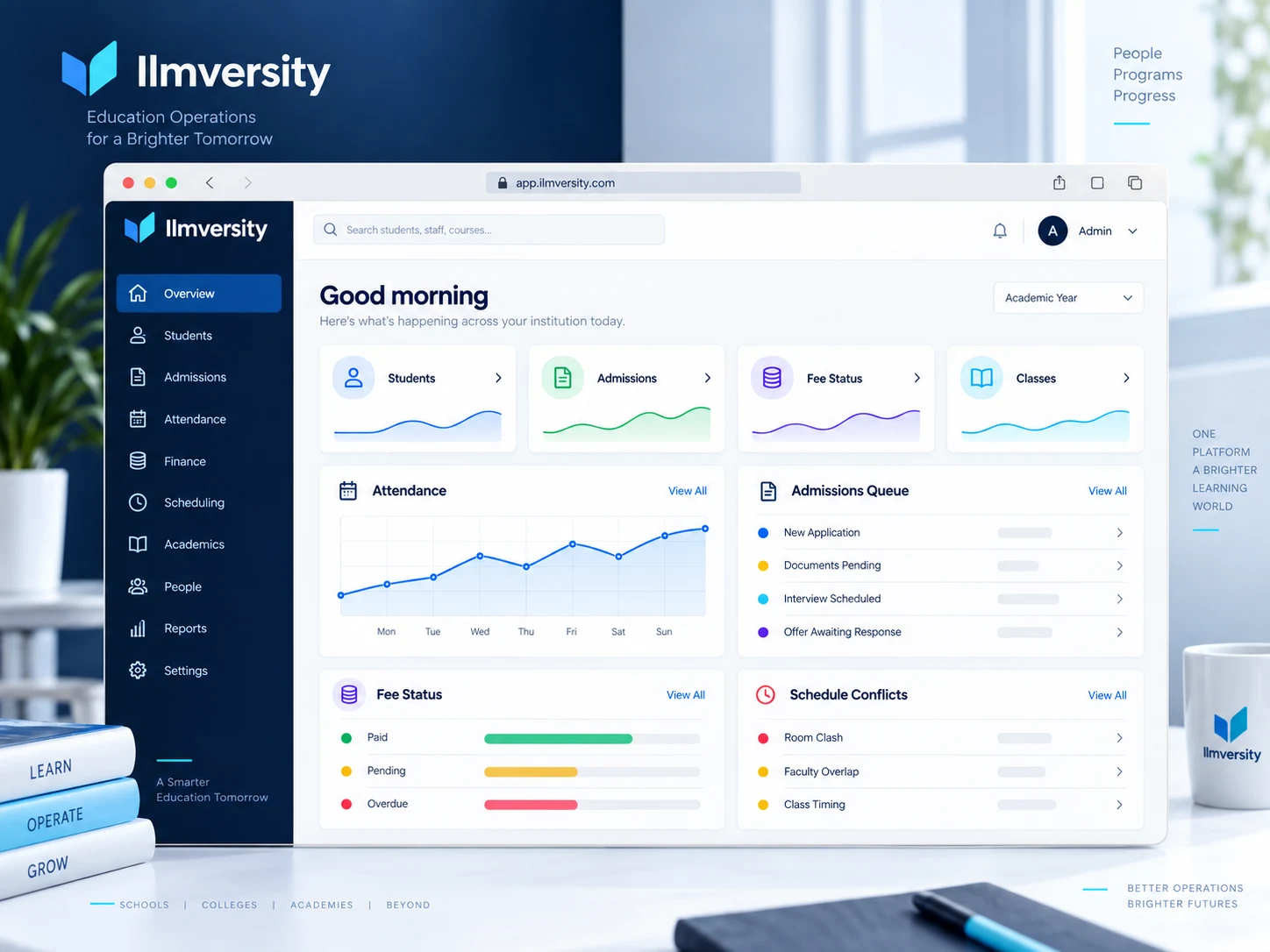
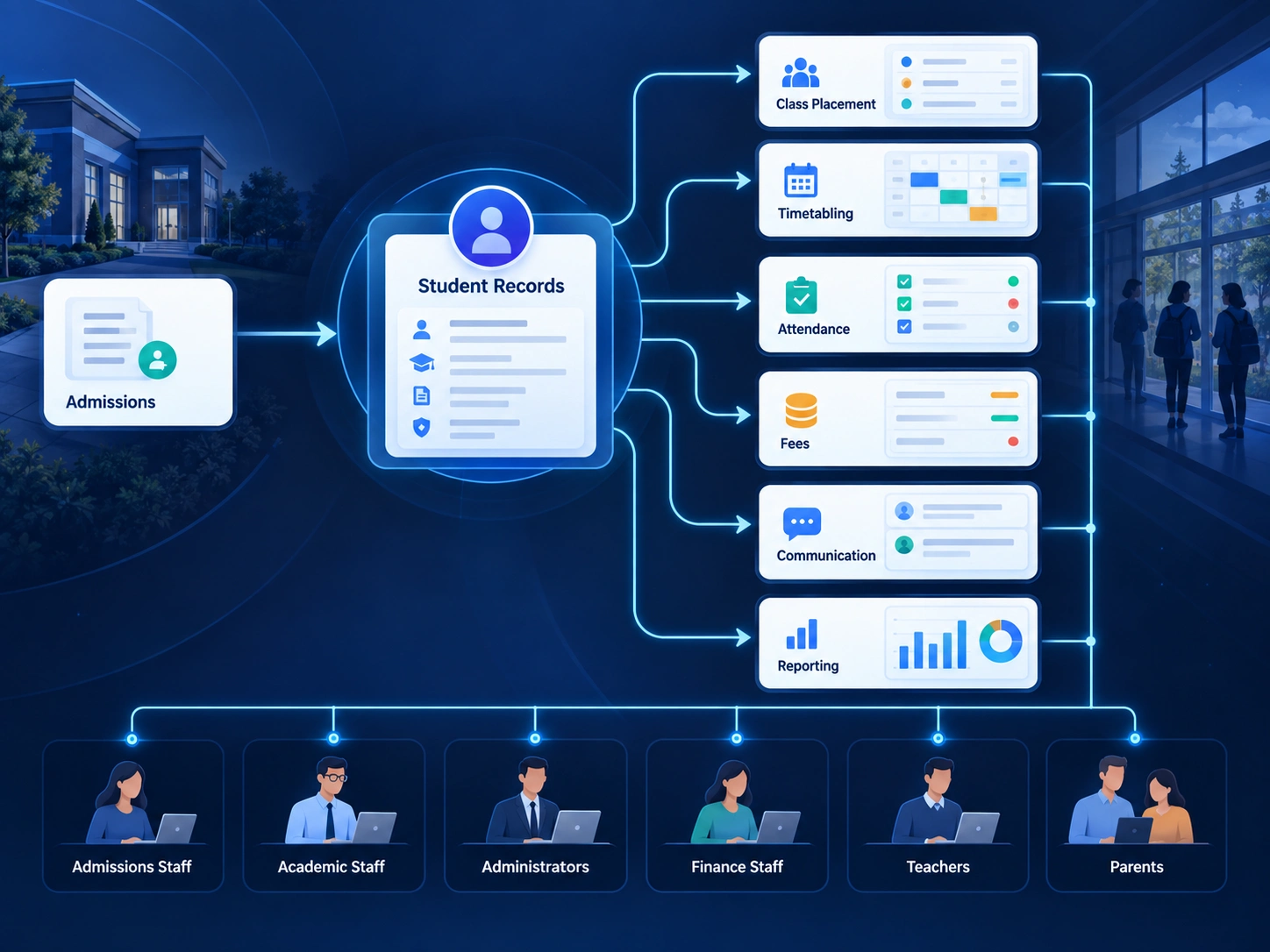
Product walkthrough: connected education operations, scheduling, attendance, and finance workflows.
Like this project
Posted Sep 26, 2026
Strengthened backend services, payment workflows, AI-enabled features, and production delivery for a connected school-management platform.