TraceGrid: Global Supply-Chain Control Tower Concept

Waleed yaseen


TraceGrid — Designing a Verifiable Global Supply-Chain Control Tower
Independent concept case study • Product strategy, full-stack architecture, and enterprise UX
The opportunity
Global supply chains rarely fail because a team lacks data. They fail because critical signals arrive in different systems, at different speeds, with no shared decision model. A delayed vessel appears in one feed, inventory sits in an ERP, supplier commitments live in email, and regional demand changes in a planning workbook. By the time those facts are reconciled, the business is already reacting to yesterday’s problem.
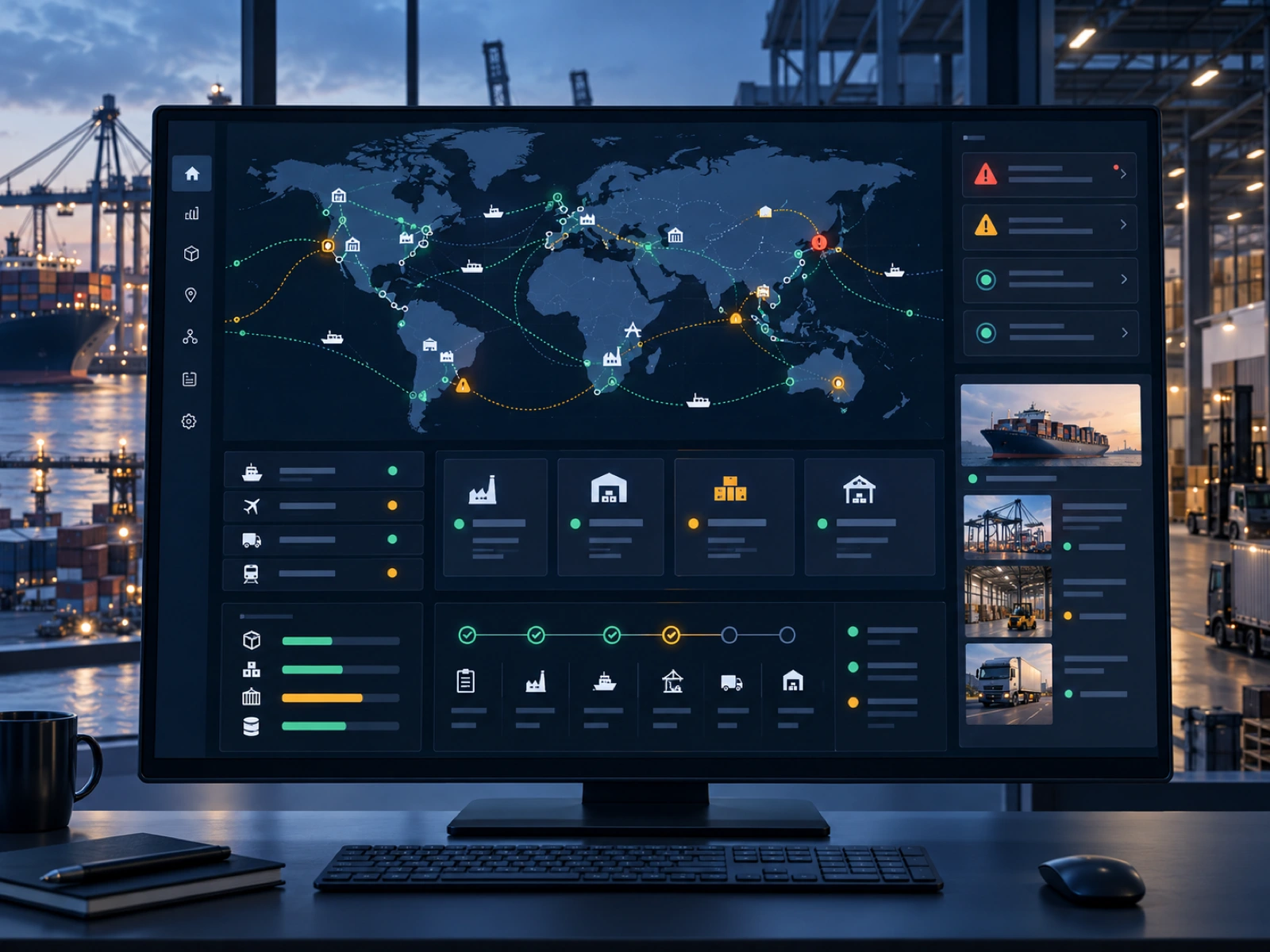
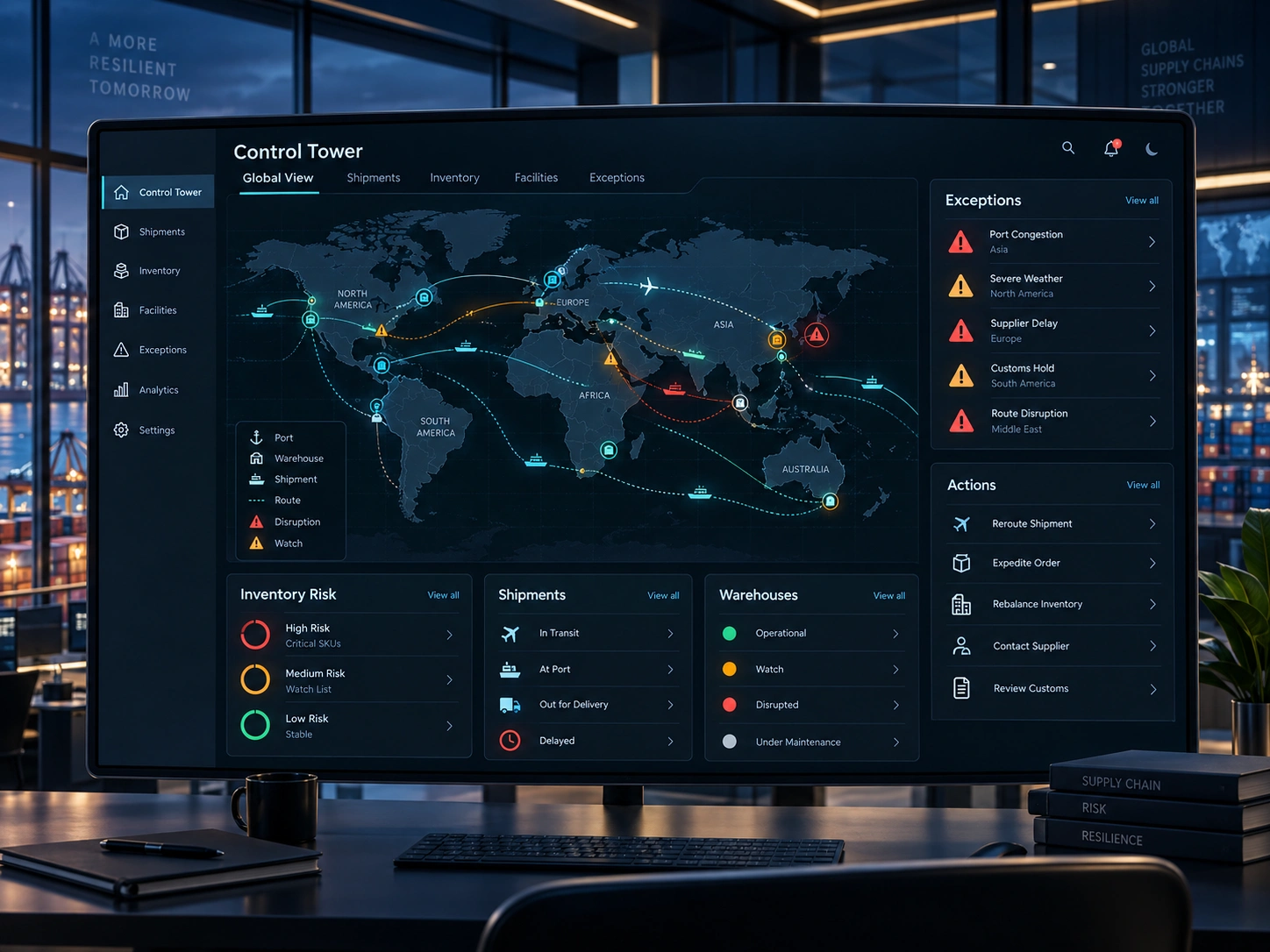
I designed TraceGrid as a concept for a multi-region manufacturer managing suppliers, ports, warehouses, and customer commitments across several continents. The goal was not another map covered in dots. It was a decision system that could answer three questions quickly and defensibly:
• What changed?
• Which orders and customers are now at risk?
• What is the best allowed recovery action, and why?
The governing idea
Every disruption should become a traceable decision, not an isolated alert.
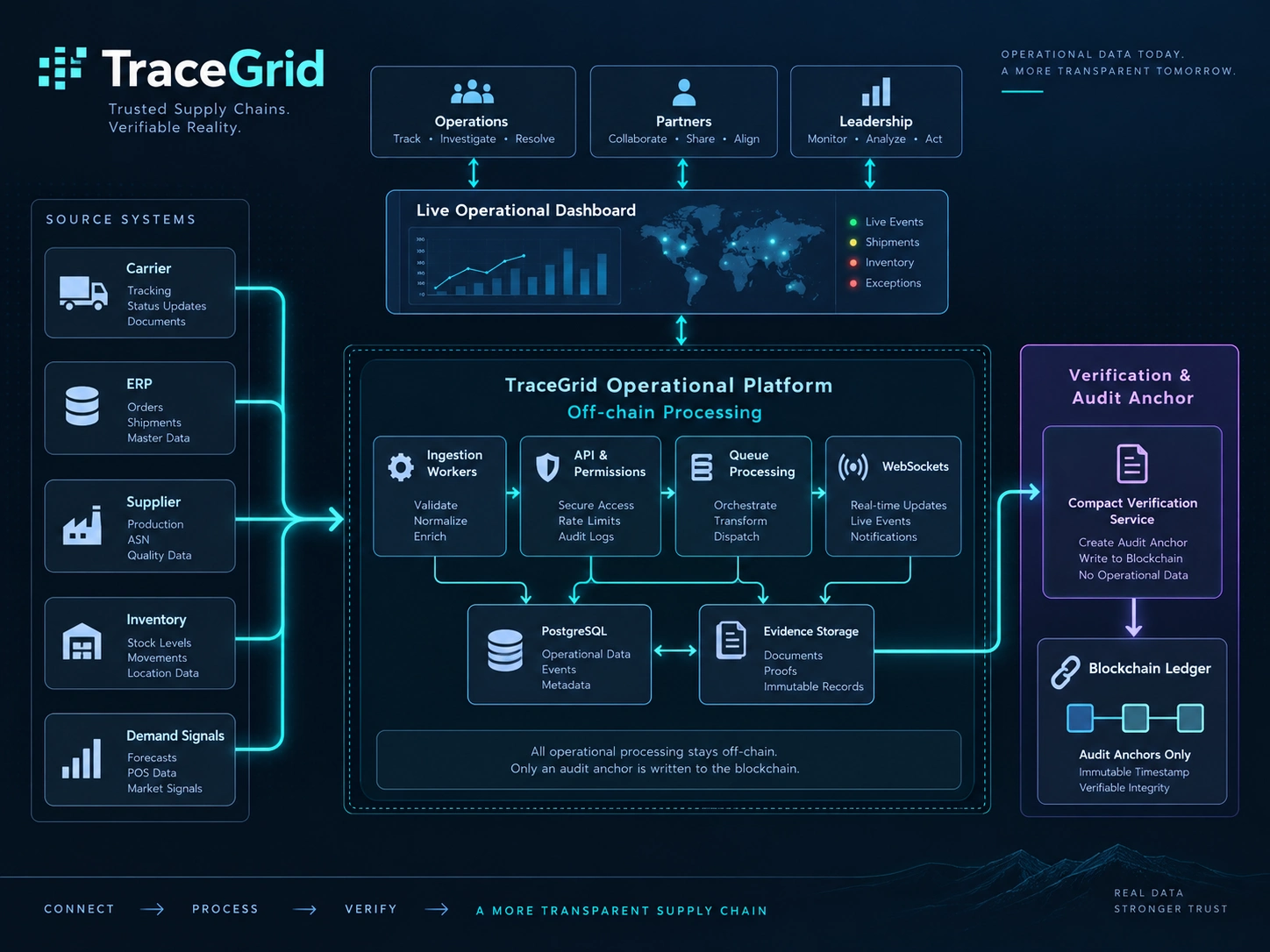
TraceGrid combines an operational control tower with a deterministic allocation engine. Business processing remains off-chain, where planners need speed, privacy, and control. A verification layer records the decision inputs, rule version, allocation output, and approval state as an immutable audit anchor. The result is a system where an outcome can be checked against the rules that existed when the decision was made.
This architecture adapts a principle I have used in auditable allocation systems: processing happens off-chain, while blockchain provides a verification and audit anchor. The purpose is to make outcomes traceable and checkable against defined rules.
Turning fragmented signals into one operational model The first design task was defining a canonical event model. Carrier updates, supplier milestones, inventory changes, demand forecasts, purchase orders, and service commitments become normalized events with a source, timestamp, confidence level, affected entities, and geographic scope.
Rather than copying every upstream field into one large database, the platform preserves source references and maps only the attributes needed for decisions. This reduces coupling and lets the system evolve as carriers, ERPs, or planning tools change.
The operational graph connects:
• Suppliers and production sites
• Ports, terminals, and transport lanes
• Warehouses and available inventory
• Orders, customers, and service commitments
• Rules, approvals, and previous allocation decisions
A delayed shipment is therefore not just a red status. It is a node connected to downstream inventory, orders, customer priority, and possible alternatives.
Designing the exception workflow Supply-chain teams do not need every event promoted to an alert. They need the few changes that require a decision.
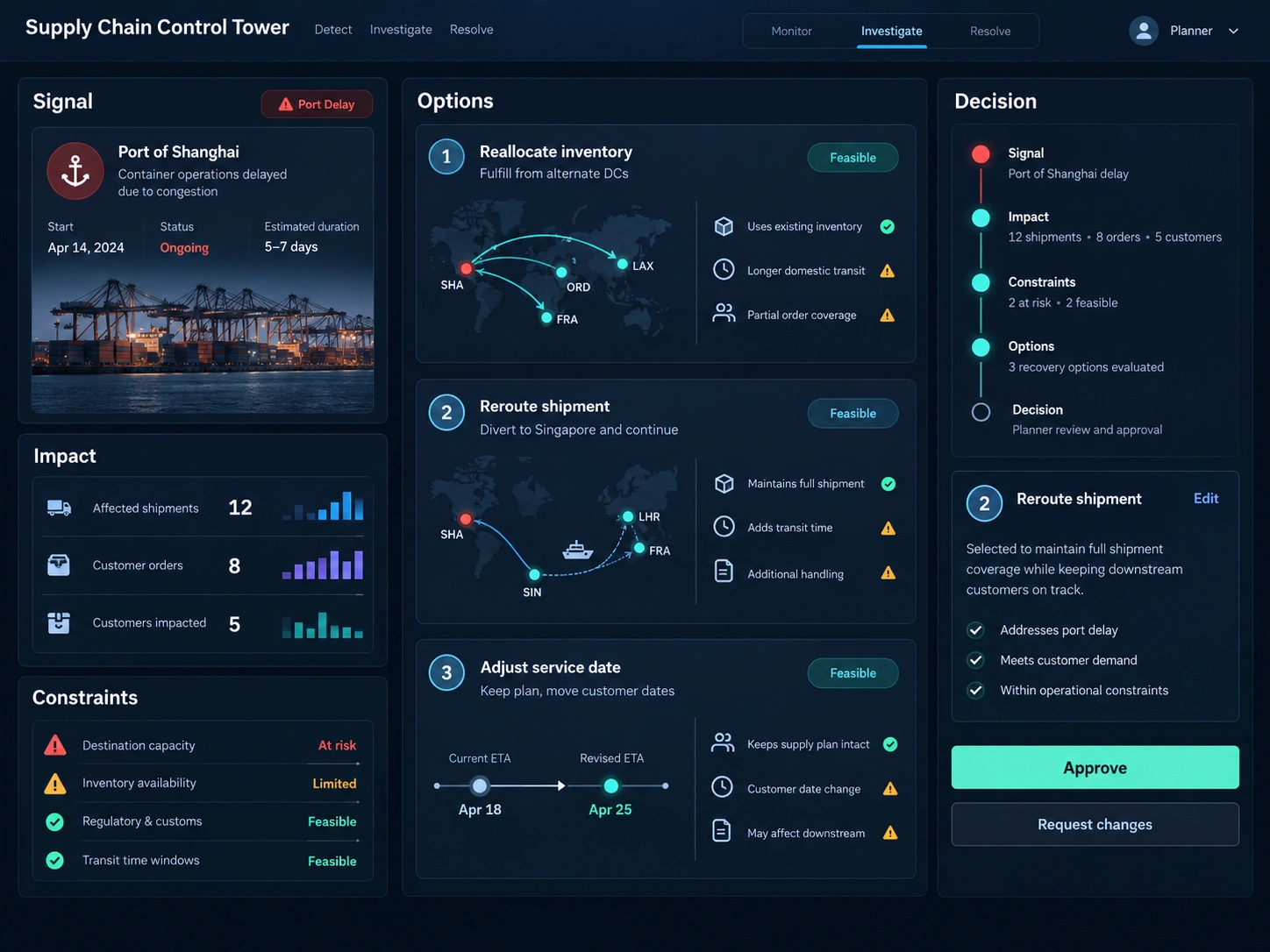
TraceGrid scores an exception using impact, urgency, confidence, and recoverability. The interface opens with a ranked exception queue, then progressively reveals the affected network, impacted commitments, and eligible actions. This prevents a dense global map from becoming the product’s primary navigation.
A planner can move through a consistent investigation flow:
Signal → Impact → Constraints → Options → Decision → Verification
For example, when a port delay threatens two regional orders, the system can compare reallocation from another warehouse, partial fulfillment, route substitution, or an approved service-date change. Each option shows the trade-off it creates elsewhere. The operator remains in control; the system makes dependencies visible.
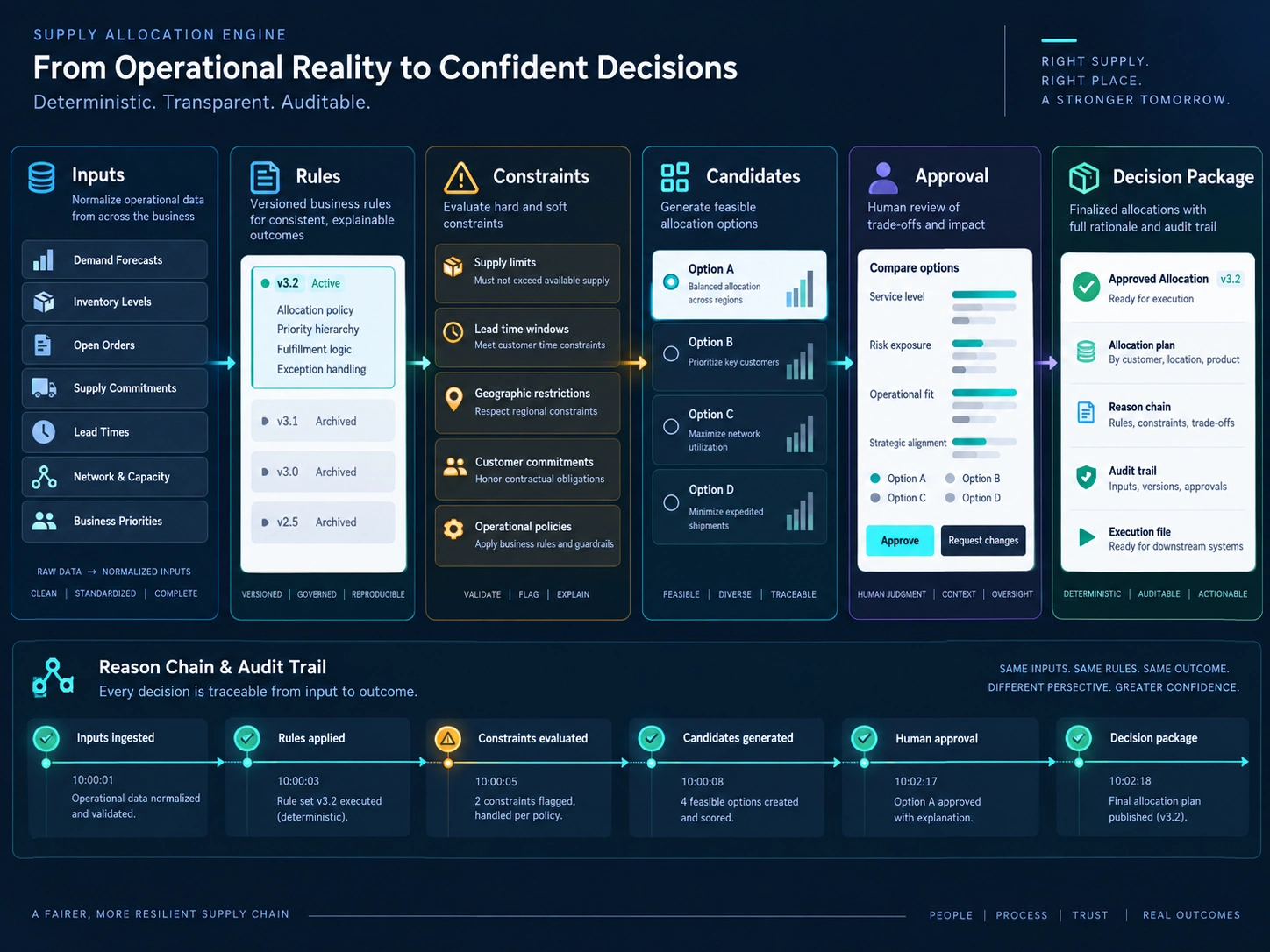
Making allocation deterministic The allocation engine separates policy from application code. Rules are versioned and evaluated in a predictable order, covering inventory eligibility, customer priority, geography, service level, expiry, cost guardrails, and manual approvals.
A simplified decision package contains:
• The inputs available at decision time
• The exact rule-set version
• Exclusions and failed constraints
• Candidate allocations and their trade-offs
• The selected output and approval trail
Idempotent commands prevent duplicate actions when feeds retry. Optimistic concurrency checks stop two planners from allocating the same constrained inventory. Long-running recalculations use queued jobs, while the interface shows the last confirmed state and the status of the pending evaluation.
Building trust into the interface Enterprise users reject automation they cannot interrogate. TraceGrid therefore treats explainability as a product feature.
Every recommended action includes a compact reason chain: which signal triggered the exception, which orders were affected, which constraints removed alternatives, and which rule allowed the final allocation. The UI uses progressive disclosure so an operations lead can act quickly while an auditor can inspect the full evidence package.
Role-based permissions separate viewers, planners, approvers, and administrators. Sensitive supplier costs remain protected, while operational teams still see whether a limit or contract rule influenced an outcome.
Architecture designed for integration The concept uses a modular service boundary rather than a collection of premature microservices:
• Web application for control-tower and investigation workflows
• API layer for identity, permissions, decisions, and audit access
• PostgreSQL for operational entities and transactional integrity
• Event ingestion workers for carrier, ERP, and supplier feeds
• Queue-based processing for recalculation and notification workflows
• WebSockets for live exception and decision-state updates
• Object storage for source documents and evidence packages
• Verification service for compact audit anchors
Connectors are isolated behind adapters so the domain model does not depend on one ERP or carrier. Observability tracks ingestion lag, stale data, failed evaluations, rule-version drift, and actions waiting for approval.
What the concept resolves
TraceGrid changes supply-chain visibility from passive monitoring into accountable decision support. It gives operations teams one path from disruption to action, exposes the consequences of each recovery option, and preserves enough evidence to explain the outcome later.
The value is not a prettier dashboard. It is faster coordination, fewer contradictory decisions, controlled automation, and a verifiable record when a customer, partner, or auditor asks why a specific allocation occurred.
What I would validate before production
This is an independent concept and system-design case study, not a claim of a deployed client platform. A production engagement would validate the decision rules with planners, test data latency and completeness, measure investigation time against the existing workflow, and pilot one region or product family before expanding the automation boundary.
My role
Product strategy • Full-stack architecture • Enterprise UX • Decision-workflow design • Data modeling • API design • Audit and verification design
Suggested stack
TypeScript • Next.js • Node.js or NestJS • PostgreSQL • Redis • WebSockets • Queue workers • Cloud object storage • EVM-compatible verification anchor
Like this project
Posted Sep 26, 2026
Designed a verifiable supply-chain control tower for disruption response, deterministic allocation, and accountable operational decisions.