Weld Defect Classification System

Chirag Patankar


Weld Defect Classification
Overview
This project is a deep learning-based system for classifying weld defects using convolutional neural networks (CNNs). The system processes weld images and predicts whether a weld is good or defective, categorizing defects into six different classes.
Features
Trainable Model: Uses PyTorch to train a CNN on labeled weld images.
Testing Module: Evaluates model accuracy using test images.
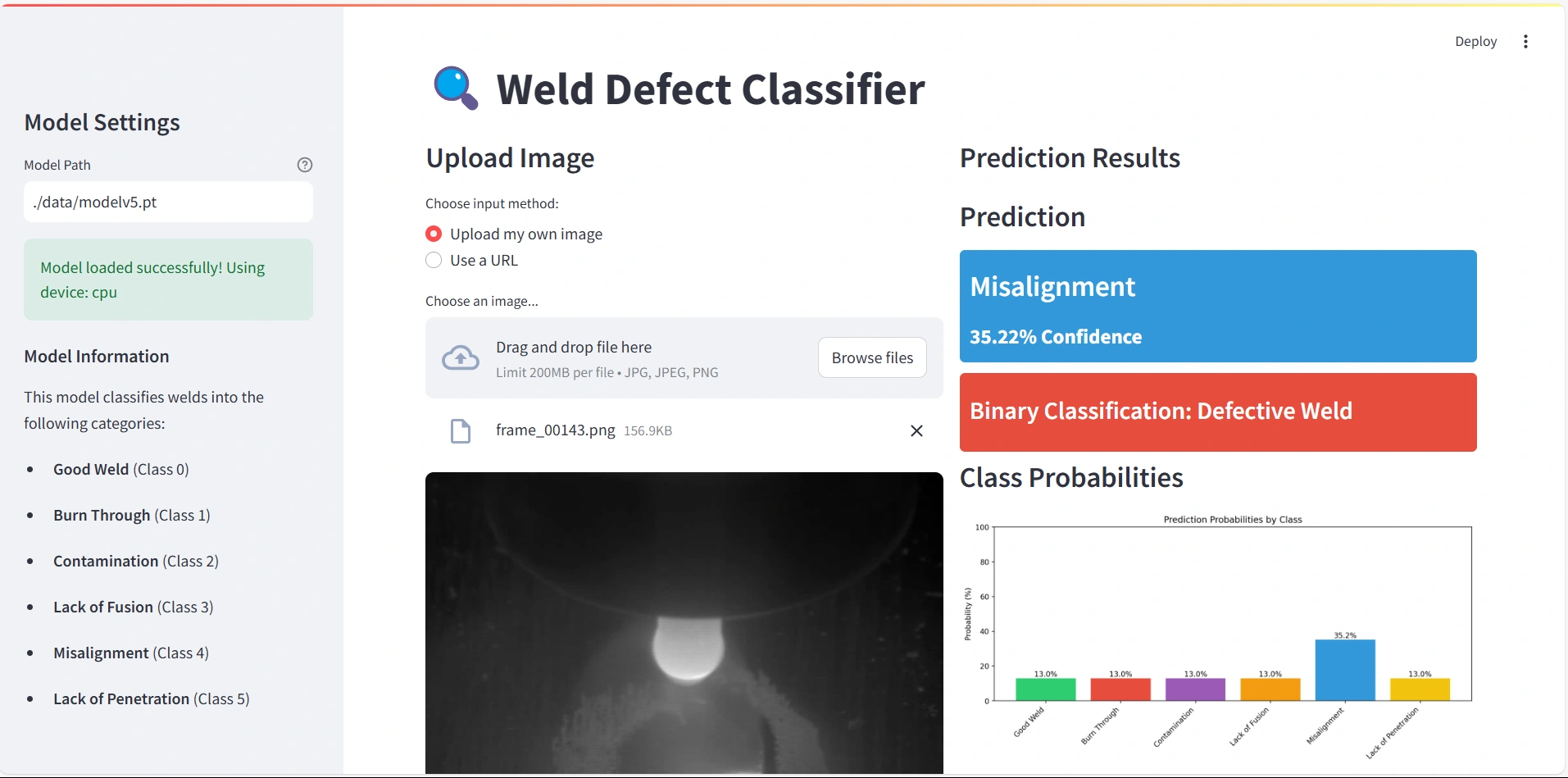
Web Interface: A Streamlit-powered UI for real-time image classification.
Binary and Multi-Class Classification: Can classify welds as
Good or Defective, and further categorize defects into specific types.Installation
Prerequisites
Ensure you have Python 3.8+ installed. You also need the following dependencies:
Dataset
The dataset used for training and testing is available on Google Drive. You can download it using the link below:
Usage
Training the Model
To train the model, run:
This will load training images, process them, and train a CNN model. The trained model is saved as
modelv5.pt.Testing the Model
After training, evaluate the model using:
This script loads test images and prints evaluation metrics such as accuracy.
Running the Web App
To launch the Streamlit UI for classifying weld images, run:
This will start a web-based interface where users can upload images and receive predictions.
Project Structure
Model Details
CNN architecture with multiple convolutional, batch normalization, dropout, and ReLU layers.
Uses cross-entropy loss and Adam optimizer for training.
Outputs a classification prediction with probability scores.
Convolutional Neural Networks (CNNs)
Convolutional Neural Networks (CNNs) are a class of deep learning models specifically designed for image processing tasks. They consist of multiple layers, including:
Convolutional Layers: Extract spatial features from images by applying filters.
Pooling Layers: Reduce dimensionality and retain essential information.
Fully Connected Layers: Combine extracted features to make classification decisions.
Activation Functions (e.g., ReLU): Introduce non-linearity to improve learning capability.
CNNs are effective for weld defect classification as they can learn to recognize intricate patterns in weld images, distinguishing between different defect types accurately.
Defect Classes
Good Weld
Burn Through
Contamination
Lack of Fusion
Misalignment
Lack of Penetration
Example Output
Below is a sample output from the web application:
Future Enhancements
Improve accuracy by fine-tuning the model.
Extend dataset with more labeled weld images.
Deploy as a cloud-based service for industrial use.
License
This project is licensed under the MIT License.
Like this project
Posted May 27, 2025
Developed a CNN-based system for classifying weld defects with a Streamlit UI.
Likes
0
Views
11