
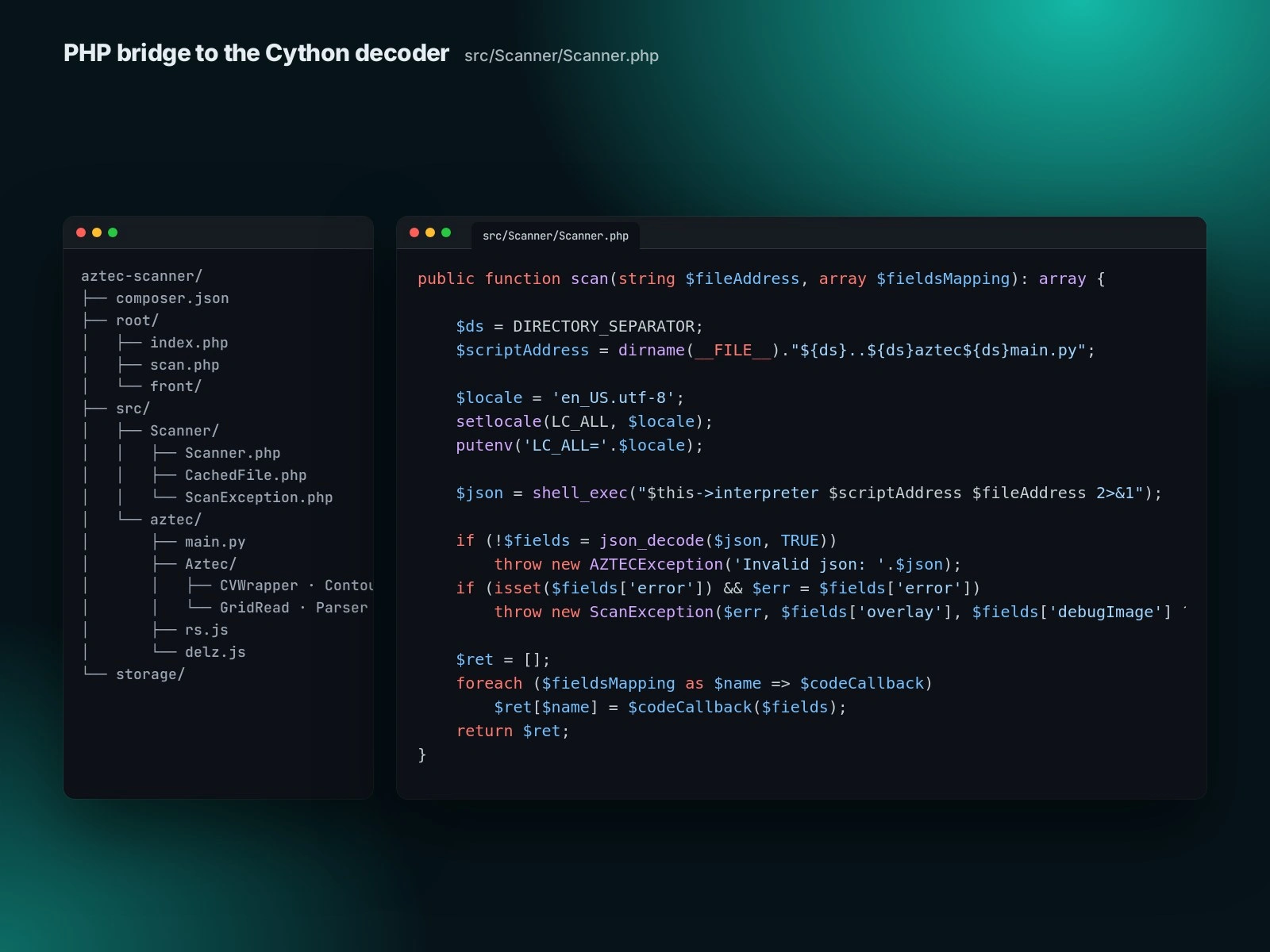
Reads the Aztec code on Polish vehicle registration certificates from a phone photo, so insurance chatbots get exact car data without typing.
Role: Author
Client: Insurance assistance chatbots, Poland
Team: Solo
Period: 2018–2019
Challenge
Car-insurance assistance chatbots in Poland need exact vehicle data — make, model, VIN, registration number — and asking drivers to type it is slow and error-prone. Every Polish registration certificate carries an Aztec 2D code holding that data, but decoding it from real phone photos, which are skewed, unevenly lit and low-resolution, is far harder than reading a clean scan. The bots needed a scanner that copes with such photos and plugs into their PHP back end.
Solution
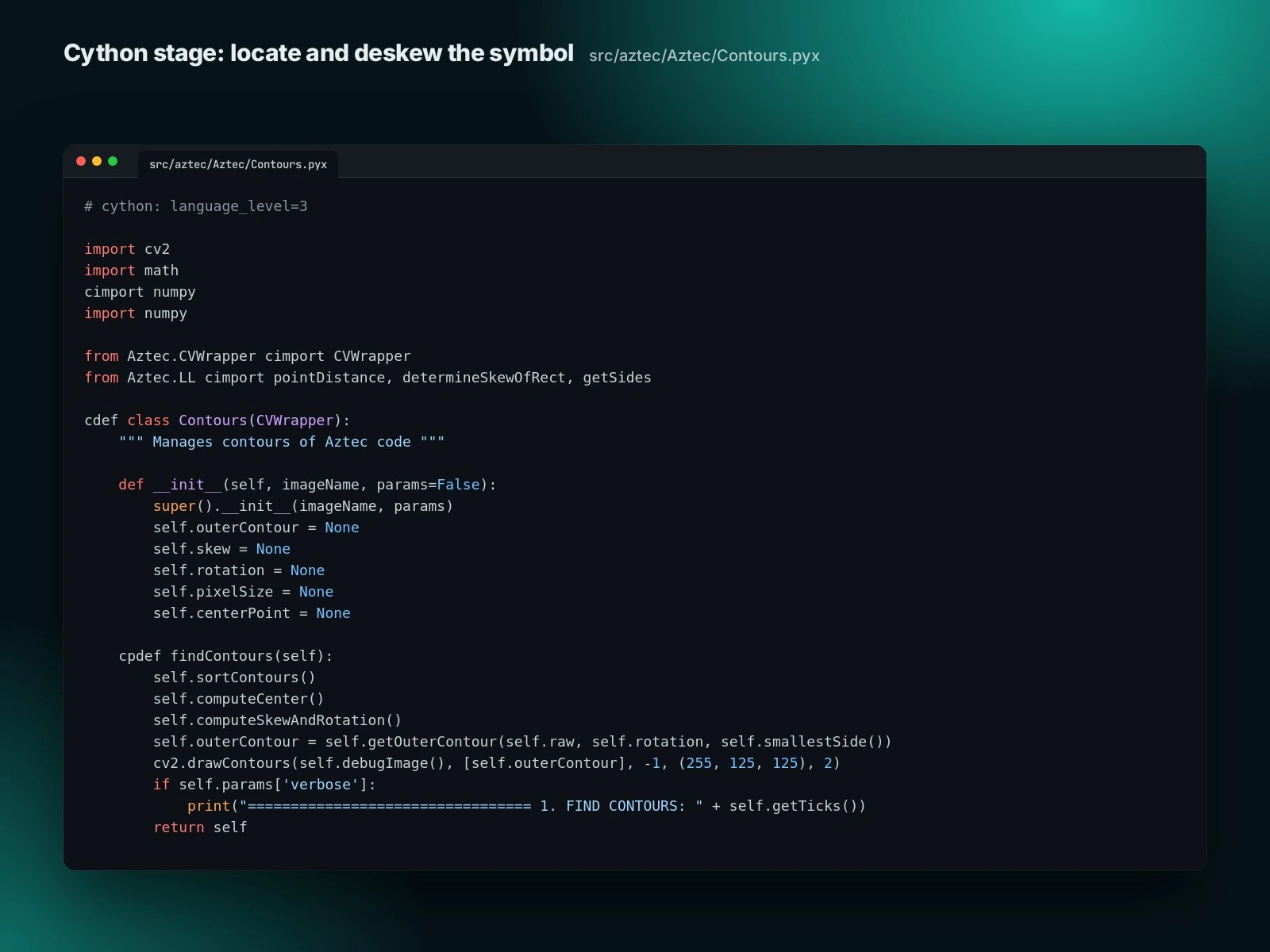
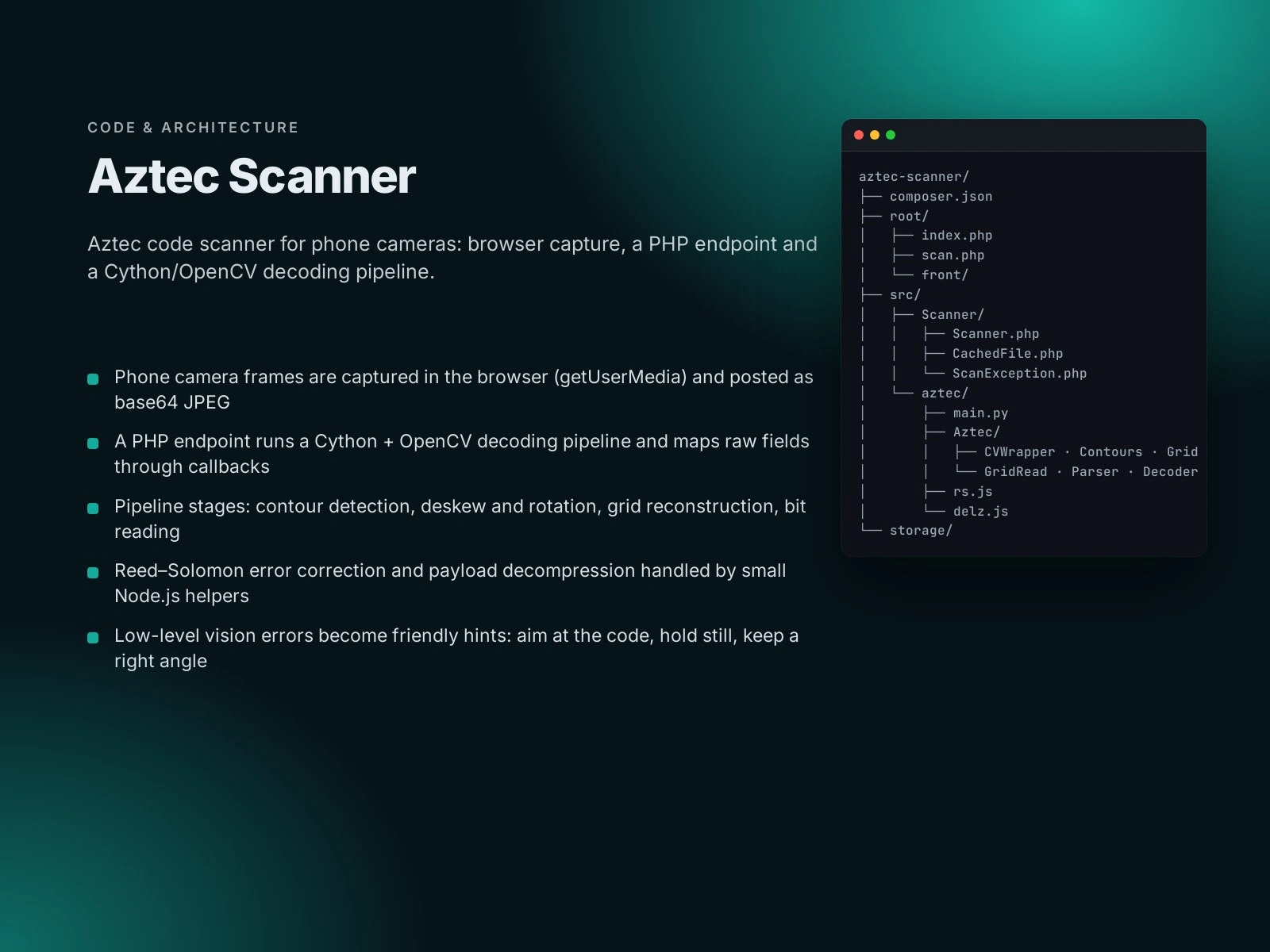
I built the decoder as a Python pipeline with OpenCV and NumPy, compiling the heavy image-processing modules with Cython for speed. Contour detection locates the symbol; grid detection, enhancement and reading turn pixels into bits; then the mode message and data layers are parsed. Reed–Solomon error correction recovers damaged codewords, and the certificate payload is decompressed and decoded into fields. A PHP wrapper with GD runs the pipeline, maps fields to the bot’s data model and turns failures into friendly retry messages.
Key features
Locates the Aztec symbol in skewed, noisy phone photos
Grid detection, enhancement and bit reading compiled with Cython
Reed–Solomon error correction for damaged codewords
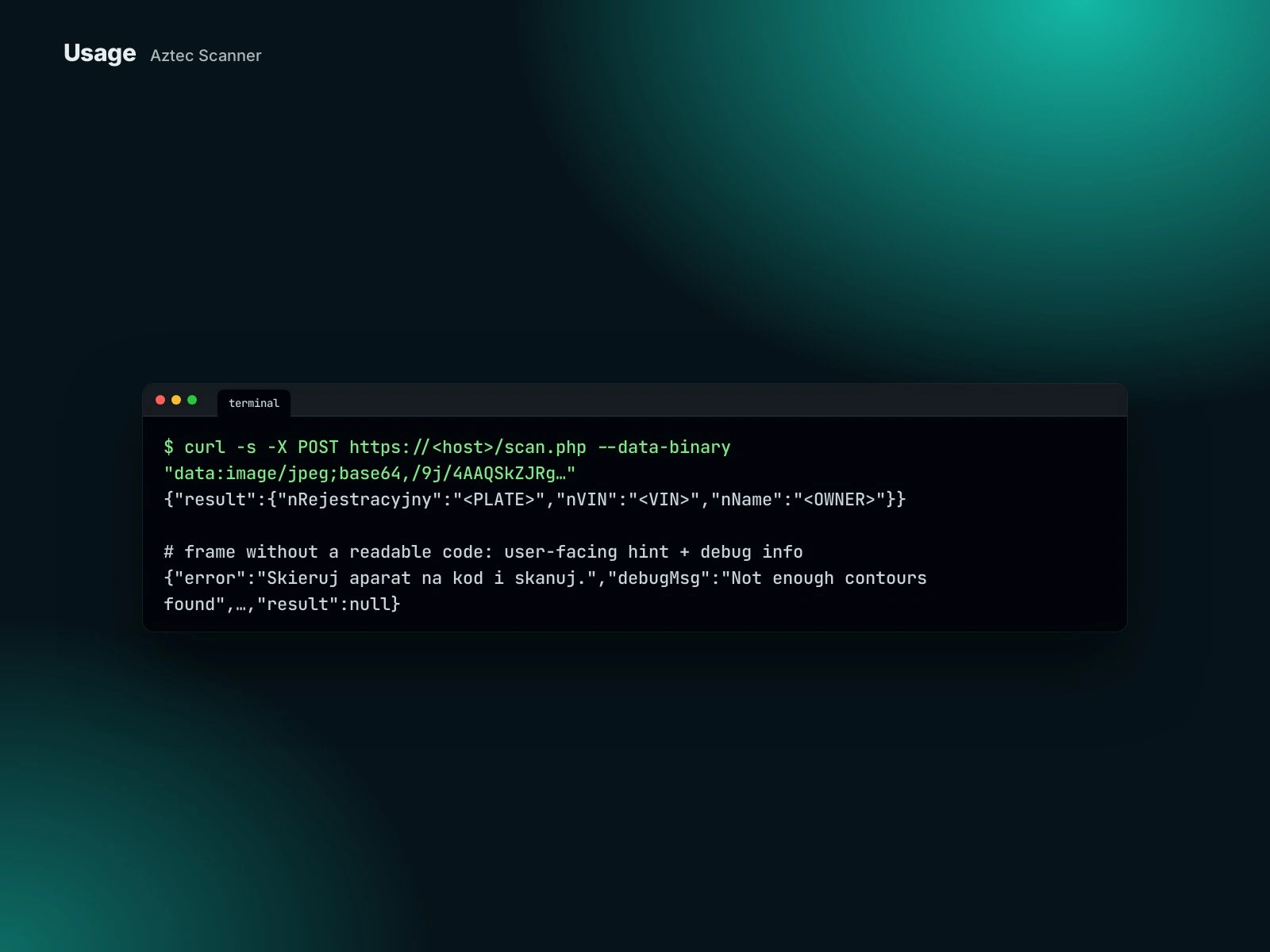
Decodes the certificate payload into mapped vehicle fields
PHP wrapper with error handling and user-friendly retry messages
Outcome
Used in insurance assistance chatbots; 30 commits over five months; closed source
Stack
Python, Cython, OpenCV, NumPy, PHP, GD, Node.js, Reed–Solomon
Full case study: arsengoian.com/work/aztec-scanner/
0 likes · 1 view · Oct 22, 2026
Reads the Aztec code on Polish vehicle registration certificates from a phone photo, so insurance chatbots get exact car data without typing.
Timeline
Oct 1, 2018 - Feb 28, 2019


