ScholarForge Development: AI-Assisted Academic Writing Platform

Effaxon Inc


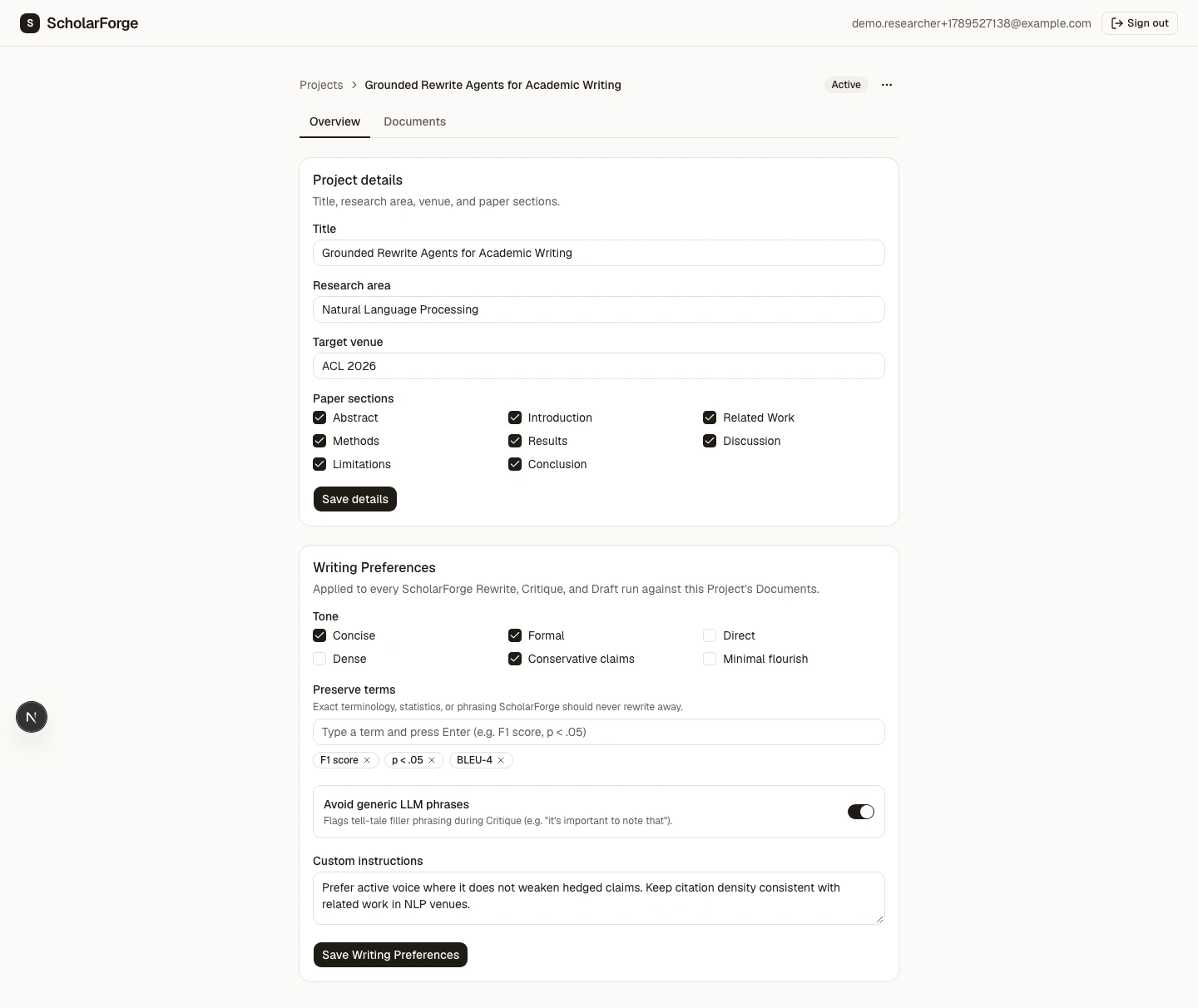
ScholarForge: AI-Assisted Academic Writing Platform
Connecting scholarly writing principles, explainable revisions, and researcher control in one workspace.
ScholarForge is an academic-writing platform that helps researchers improve their manuscripts through AI-powered rewriting and critique grounded in trusted writing guidance.
We built the platform with Next.js and FastAPI, connecting research-project management, document editing, knowledge ingestion, principle retrieval, and a multi-stage AI revision workflow.
The problem
Academic writing requires more than correct grammar. Researchers need to communicate contributions clearly, structure arguments, preserve technical precision, and support claims with appropriate evidence.
Generic AI rewriting can introduce vague language, alter qualifications, or obscure why changes were made. Meanwhile, useful guidance from scholarly-writing books and manuals is difficult to apply consistently during revision.
ScholarForge was built to bring that guidance into the writing process and make proposed changes traceable and reviewable.
What we built
Research writing workspace: Organize projects and documents by manuscript section, with editing, writing preferences, and revision history.
Writing knowledge pipeline: Process source documents into structured writing principles while retaining source provenance.
Principle-grounded rewriting: Diagnose writing problems, retrieve relevant guidance, and use it to plan, generate, critique, and refine revisions.
Structured critique: Provide actionable feedback on existing text without requiring a replacement passage.
Controlled revision review: Support accepting, rejecting, partially applying, or regenerating proposed changes, with document history for recovery.
AI provider selection: Allow users to choose between OpenAI and Anthropic for generation through a shared provider interface.
Engineering challenges
The core challenge was retrieving guidance that addresses the writing problem. I implemented hybrid retrieval using PostgreSQL full-text search and pgvector similarity search, followed by reranking. This connects diagnosed issues with relevant writing principles while preserving their provenance throughout the pipeline.
Preserving research meaning required additional checks around generation. The revision workflow combines deterministic checks for retained numbers and citation markers with semantic validation intended to detect unsupported changes. Proposed revisions remain subject to researcher review before modifying the document.
Another focus was making a multi-stage AI process understandable and reliable. Explicit task states, persisted execution traces, and streamed progress updates expose the workflow’s progress. A shared provider interface supports both generation providers, while automated tests and evaluation fixtures cover retrieval, revision behavior, preservation checks, and access boundaries.
Delivered outcome
An implemented academic-writing application that connects manuscript editing with principle-grounded rewriting, structured critique, and controlled revision review. Researchers can request improvements, inspect the supporting guidance, and decide which changes to apply within the same workspace.
Built as an independent portfolio product, ScholarForge demonstrates full-stack development across retrieval-augmented generation, document ingestion, structured knowledge extraction, AI workflow orchestration, and human-reviewed editing.
Our role: Full-Stack & AI Engineer
Technology: Next.js · React · TypeScript · Tailwind CSS · Python · FastAPI · PostgreSQL · pgvector · SQLAlchemy · OpenAI API · Anthropic API
Status: IN PROGRESS
Like this project
Posted Sep 28, 2026
Developed ScholarForge, a platform for AI-assisted academic writing.
Likes
0
Views
1