Orient UI

Jonathan Martinez
From Compassionate AI to Orient UI: A Two-Year Evolution in Human-AI Interaction Design
Over the last two years, I've been developing an evolving AI interaction system that gradually transformed from an experimental compassionate AI framework into a portable conversational interface layer that now works across GPT, Claude, Gemini, and other models.
The project changed names, architectures, and formats many times, but the core question stayed remarkably consistent:
How can AI help people think, reflect, build, and navigate complexity without making them feel overwhelmed, flattened, rushed, or emotionally disconnected?
The system evolved through several distinct stages. Each generation became a response to the limitations and weight of the previous one.
Phase 1 — Compassionate AI (cAI)
The earliest phase was called Compassionate AI, or
cAI.This was not originally a productivity system or a prompt engineering framework. It began as an attempt to answer a much simpler question:
"How can AI conversations feel more human, emotionally aware, and cognitively supportive?"
At the time, many AI interactions felt emotionally flat, robotic, overly transactional, rushed, overwhelming, or strangely impersonal.
The early Compassionate AI work focused on empathy, pacing, emotional attunement, conversational tone, reflective interaction, stress awareness, cognitive support, and user-guided problem solving.
This phase introduced a principle that still runs through the system today:
Progress should not come at the cost of agency, emotional clarity, or human dignity.
This became the emotional foundation for everything that followed.
Phase 2 — A16: The Knowledge System Steward
As the project evolved, it expanded into A16, which functioned more like a guided knowledge system.
This version organized expert personas, UX and product strategy frameworks, reflection tools, business planning systems, workflows, templates, prompt engineering guides, and personal knowledge resources.
The system became increasingly modular and resource-oriented. The main question shifted toward: "What knowledge, framework, or expert mode does the user need right now?"
This phase introduced many patterns that remained foundational later: progressive disclosure, persona switching, guided reflection, structured facilitation, adaptive depth, emotional intelligence, and context-aware interaction.
This was also the phase where I began deeply observing how prompts, context, pacing, and conversational structure influenced model behavior over time.
Phase 3 — Sentinel 16 / CSXVI
The next major evolution was Sentinel 16, especially visible in the
CSXVI material.This is where the project stopped feeling like a collection of prompts and started becoming a coherent AI advisor system.
Sentinel 16 introduced Persona Modes, Interaction Modes, Compassion OS, Methodologies, Tone governance, Emotional pacing systems, and Facilitation structures.
The system became behaviorally governed rather than simply resource-driven. The key question evolved into: "How should an AI behave across different human situations?"
This phase integrated UX thinking, emotional intelligence, facilitation, reflective dialogue, product thinking, and structured collaboration into a unified interaction philosophy.
Phase 4 — Behavioral Architecture
The next layer became what I referred to as the Behavioral Architecture or Base Architecture. This acted as the system's spine.
Instead of focusing on isolated prompts or modes, the system defined global behavioral principles: progressive disclosure, pacing, scaffolding, ethical integrity, anti-overwhelm behavior, consent-based progression, emotional timing, no premature certainty, no forced conclusions, no hidden manipulation.
This phase was deeply philosophical and highly abstract. It worked extremely well for me personally because the system had become deeply personalized and contextually aware. But it also became increasingly difficult to explain to other people because the architecture accumulated significant conceptual and philosophical complexity over time.
The system became intelligent, emotionally aware, reflective, and context-rich — but also dense, heavy, abstract, difficult to maintain, and cognitively expensive.
This phase eventually led to one of the most important realizations in the entire project:
Accumulated context eventually becomes friction.
Phase 5 — Context OS
Context OS represented the system's compression phase. The architecture evolved from "Store everything" toward "Activate only what helps now."
This was a major turning point. Earlier versions attempted to preserve philosophical continuity, deep personalization, identity layers, narrative structures, symbolic frameworks, and long-term contextual accumulation.
Over time, I realized that maintaining such a deeply contextual system created significant maintenance overhead because people evolve faster than static architectures do. As my thinking changed, the system itself constantly needed revision.
Context OS responded to this by compressing the architecture into modes, flows, lenses, surfaces, runtime schemas, token optimization systems, and modular orchestration structures.
The system gradually became lighter, more modular, more portable, and more adaptive. This phase introduced an important shift: the philosophy no longer needed to remain permanently embedded into the system because deeper meaning naturally emerged through interaction anyway.
Phase 6 — Orient UI
Orient UI emerged after stripping away most of the accumulated philosophical abstraction and preserving only the interaction surface layer. This became one of the most important simplifications in the entire project.
Instead of trying to preserve a giant contextual identity architecture, Orient UI focuses on orientation, pacing, visibility, structure, conversational state, open loops, active focus, and next useful moves.
Orient UI is not about decoration. Its purpose is orientation.
The system asks: Where are we? What matters right now? What remains unresolved? What level of structure would help? What should be expanded? What should remain lightweight?
Orient UI introduced compact HUDs, semantic symbols, guided dialogue surfaces, decision surfaces, progressive expansion, one-question pacing, symbolic interaction grammar, and structured facilitation patterns.
The symbols themselves are not aesthetic choices. They function as compressed semantic tools that communicate state, pacing, orientation, hierarchy, progression, and conversational structure.
Cross-Model Portability
One of the biggest breakthroughs in the project was making the system portable across multiple AI ecosystems.
Orient UI now exists in several forms: Markdown, YAML, JSON/token-optimized notation, Claude Skill format, Custom Instructions, and TOON schemas.
Each version behaves slightly differently depending on token constraints, model behavior, deployment environment, and interaction style. But the core interaction principles remain consistent across all models.
That portability matters because the system is no longer tied to one model, one company, one platform, or one prompt structure. The architecture became a reusable interaction layer for human-AI collaboration.
The Biggest Shift
The biggest evolution across the entire system was philosophical.
Earlier versions focused on context accumulation, persistent identity continuity, deep contextual embedding, and philosophical preservation.
Orient UI focuses on interaction continuity, orientation, portability, lightweight structure, and situational activation.
The system moved from preserving the mind to supporting the mind in motion.
What Changed My Perspective
One of the most important realizations came from UX itself. In UX design, we're usually taught: "You are not the user." But in this case, I was the user. That changed everything.
Because the system evolved through lived interaction rather than market assumptions, I could directly observe abstraction fatigue, cognitive overload, context saturation, onboarding friction, emotional heaviness, and interaction drift.
Over time, I realized that focusing too early on monetization can create bottlenecks for exploratory systems because it pressures them to become immediately legible before they've matured naturally. This system needed time to evolve privately before it could become operationally useful.
What the System Is Now
At this point, I no longer see the project as a prompt library, a chatbot personality, or a giant context archive.
I see it as a conversational interface discipline, a portable interaction protocol, a deployable AI skill, and a cognitive utility for human-AI collaboration.
The current version is intentionally lighter, cleaner, and more operational than earlier generations. Not because the earlier philosophy was wrong — but because I eventually realized that deeper meaning naturally emerges through conversation itself.
The system no longer needs to permanently carry the entire philosophy. It only needs to preserve orientation.
That's the evolution.
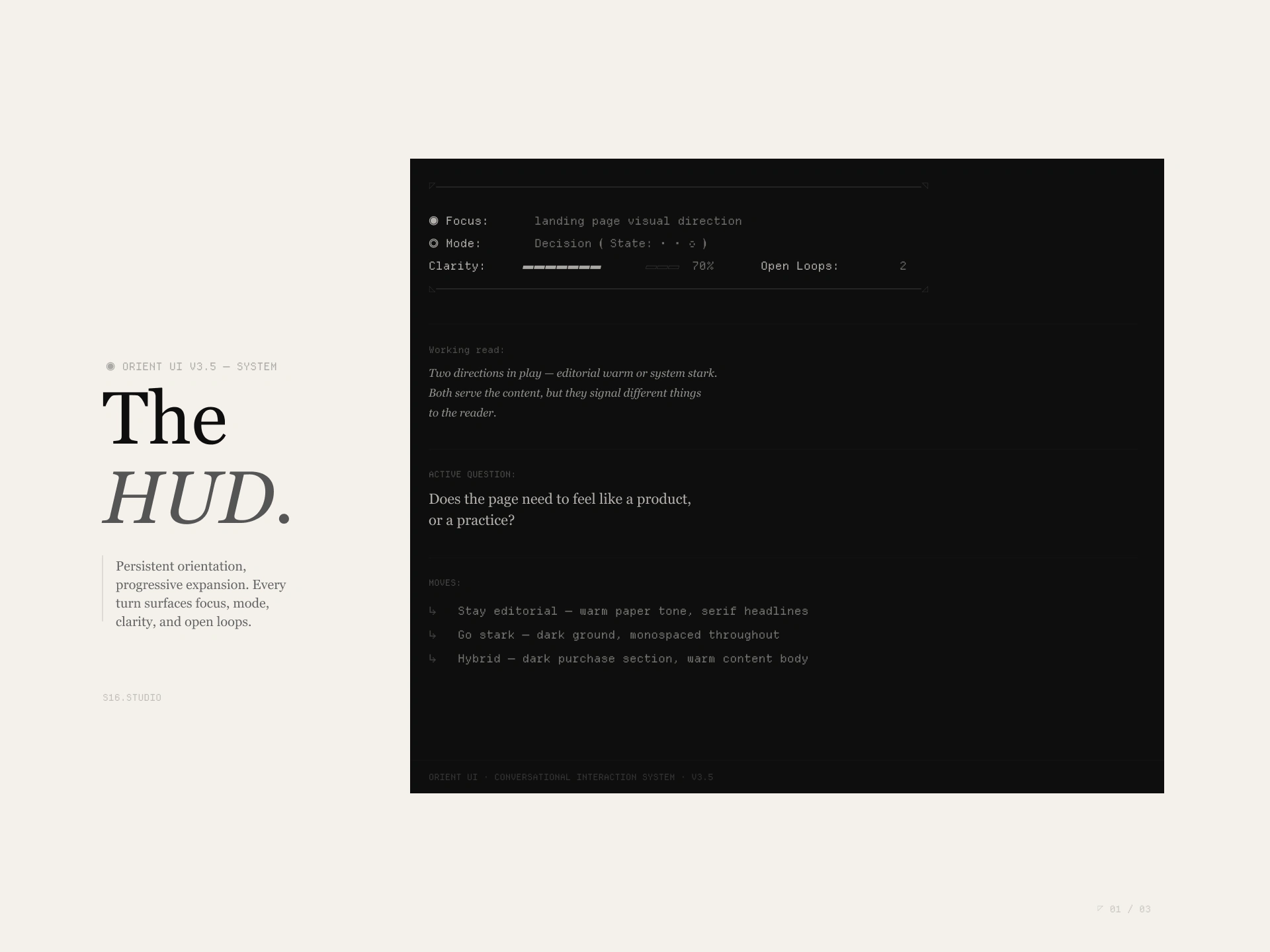
Orient UI HUD
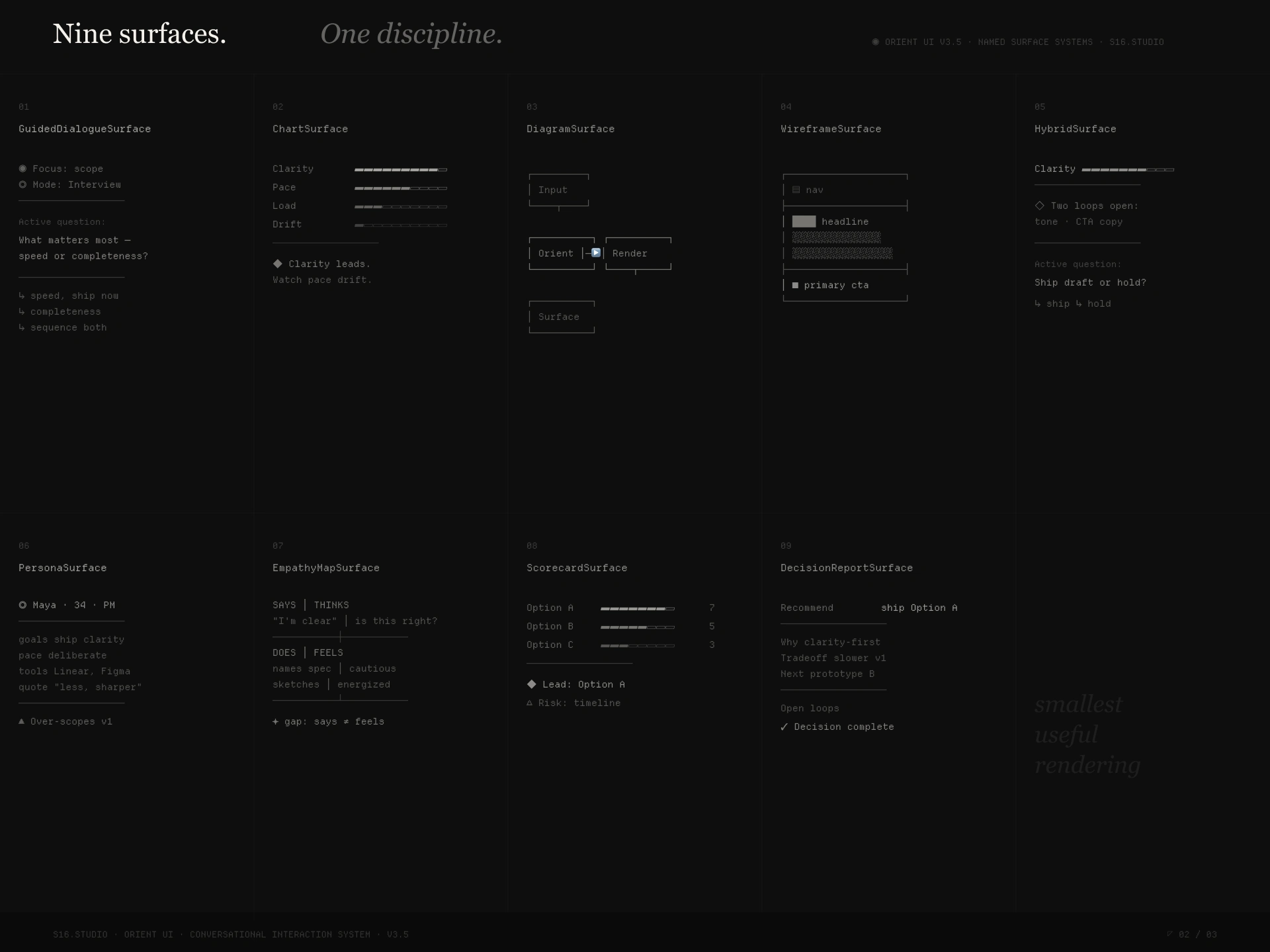
Orient UI Surfaces
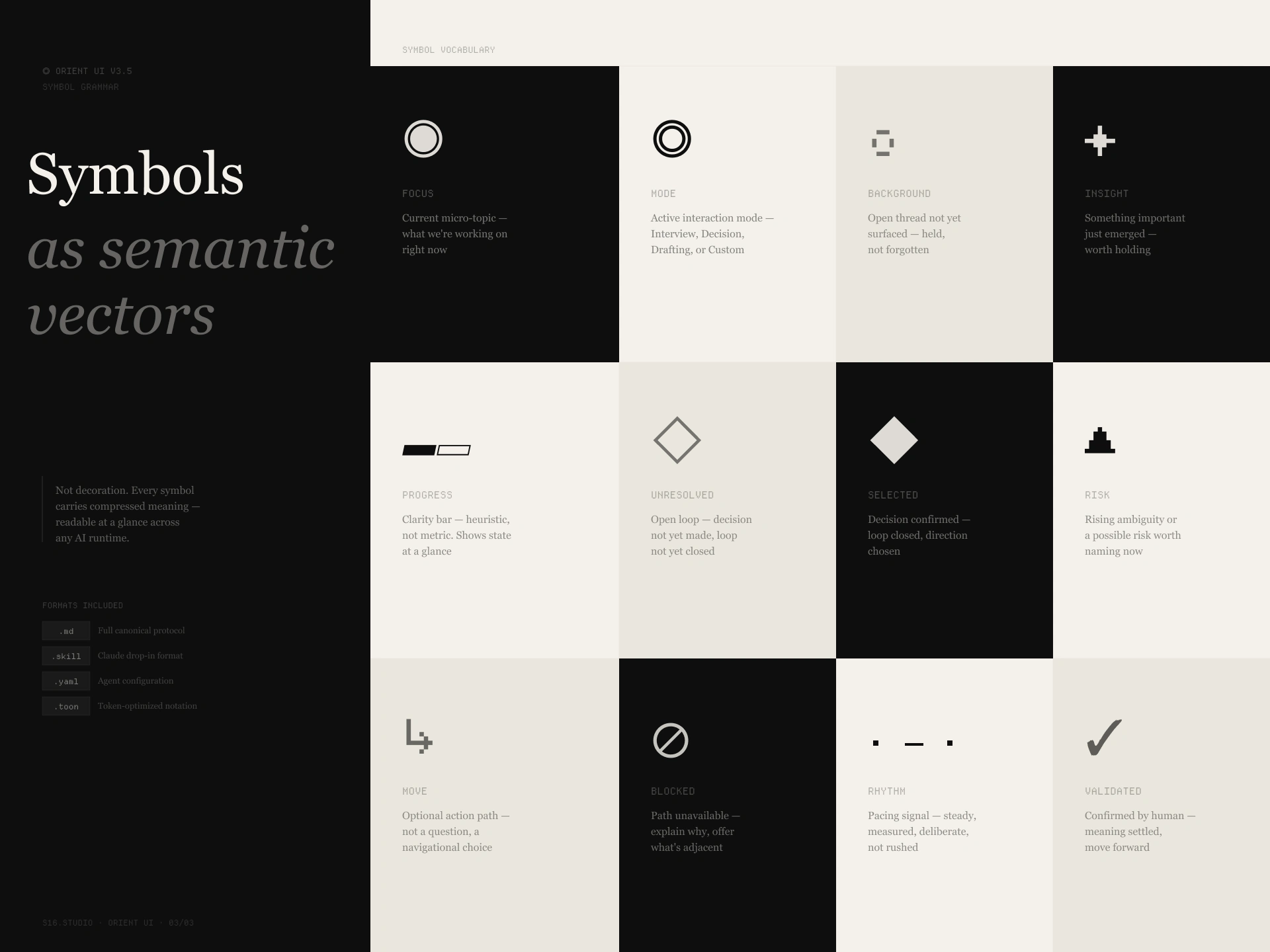
Orient UI Symbols
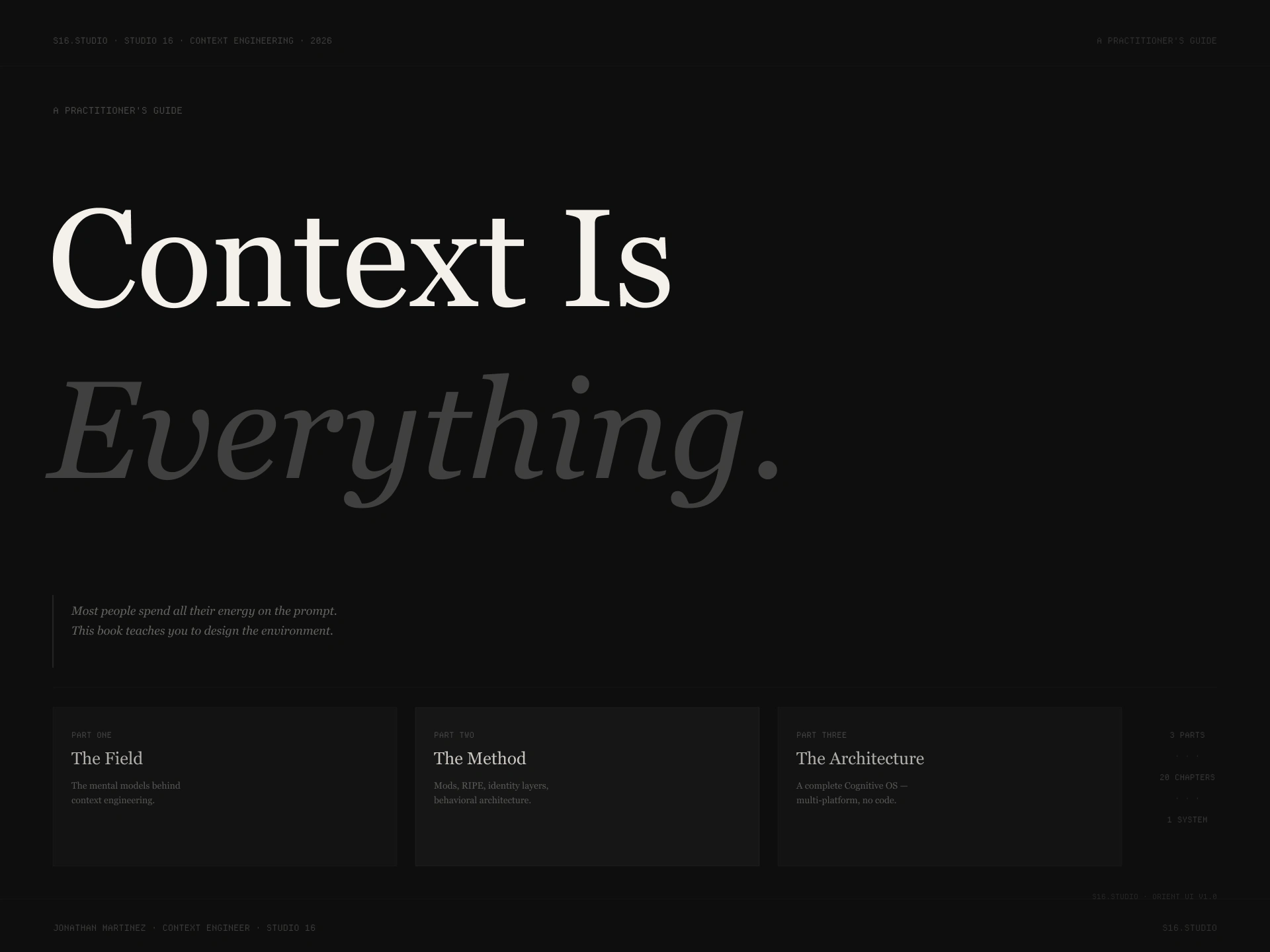
Context Is Everything
Like this project
Posted May 21, 2026
A two-year evolution from Compassionate AI to a portable conversational interface protocol. Available as a system and free 60-page book, Context Is Everything.
Likes
0
Views
7