ScenarioReceipt: Evidence-Grounded Product UI

Kai Relaunch Dept


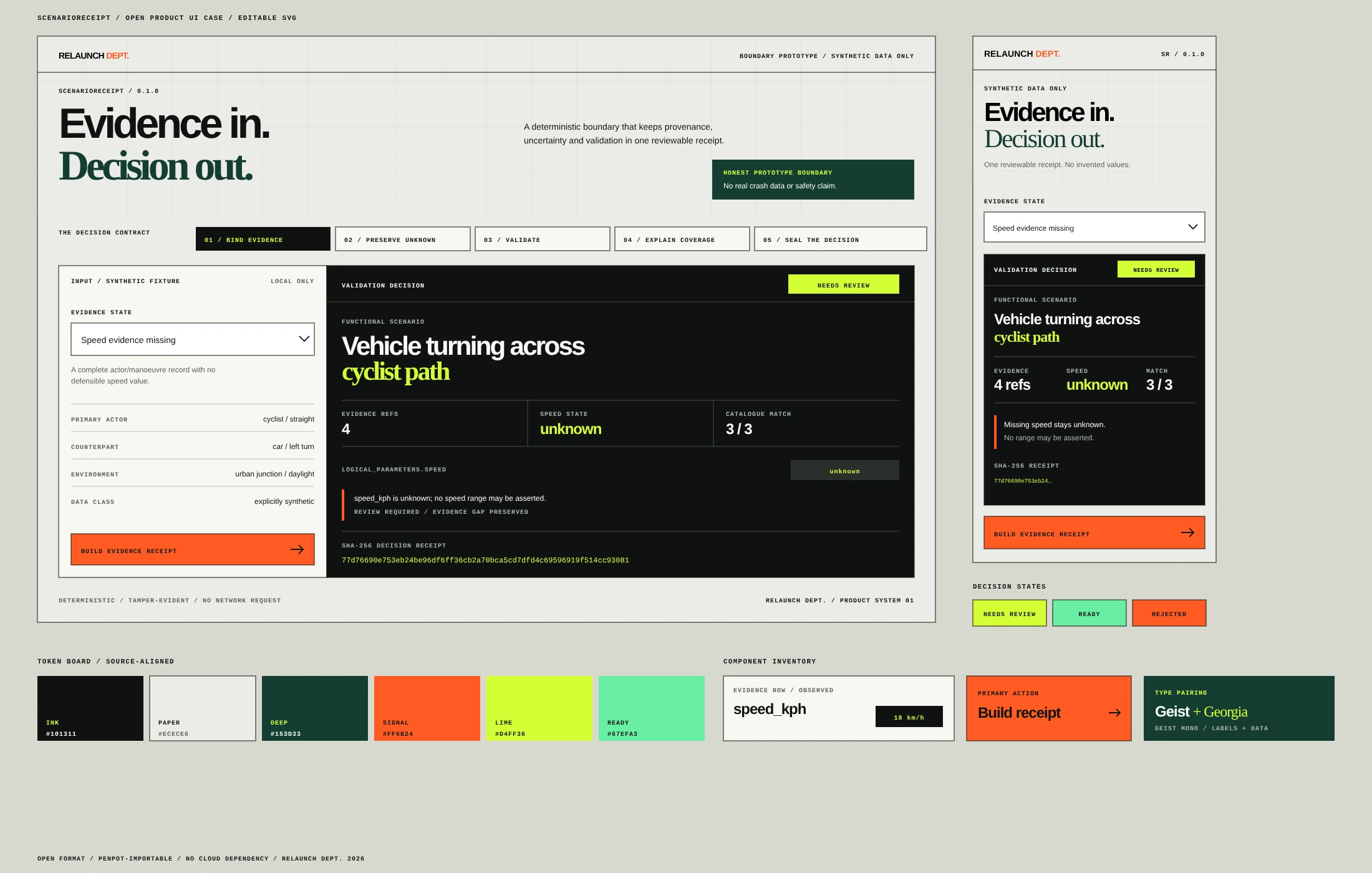
A crash-to-validation boundary that keeps provenance, uncertainty, deterministic checks, catalogue coverage, and the final decision in one reviewable receipt.
Honest prototype boundaryNo real crash database, generative extractor, automotive accuracy, ASAM compatibility, or safety certification is claimed.
THE DECISION CONTRACT
One boundary between model output and engineering use.
01
Bind evidence
Every populated attribute points back to a stable source identifier and field path.
02
Preserve uncertainty
Missing speed remains unknown. The boundary never invents a convenient range.
03
Deterministic range, schema, privacy, and consistency gates control promotion.
04
Catalogue candidates expose each matched and unmatched constraint, not only a score.
05
A canonical SHA-256 receipt makes later changes to evidence or output detectable.
OPEN DESIGN HANDOFF
Not a screenshot. The working board.
A complete, editable UI board in an open vector format, paired with portable design tokens and the live product boundary below.
2200 × 1400 / desktop + mobile / three decision states / open SVG
26named groups
text layers
Open it. Edit it. Hand it off.
The board uses standard vector and text objects, so it can be imported into Penpot or Figma without locking the work to either platform. Tokens are supplied separately in DTCG-style JSON.
Open-format handoff, not a native Penpot or Figma component file. Reusable component semantics are created after import when the receiving workspace actually needs a shared library.
LIVE BOUNDARY TEST
Change one evidence state. Inspect the whole decision.
Evidence stateSpeed evidence missingObserved speed: 18 km/hInvalid speed: -5 km/h
A complete actor/manoeuvre record with no defensible speed value.
CounterpartEnvironment
explicitly synthetic
Build evidence receipt
Select a synthetic evidence state and build the receipt. The browser performs the calculation locally and sends no data.
This interaction demonstrates the deterministic acceptance boundary only. It does not extract from real reports, call a model, assign crash fault, or certify a scenario for safety use.
FIVE-MONTH ADVANCE PATH
The missing work stays visible.
Deterministic boundary
Synthetic fixtures, evidence references, uncertainty states, validation, catalogue matching, and stable receipts.
Licensed source adapters
Two open European accident sources, a versioned scenario schema, data cards, and a labelled baseline.
Constrained extraction
Like this project
Posted Aug 31, 2026
Codex-assisted and manually reviewed product UI turning synthetic crash evidence into three explicit validation states and reviewable SHA-256 receipts.